

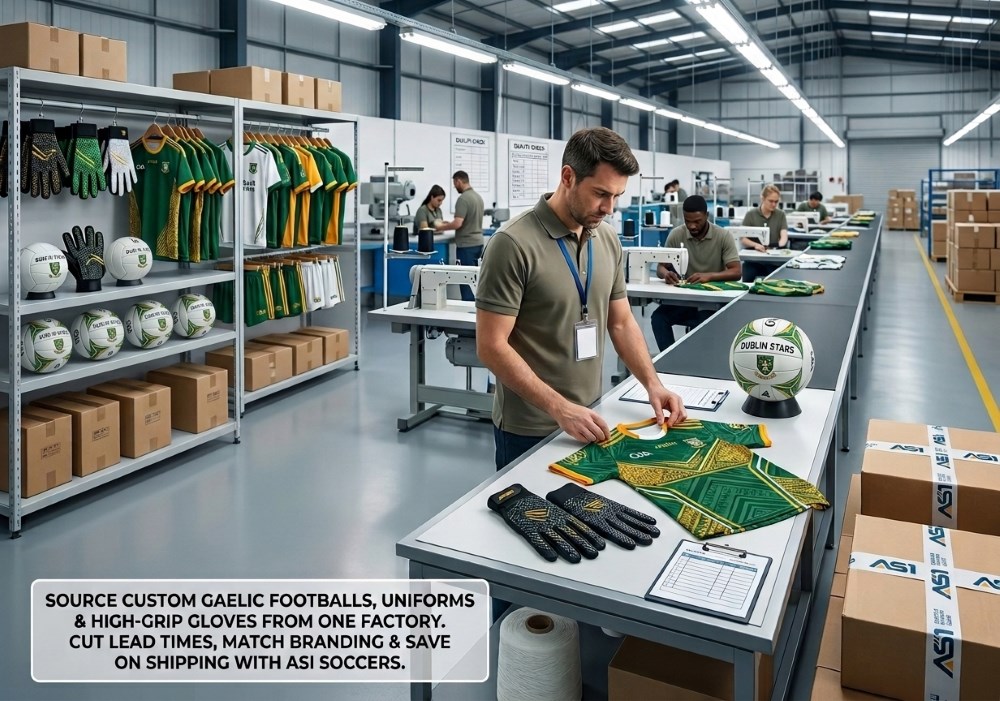
Streamlining GAA Gear Supply Chains: Why Sourcing Gaelic Football, Uniforms, and Gloves Under One Roof Is Revolutionizing Club & Brand Procurement
Buying Gaelic football gear from five different factories costs you time, money, and headaches. One factory that makes the ball, the jersey, and the gloves fixes all three problems at once.
Clubs and brands that switch to a single-source GAA gear manufacturer report shorter lead times, matching colors across every product, and lower shipping bills. This article breaks down why “one roof” sourcing beats scattered sourcing, what to check before you sign a contract, and how to get a sample pack sent to your door.
If you manage kit orders for a club, run a sportswear brand, or handle bulk buying for a distributor, this guide is built for you.
The Problem With Scattered GAA Sourcing
Most sourcing managers didn’t plan to work with four or five vendors. It just happened that way.
One factory was good at footballs. Another had cheaper jerseys. A third specialized in gloves. Over time, the supply chain grew sideways instead of getting simpler.
Here’s what that scattered setup actually costs a club or brand:
- Color mismatches. Your jersey red doesn’t match your ball’s trim red. Small difference, big brand problem.
- Longer lead times. Each factory has its own schedule. If one runs late, your whole kit delivery slips.
- Higher shipping costs. Five shipments from five places always cost more than one consolidated shipment.
- More quality control checkpoints. Every vendor has different standards. You end up doing five separate inspections instead of one.
- More email threads, more invoices, more confusion.
None of these problems are your fault. They’re built into a fragmented sourcing model. The fix isn’t better emails; it’s a different setup entirely.
What “Under One Roof” Actually Means
“Under one roof” doesn’t mean one warehouse that repackages products from other factories. It means one facility that manufactures the ball, sews the uniform, and knits or molds the gloves, all with the same production team, quality checks, and shipping schedule.
This is called vertically integrated manufacturing. Instead of outsourcing pieces of your order to different specialists, one GAA gear manufacturer handles the whole job.
Why This Setup Matters for GAA Gear Specifically
Gaelic football has some unique production demands that most general sportswear factories don’t fully understand:
- The ball itself: a Custom Gaelic football 18-panel design needs precision stitching and consistent bladder pressure, which is a specialized skill, not a generic sportswear skill.
- The uniform: GAA jerseys need breathable, sweat-wicking fabric that holds sublimated designs through hundreds of wash cycles.
- The gloves: Gaelic football gloves need high-grip palm materials that stay tacky in wet Irish weather, something a generic glove factory may not test for.
A factory that only makes footballs may not understand jersey fabric science. A factory that only sews jerseys may not know how to grip-test a glove palm. One roof means one team that’s mastered all three.
Comparison: Scattered Sourcing vs. Consolidated Manufacturing
| Factor | Scattered Sourcing (Multiple Vendors) | Consolidated Manufacturing (One Roof) |
|---|---|---|
| Lead time | Depends on the slowest vendor | Set by one coordinated schedule |
| Color/brand consistency | Hard to match across products | Matched using one color standard |
| Shipping cost | Multiple freight charges | One consolidated shipment |
| Quality control | Different standards per vendor | One QC process for everything |
| Communication | Multiple contacts, multiple time zones | One point of contact |
| Minimum order flexibility | Varies by vendor, often higher combined | Often more flexible when bundled |
| Sample turnaround | Slower, each vendor ships separately | Faster, one sample pack, one shipment |
| Private-label branding | Inconsistent logo placement/quality | Uniform branding across the full kit |
This table isn’t theoretical. It reflects what sourcing managers actually deal with when they split orders across vendors versus when they consolidate.
Why Clubs Care About This
GAA clubs aren’t big corporations. Most are run by volunteers who also have day jobs. Kit officers don’t have time to chase five suppliers before the season starts.
Real Problems Kit Officers Face
- Ordering jerseys in October but gloves don’t arrive until January, right before the first match.
- Team colors look slightly “off” between the ball, socks, and jersey in team photos.
- Budget overruns from paying separate shipping fees for small batches.
- Re-ordering headaches when a supplier discontinues a product mid-season.
A single manufacturer that produces the full kit, footballs, uniforms, and gloves removes these pain points. One order. One delivery window. One invoice.
What Club Buyers Should Ask a Manufacturer
Before signing with any GAA gear manufacturer, ask:
- Do you make the football, uniform, and gloves in the same facility?
- Can you match Pantone colors across all three product types?
- What’s your minimum order quantity for a full club kit?
- Can I get a sample pack before placing a bulk order?
- What’s your average lead time from order to delivery?
If a manufacturer can’t answer these clearly, that’s a warning sign.
Why Sportswear Brands Care About This
Brand owners have a different set of concerns than clubs, but the same root problem applies.
Brand-Specific Sourcing Challenges
- Private-label consistency. If your brand’s logo looks slightly different on the ball versus the jersey, customers notice.
- Scaling production. A brand growing from 500 units to 5,000 units needs a factory that can scale without quality dropping.
- Custom sublimation. Sublimated designs (full-color prints baked into fabric) need to look identical across every uniform in a batch.
- Margin protection. Every extra vendor in your supply chain adds a markup. Fewer vendors mean better margins.
The OEM Advantage
Working with an all-in-one sports apparel OEM (Original Equipment Manufacturer) lets a brand focus on design and marketing while the factory handles production, quality checks, and packaging.
This is especially useful for brands selling in multiple countries, Ireland, the UK, Australia, and North America, where shipping delays from multiple vendors can wreck a launch date.
Deep Dive: Custom Gaelic Football 18 Panels
The 18-panel Gaelic football isn’t just tradition. It’s engineering.
Why 18 Panels?
The 18-panel design gives the ball:
- A rounder, more consistent shape than fewer-panel balls
- Better grip distribution across the surface
- More durability under repeated kicking and hand-passing
- Consistent bounce, which matters for referees and players alike
What to Look For in a Custom 18-Panel Ball
| Feature | Why It Matters |
|---|---|
| Panel stitching | Hand-stitched panels last longer than machine-glued panels |
| Bladder material | Butyl bladders hold air longer than latex |
| Surface material | PU (polyurethane) offers better grip in wet conditions |
| Weight consistency | Match weight (approx. 480g) across every ball in a batch |
| Custom branding | Screen-printed or embossed logos should not peel after washing |
A factory that also makes uniforms and gloves under the same roof tends to apply this same panel-level attention to detail across every product line, because their whole reputation rests on consistency, not just one item.
Deep Dive: Custom Sublimated GAA Jerseys
Sublimation printing is now the standard for GAA jerseys because it lets teams use bold colors, gradients, and sponsor logos without the print cracking or fading.
How Sublimation Works (In Plain English)
Heat turns ink into gas, and that gas bonds directly into the fabric fibers. Unlike a screen print sitting on top of fabric, a sublimated design becomes part of the fabric itself.
Benefits for GAA Teams
- Colors stay bright after 50+ washes
- No cracking, peeling, or fading
- Full-color designs, not limited to a few solid colors
- Breathable fabric stays lightweight even with heavy printing
What Sourcing Managers Should Confirm
- Fabric GSM (grams per square meter), lighter for summer matches, heavier for durability
- Moisture-wicking treatment
- Colorfastness testing results
- Turnaround time for custom sublimated designs
Deep Dive: High-Grip Gaelic Football Gloves
Gloves are often an afterthought in kit planning, but they’re arguably the most technical product in a GAA kit.
What Makes a Glove “High-Grip”
- Palm material. Latex foam palms grip well in dry and slightly damp conditions.
- Perforation. Small holes let sweat escape, keeping grip consistent through a full match.
- Wrist strap design. A secure strap keeps the glove in place during hard catches and blocks.
- Weather performance. Gloves need to perform in Irish rain just as well as in dry Australian summer conditions.
Comparison: Standard Gloves vs. High-Grip Performance Gloves
| Feature | Standard Gloves | High-Grip Performance Gloves |
|---|---|---|
| Palm material | Basic rubber | Latex foam or silicone-grip blend |
| Breathability | Minimal | Perforated panels |
| Durability | 1 season average | 2+ seasons with proper care |
| Wet-weather grip | Drops significantly | Maintains grip |
| Customization | Limited | Full color and logo customization |
A manufacturer that produces both the jersey and the glove can match branding colors between the two, something separate vendors rarely manage to do perfectly.
The Hidden Cost Savings of Consolidation
Sourcing managers often focus on unit price and miss the bigger picture. Here’s where consolidated manufacturing actually saves money.
1. Freight Consolidation
Shipping one container from one factory costs less than shipping three smaller loads from three factories. Freight companies charge less per unit when cargo is combined.
2. Reduced Admin Overhead
Every vendor relationship needs a purchase order, an invoice, a payment terms negotiation, and follow-up emails. Cutting vendors from five to one cuts this admin work by roughly the same ratio.
3. Fewer Quality Control Failures
Each additional vendor is another chance for a defect to slip through. A single QC process across one factory catches issues before the whole batch ships, not after it lands in three different warehouses.
4. Better Bulk Pricing Leverage
A club or brand ordering a full kit– balls, jerseys, and gloves- from one manufacturer often has more room to negotiate volume pricing than when splitting a budget across separate small orders with separate vendors.
5. Faster Reorders
When a jersey design needs a mid-season reorder, one factory with your specs on file can turn it around faster than starting a new conversation with a separate vendor.
Who Benefits Most From Consolidated GAA Manufacturing
GAA Kit Officers
Need dependable, matching kits delivered on time, without chasing five suppliers.
Sports Brand Owners
Need private-label consistency and room to scale production without quality slipping.
Sports Equipment Distributors
Need bulk GAA kit production with predictable lead times to keep retail shelves stocked.
International Buyers (UK, Australia, North America)
Need one shipping relationship instead of coordinating freight from multiple countries or factories.
One Factory. Three Products. Zero Headaches.
How ASI Soccers builds Gaelic footballs, uniforms and gloves under one roof — so your kit ships together, matches perfectly and costs less.
The Problem With Scattered Sourcing
Colors Don’t Match
Longer Lead Times
Higher Shipping Costs
More QC Checkpoints
Scattered Vendors vs. One Roof
3–5 separate factories
Different schedules
Multiple shipments
Mismatched branding
Higher total cost
1 factory, full kit
One production schedule
One consolidated shipment
Matched colors, every item
Lower total cost
Three Products, One Standard
Built together, so they match every time.Gaelic Football
- 18-panel construction
- Butyl bladder core
- Grippy PU surface
Custom Uniform
- Full sublimation print
- Sweat-wicking fabric
- Fade-resistant colors
High-Grip Gloves
- Latex-foam palm
- Perforated for airflow
- Secure wrist strap
Ready To Streamline Your Order?
Request a consolidated manufacturing quote and sample pack — custom Gaelic football, uniforms and high-grip gloves, produced under one roof by ASI Soccers.
Common Mistakes to Avoid When Switching Suppliers
- Not requesting a sample pack first. Always test the ball, jersey, and glove before committing to a bulk order.
- Ignoring minimum order quantities. Ask upfront; don’t assume a factory can handle a small trial order.
- Skipping color-matching proofs. Get a physical Pantone match, not just a digital mockup.
- Overlooking lead time guarantees in writing. Verbal promises don’t hold up when a season deadline is on the line.
- Not asking about fabric and material certifications. Especially important for brands selling internationally.
Frequently Asked Questions
Q: What does “GAA gear manufacturer under one roof” mean exactly?
A: It means one factory produces the football, the uniform, and the gloves together, instead of outsourcing each product to a different supplier.
Q: Why does an 18-panel design matter for a Gaelic football?
A: The 18-panel construction gives the ball a rounder shape, more consistent bounce, and better durability compared to fewer-panel designs.
Q: Can a single manufacturer really match colors across a ball, jersey, and gloves?
A: Yes, when the same facility handles all three, they use one Pantone color standard across every product, which is much harder to achieve with separate vendors.
Q: Is consolidated manufacturing more expensive than working with separate vendors?
A: Usually it’s cheaper overall once you factor in combined freight shipping, fewer admin costs, and stronger bulk pricing leverage.
Q: How long does a full custom GAA kit order usually take?
A: This varies by manufacturer and order size, but consolidated production generally cuts total lead time because everything is scheduled together instead of waiting on multiple separate factories.
Q: Can international clubs and brands order from a single GAA manufacturer?
A: Yes. Clubs and brands in Ireland, the UK, Australia, and North America commonly work with a single manufacturer and have kits shipped internationally as one consolidated order.
Q: What should I request before placing a bulk order?
A: Always request a sample pack first, including the football, jersey fabric swatch, and a glove sample, so you can check quality and color match before committing.
Final Word: One Factory, One Standard, One Less Headache
Sourcing Gaelic football gear doesn’t need to be complicated. When one factory builds the ball, sews the uniform, and crafts the gloves, you get matching colors, fewer shipping headaches, and a supply chain you can actually manage without a full-time logistics coordinator.
ASI Soccers brings this consolidated approach to GAA gear manufacturing, producing custom Gaelic footballs, uniforms, and high-grip gloves in one facility. That means one quote, one sample pack, one production schedule, and one shipment, instead of five separate headaches.
Whether you’re a club kit officer trying to get your team suited up on time, or a sportswear brand scaling a private-label line across Ireland, the UK, Australia, and North America, working with one manufacturer instead of five is the simplest way to protect your brand, your budget, and your deadlines.
Ready to Simplify Your GAA Gear Sourcing?
Ready to streamline your club’s order or private-label production line? Request a Consolidated Manufacturing Quote & Sample Pack Today to get custom Gaelic football, uniforms, and high-grip gloves produced seamlessly under one roof.
Explore the full range of custom sportswear options here: ASI Soccers Custom Sportswear Manufacturer