

Types of Soccer Balls: 25 Kinds, Materials, and How to Pick the Right One
The best soccer ball depends on three things: where you play, who plays, and how often. Match the ball to those three, and you will rarely go wrong.
- Real games on grass: Choose a match ball or a match-quality replica.
- Daily practice: Choose a training ball with a tough cover.
- Artificial turf, concrete, sand, or indoors: Choose a ball made for that surface.
- Kids: Get the right size first. Then look at the material.
| Situation | Best ball type | What matters most |
|---|---|---|
| Official matches on grass | Official match ball | Meets size, weight, and pressure rules |
| Team practice, 4–5 days a week | Training ball | Lasts through thousands of kicks |
| Artificial turf | Turf or AstroTurf ball | Cover handles rubbing on the surface |
| Sports hall or hard indoor court | Futsal ball | Low, controlled bounce |
| Concrete or asphalt | Street ball | Tough cover, holds air |
| Sand | Beach ball | Soft feel |
| Very young kids | Lightweight pediatric ball | Light and soft |
| Clubs, schools, events | Custom-branded ball | Logo, colors, artwork |
Soccer Ball or Football?
They are the same thing. Most of the world says “football.” The USA and a few other countries say “soccer.” This guide uses both words.
The 25 Types at a Glance
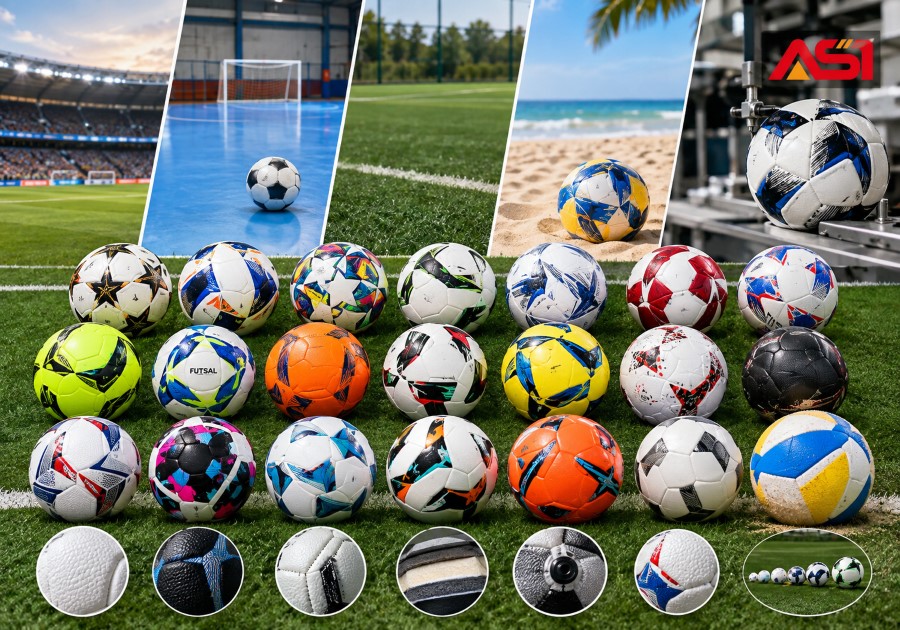
Every type is built for a place, a player, a build style, or a purpose. Here are all 25, sorted into four groups.
Group 1: Balls Built for a Surface or Weather Condition
| # | Type | Best for | Main strength | Watch out for |
|---|---|---|---|---|
| 1 | Turf ball | Artificial grass, indoor football centers | Cover handles rubbing on synthetic turf | Wears faster on concrete |
| 2 | Indoor / futsal ball | Halls and small courts | Lower bounce, controlled movement | Not made for rough outdoor ground |
| 3 | Street ball | Concrete, asphalt, playgrounds | Resists wear, holds air | Less soft touch than a premium ball |
| 4 | Beach ball | Sand | Soft feel | Not for hard ground |
| 5 | All-weather ball | Rain and damp fields | Made to handle wet conditions | Test in real rain before a big order |
| 6 | AstroTurf-specific ball | Synthetic pitches, academies | Built for friction and heavy use | Overlaps with turf balls, so compare specs |
| 7 | High-altitude ball | Mountain venues | Chosen for thin-air conditions | Test at the real altitude |
Good to know: AstroTurf is a brand name of artificial grass. People often use it for any synthetic pitch. That is why turf balls and AstroTurf balls overlap.
Group 2: Balls Built for the Player
| # | Type | Best for | Main strength | Watch out for |
|---|---|---|---|---|
| 8 | Mini/skills ball | Footwork, tricks, drills | Small size builds close control | Not for matches |
| 9 | Junior / youth ball | School and club players | Sizes match ages | Wrong size hurts technique |
| 10 | Lightweight pediatric ball | Very young children | Light, soft, easy to kick | Too light for older players |
| 11 | Freestyle ball | Juggling and tricks | Predictable handling, comfortable surface | Surface texture matters a lot |
| 12 | Weighted / power ball | Strength and technique drills | Adds resistance | Use with a coach and the right weight |
| 13 | Goalkeeper reflex ball | Reaction and handling drills | Different weights and surfaces make drills harder | Specialty gear |
Group 3: Balls Defined by How They Are Made
| # | Type | Best for | Main strength | Watch out for |
|---|---|---|---|---|
| 14 | Hand-stitched premium match ball | Buyers who want traditional craft | Soft touch, detailed stitching | Slower to make, so it costs more |
| 15 | Hybrid / thermo-bonded ball | Modern match and premium play | Even bonding, less water absorption | Higher price |
| 16 | Machine-stitched leisure ball | Schools, community clubs, retail | Lower price, good lasting power | Less premium feel |
| 17 | Vintage/retro leather-style ball | Collectors, gifts, heritage projects | Classic look | Genuine leather needs extra production time |
Group 4: Balls Defined by Purpose
| # | Type | Best for | Main strength | Watch out for |
|---|---|---|---|---|
| 18 | Official match ball | Competitions | Meets size, weight, rebound, and pressure rules | Costs more; not meant for daily drills |
| 19 | Training ball | Academies, schools, coaches | Built for frequent use | Less refined touch |
| 20 | Replica/fan ball | Fans and retail | Pro-style graphics, lower price | Specs sit below a match ball |
| 21 | Match-quality replica | Serious amateurs and clubs | Close to a pro feel | Below top competition level |
| 22 | Night / glow ball | Evening play, promotions | Easy to see in low light | Check material quality |
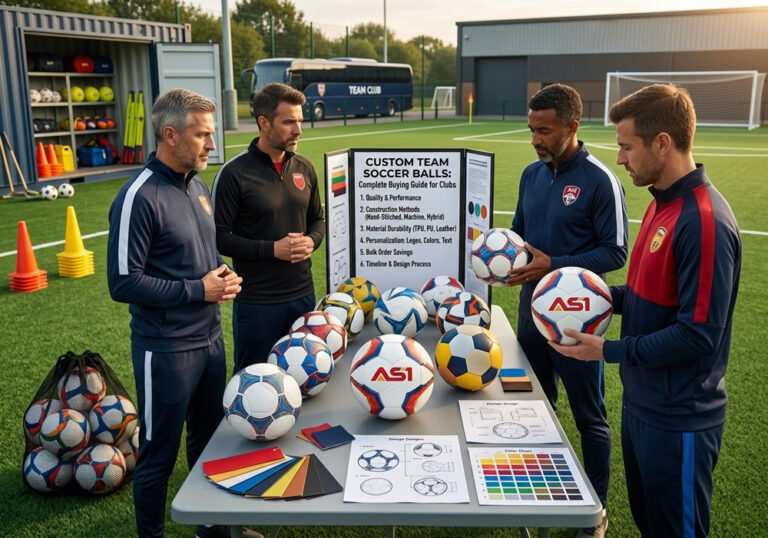
| 23 | Promotional / custom ball | Companies, clubs, tournaments | Your logo and colors | Needs time for artwork and samples |
| 24 | Eco-friendly ball | Buyers who care about the planet | Recycled or lower-impact materials | Ask for proof of the claims |
| 25 | Smart connected ball | Data-driven training | Tracks things like kicks, speed, and spin | Higher price |
How the Types Compare in Real Life
Examples make the choice clearer.
Example 1: A school in a rainy town. The school has grass fields and daily PE classes. It needs a machine-stitched training ball with a tough cover. An all-weather ball is worth a look too.
Example 2: An indoor football center with artificial grass. Games run every evening. A turf ball fits best. A premium hand-stitched ball would wear out too fast here.
Example 3: A serious amateur team. The players want a pro feel but do not need top competition specs. A match-quality replica is the smart buy.
Example 4: A brand planning a giveaway. The brand wants logos on the ball. It should choose a promotional ball and plan for artwork and a sample first.
What a Soccer Ball Is Made Of
A ball has four main parts.
- Outer cover. It affects touch, grip, water resistance, and looks.
- Internal layers. They affect softness, shape, rebound, and lifespan.
- Bladder. This is the air bag inside the ball. It affects how well the ball holds air.
- Panels. These are the shapes that make up the surface. Their number, shape, and layout affect how the ball is made and how it looks.
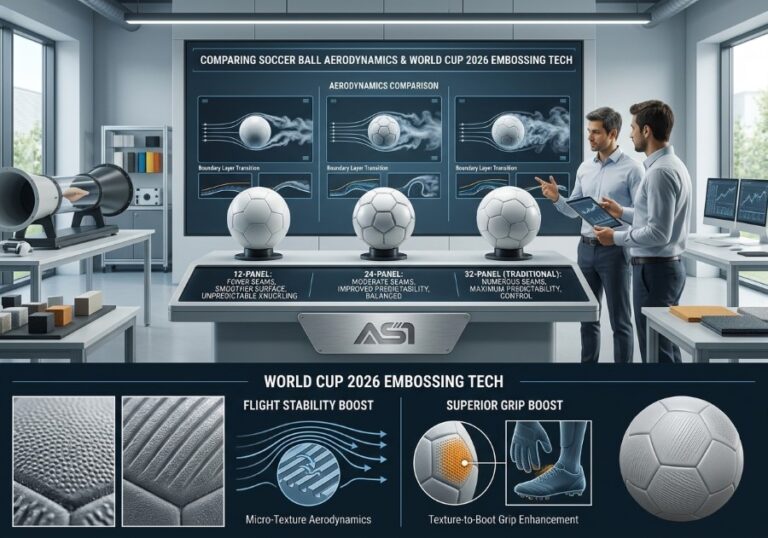
The classic ball has 32 panels: 12 pentagons and 20 hexagons. Many modern thermo-bonded balls use fewer, larger panels.
Cover Material: PU vs PVC
PU stands for polyurethane. It is a soft, man-made material. PVC is a firmer plastic.
| Feature | PU | PVC |
|---|---|---|
| Feel | Softer, more responsive | Firmer |
| Usual price | Higher | Lower |
| Usual use | Premium, match, and training balls | Recreational and entry-level balls |
| Best for | Serious play | Casual play and tight budgets |
Four cover choices are common: premium PU, economical PU, PVC, and genuine leather. Each one serves a different buyer.
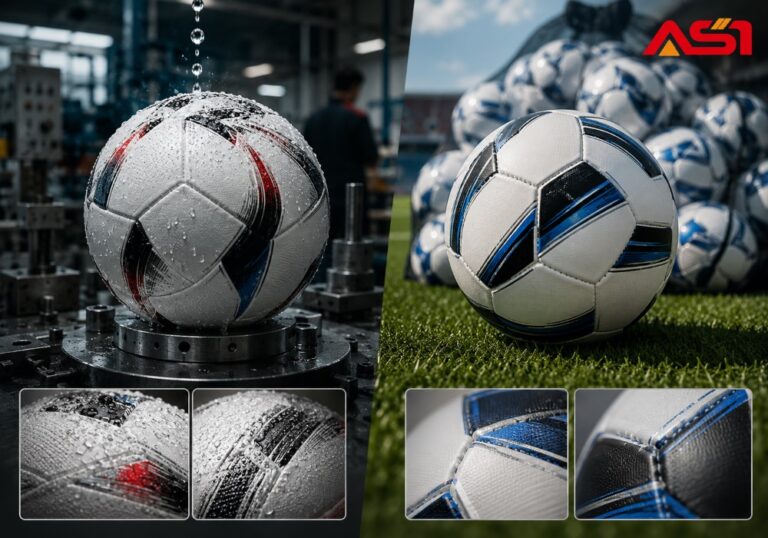
Why Japanese PU? Some premium makers use special Japanese PU, including Teijin materials. It can be made in many thicknesses, textures, and finishes. Texture changes touch, grip, and looks, so it matters most on premium thermo-bonded balls.
Bladder: Butyl vs Latex
| Feature | Butyl | Latex |
|---|---|---|
| Air retention | Holds air longer | Loses air faster |
| Feel | Firmer response | Softer touch |
| Upkeep | Needs pumping less often | Needs more frequent pumping |
Construction: Hand-Stitched vs Machine-Stitched vs Thermo-Bonded
| Method | Typical use | Key traits |
|---|---|---|
| Hand-stitched | Premium and traditional balls | Craft, soft feel, strong build |
| Machine-stitched | Training and leisure | Lower cost, tough, good for large orders |
| Thermo-bonded | Premium and match balls | Clean surface, steady shape, less water absorption |
| Hybrid | Match and training | Mixes two building methods |
No method wins everywhere. The right one depends on the market, the surface, the performance needed, and the price.
What Size Soccer Ball Should You Buy?
Age guides vary a little by league. Check your league’s rules first.
| Size | Usual players | Notes |
|---|---|---|
| 1 and 2 | Skills and mini balls | For tricks and drills |
| 3 | Under about 8 years | Small and light |
| 4 | About 8 to 12 years | Also the size used in futsal |
| 5 | Ages 12 and up, and adults | Standard full-size ball |
What “Official” Means for Match Balls
The Laws of the Game set rules for size 5 balls. A match ball must be 68 to 70 cm around. It must weigh 410 to 450 grams at the start of the match. Its pressure must be 0.6 to 1.1 atmospheres at sea level. That is roughly 8.5 to 15.6 psi.
Futsal uses different numbers.
| Feature | Outdoor size 5 | Futsal ball |
|---|---|---|
| Circumference | 68–70 cm | 62–64 cm |
| Weight | 410–450 g | 400–440 g |
| Bounce | Normal | Lower (50–65 cm when dropped from 2 m) |
| Surface | Grass or turf | Hard indoor court |
For clubs and buyers, one thing matters most: the ball should play the same in minute 1 as in minute 90.
How to Choose: 7 Questions
- Where will you use it? Grass, turf, indoor courts, streets, and sand all need different balls.
- Who will use it? Pros, kids, and casual players need different sizes and specs.
- How often? Daily training needs a tougher ball than weekend play.
- Which construction? Choose hand-stitched, machine-stitched, thermo-bonded, or hybrid.
- Which material? Choose premium PU, economical PU, PVC, or genuine leather.
- Do you need branding? Clubs, companies, and events often want logos and colors.
- Which standard applies? For official competitions, find out which approval your event requires.
Common Mistakes to Avoid
- Buying the wrong size for the age group.
- Using a premium match ball on concrete.
- Pumping the ball too hard or too soft. Check the pressure range near the valve.
- Believing a green or “eco” label without asking what the ball is made from.
- Placing a big order without testing a sample.
Custom Football Manufacturing
A custom ball turns a standard product into your own product. A project usually follows these steps:
- Choose the construction.
- Choose the material.
- Choose the panel layout.
- Create the artwork.
- Build a digital mockup.
- Make a sample.
- Test and approve the sample.
- Confirm the bulk order.
- Manufacture the balls.
- Inspect quality.
- Pack and ship.
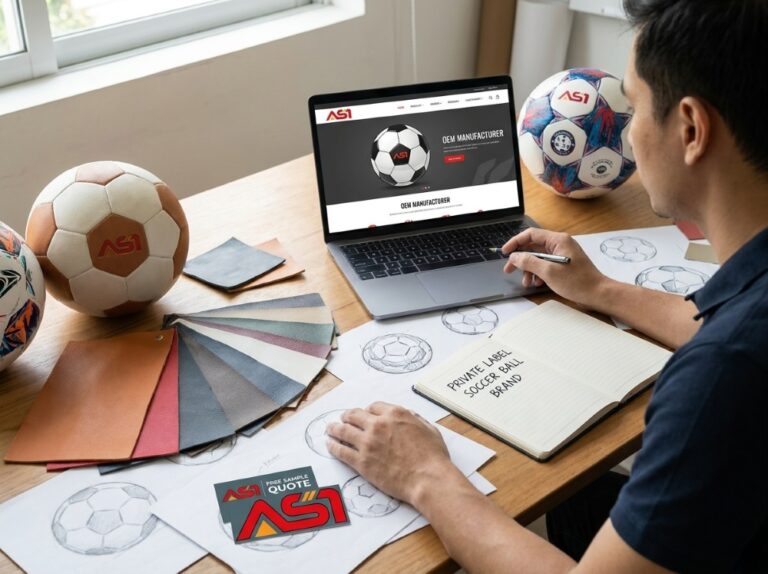
A good maker explains each step before bulk production starts. ASI Soccers, a manufacturer of sports and soccer balls in Sialkot, Pakistan, is one example of a maker that works this way.
Why panel design matters. A cool design on a computer screen may not work on a real ball. It often needs changes to fit a panel layout that can be made. That is why a professional artwork file and a mockup come before any bulk order.
Types of Soccer Balls
Match the ball to the surface, the player, and the use.
The Buying Formula
Quick Pick
All 25 Types in 4 Groups
By surface7
By player6
By build4
By purpose8
Inside a Soccer Ball
Cover material
Bladder
Construction
Which Size?
Age guides vary. Check your league rules.
Outdoor Size 5 vs Futsal
7 Questions Before You Buy
5 Mistakes to Skip
Custom Ball in 11 Steps
Big Football Markets
Ready to pick your ball?
Browse ASI Soccers categoriesASI Soccers makes sports and soccer balls in Sialkot, Pakistan.
Football Buyers Around the World
- Europe: A long football history, with a large pro, academy, and grassroots market.
- Australia: A growing football scene with strong demand from clubs, schools, and casual players.
- USA: A big soccer market across youth clubs, academies, schools, and colleges.
Each market has its own needs. One spec does not fit every buyer.
Frequently Asked Questions
What is the difference between a soccer ball and a football?
Nothing. Both words describe the same ball. The name changes by country.
Which ball is best for artificial turf?
A turf- or AstroTurf-specific ball. Look for a cover that handles rubbing and heavy use.
Is PU better than PVC?
PU feels softer and more responsive, so it suits serious play. PVC costs less and suits casual use. “Better” depends on your budget and needs.
Which size fits a 10-year-old?
Size 4 is the usual pick for ages 8 to 12. Check your league’s rules.
Hand-stitched or thermo-bonded: which is better?
Neither wins every time. Hand-stitched balls offer craft and a soft touch. Thermo-bonded balls offer a clean surface, steady shape, and less water absorption.
Can I use a futsal ball outdoors?
You can, but the cover may wear faster. It also bounces lower than an outdoor ball.
Can I put my logo on a ball?
Yes. A maker will usually create artwork, show a mockup, and produce a sample before the bulk order.
Final Thoughts
There is no single best soccer ball. Your best pick depends on a simple formula:
Playing surface + player age + use + construction + material + budget.
Answer those six points and the right ball becomes clear. Whether you need a match ball, a futsal ball, a beach ball, or a custom-branded ball, a small amount of homework pays off on the pitch.
Ready to Find Your Ball?
Pick the ball type that fits your game, your surface, and your budget. Visit the ASI Soccers product category pages to compare balls, choose a construction and material, and start a custom order.
👉 For frequent price quotations, contact our sales team now!