

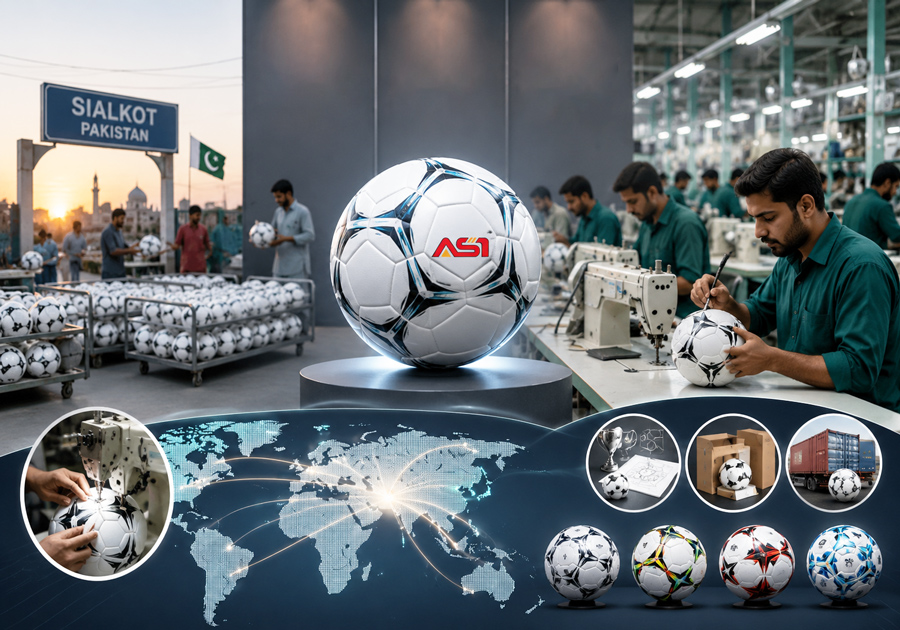
Many known sports brands launch, scale, or source soccer and sports balls brands by using Sialkot, Pakistan manufacturers, for hand-stitched, regulation-grade balls, it is the default global standard. The city produces approximately 70% of the world’s hand-stitched soccer balls, supplies every major brand from Adidas to Puma, and has been the backbone of FIFA World Cup match balls for decades. This guide explains why that matters, how the manufacturing ecosystem works, what game regulations demand, and how to navigate the Pakistan vs. China decision intelligently.
The City That Stitches the World’s Game
There is a reasonable chance that the soccer ball sitting in your garage, in your club’s equipment bag, or on the pitch at your last match was made in Sialkot — a mid-sized industrial city in Punjab, Pakistan, not far from the Kashmiri border.
That is not an exaggeration. Sialkot is responsible for roughly 70% of the world’s hand-stitched soccer balls, with annual output exceeding 40 to 65 million units depending on the production cycle. In the 2021–22 financial year alone, the city produced more than 43 million balls valued at USD $191 million.
The numbers have only grown since. In the first nine months of FY 2025–26, Pakistan’s football exports hit $197 million — up 17.81% year-on-year. Overall sports goods exports grew 12.99% to $319 million in that same period. Pakistan ranked 15th globally in sports goods exports in 2024, with total export value reaching an estimated $444 million.
Sialkot’s story starts in the late 19th century, when British colonial soldiers stationed in the region needed their worn-out footballs repaired. Local cobblers and leatherworkers stepped in. That moment of necessity became a 130-year legacy of manufacturing expertise passed down through generations. Today, roughly 60,000 workers — about 8% of the city’s population — are employed across approximately 1,000 factories in the soccer ball manufacturing sector alone.
This is not luck. This is a deep, compounding competitive moat built from skilled labor, a specialized supply chain, generational institutional knowledge, and a global reputation earned one hand-stitch at a time.
What Regulations Actually Govern a Soccer Ball
Before you can manufacture, private-label, or brand a soccer ball, you need to understand what the rules of the game literally require. The governing standards come from two bodies: FIFA (Fédération Internationale de Football Association) and IFAB (International Football Association Board), which jointly establish the Laws of the Game.
FIFA’s Law 2: The Ball
Under Law 2 of the Laws of the Game, any ball used in an official competition organized under FIFA or confederation auspices must meet specific technical minimums and bear an official quality mark.
The three FIFA quality marks are:
- FIFA Quality Pro — Required for all FIFA-sanctioned professional matches, including the World Cup and continental tournaments. The most rigorous certification.
- FIFA Quality — Suitable for professional training, academy matches, and semi-professional leagues.
- FIFA Basic — Entry-level certification; suitable for recreational leagues and general club use.
Size and Physical Specifications (FIFA/IFAB Standard)
| Specification | Size 5 (Adult/Professional) | Size 4 (Youth 8–12) | Size 3 (Children Under 8) |
|---|---|---|---|
| Circumference | 68–70 cm (27–28 in) | 63.5–66 cm (25–26 in) | 58–60 cm (23–24 in) |
| Weight | 410–450 grams (14–16 oz) | 350–390 grams | 300–320 grams |
| Pressure | 8.5–15.6 psi (0.6–1.1 atm) | 8.5–15.6 psi | 8.5–15.6 psi |
| Recommended Use | Professional/adult play | Youth club and academy | Children/recreational |
A standard Size 5 match ball consists of 32 panels — 20 hexagons and 12 pentagons — held together by approximately 690 to 720 stitches. The bladder (typically butyl or latex rubber) provides air retention and bounce. The outer casing is made of synthetic leather or polyurethane, laminated over cotton and polyester backing layers for durability.
Construction Types and Their Regulatory Impact
There are three primary construction methods, each affecting quality certification eligibility:
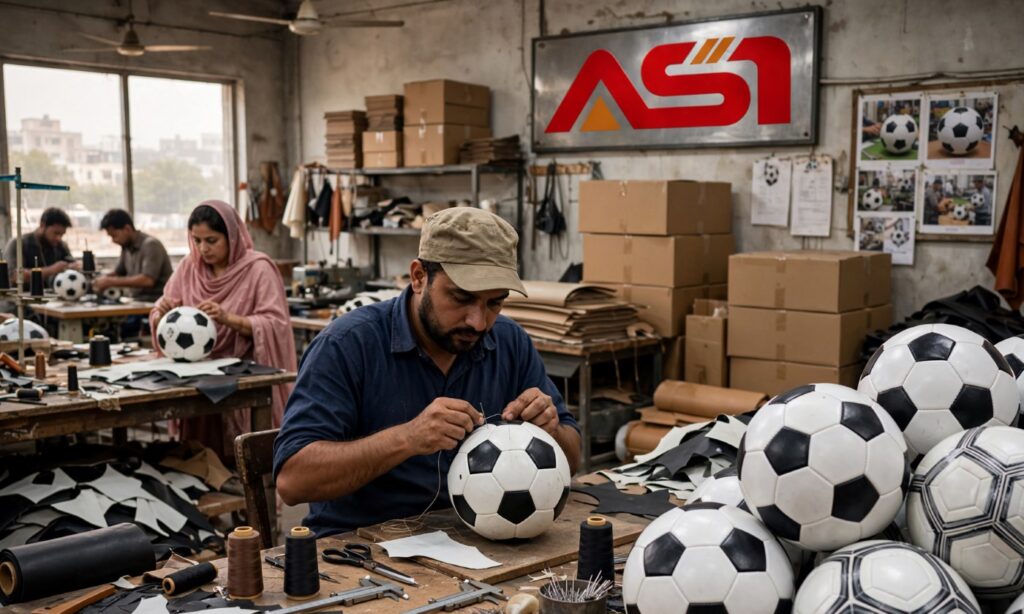
- Hand-Stitched — Panels are sewn together by skilled workers using polyester thread, with pre-punched stitch holes. Produces a durable, aerodynamically stable ball with a break-in period. Eligible for all FIFA certification tiers. Sialkot’s dominant method.
- Machine-Stitched — Automated stitching with consistent thread tension. Cost-effective, used for training and promotional balls. Eligible for FIFA Basic and Quality tiers.
- Thermo-Bonded / Thermally Bonded — Panels are joined using heat and adhesive, with no visible stitching. Used in high-end match balls like the Adidas Brazuca (2014) and Telstar 18 (2018). Offers a truer flight path but requires sophisticated tooling. Eligible for FIFA Quality Pro certification.
Critical note on branding compliance: Under IFAB Law 2, no commercial advertising is permitted on balls used in FIFA-organized competition, except for the competition logo, the competition organizer’s emblem, and the manufacturer’s authorized trademark. If you are building a licensed match ball for any official competition, your branding design must comply with these restrictions.
Why Global Brands Keep Coming Back to Sialkot
The real question for any brand sourcing decision is: why does this city, with all its logistical complexity and geopolitical considerations, still win the business of Adidas, Nike, Puma, Select, and Reebok?
The answer is not cheap labor. It is irreplaceable expertise combined with a mature, integrated supply chain.
The Sialkot Advantage — By the Numbers
- 70% of global hand-stitched soccer ball supply
- 40–65 million balls produced annually
- 1,000+ factories in the Sialkot cluster
- 130+ years of unbroken manufacturing heritage
- $444 million in Pakistani sports goods exports (2024)
- 15 million balls produced annually by top-tier individual suppliers
World Cup Match Balls Made in Sialkot
The most credible endorsement of Sialkot’s quality is not a marketing claim — it is the FIFA World Cup production record:
| Year | Match Ball | Sialkot Involvement |
|---|---|---|
| 1982 | Adidas Tango España | Established Pakistan’s waterproofing innovation reputation |
| 2002 | Adidas Fevernova | Sialkot supply chain contribution |
| 2014 | Adidas Brazuca | Manufactured entirely by Forward Sports, Sialkot |
| 2018 | Adidas Telstar 18 | Manufactured by Forward Sports, Sialkot |
| 2022 | Adidas Al Rihla | Training balls and replicas from Sialkot; match balls from China |
| 2026 | Adidas Trionda | Manufactured by Forward Sports, Sialkot |
That 2014 Brazuca production run is a particularly instructive case study. Adidas approached Forward Sports in Sialkot when its Chinese supplier could not meet demand. The Sialkot manufacturer had less than two months to go from zero Brazuca production infrastructure to full World Cup output — and it delivered. Local engineers built the required production and testing equipment in seven weeks.
The Skill That Cannot Be Outsourced Overnight
More than 80% of Sialkot’s output is still hand-stitched — a process that takes two to four hours per ball and demands a level of tactile precision that takes years to develop. Workers have inherited techniques across generations. The stitching quality directly affects aerodynamic stability, panel integrity, and how the ball behaves at game speed.
This skill concentration is Sialkot’s most defensible competitive advantage. You cannot replicate it by standing up a factory in a new country and hiring unskilled workers. China competes effectively in machine-stitched and machine-bonded products, but in the premium hand-stitched segment — the segment that wins FIFA certifications and fills professional training kits — Sialkot’s workforce is essentially in a category of one.
Pakistan vs. China: An Honest Manufacturing Comparison
This is the central question for any brand entering the soccer ball market. The answer is not binary — it depends entirely on your product tier, volume requirements, and long-term brand positioning.
| Factor | Sialkot, Pakistan | China |
|---|---|---|
| Best for | Hand-stitched, FIFA-certified, premium match/training balls | Machine-stitched, high-volume, promotional/recreational balls |
| Construction strength | Hand-stitching excellence, thermo-bonding growing rapidly | Machine-stitching, thermal bonding at industrial scale |
| FIFA certification | Widely available across quality tiers | Available but concentrated at higher-volume factories |
| Customization/OEM | Highly flexible; lower MOQ with direct factory access | Available but often higher MOQ |
| Lead times | Competitive; can be strained during World Cup cycles | Fast at scale; vulnerable to tariff disruptions |
| Import duty (EU/UK) | GSP+ status = 0% duty on many goods | Standard 12%+ duty |
| Brand perception | “Made in Pakistan” carries quality signal for hand-stitched balls | “Made in China” dominant in recreational/machine-stitched tier |
| Labor skill depth | Deep generational expertise in ball stitching | Strong in automation and machine-bonded construction |
| Supply chain integration | Highly specialized cluster; raw materials sourced globally | Broad ecosystem; Chinese materials used for lower-cost tiers |
The sourcing intelligence most brands miss: Raw material origin actually varies by ball tier regardless of where final assembly happens. For high-quality Sialkot balls, synthetic leather components are typically sourced from South Korea or Japan. Chinese-origin synthetic leather is reserved for the lowest-cost tiers. This means the production country and the material origin can be entirely different — and for premium balls, Sialkot’s quality output is partly a function of premium input materials.
The US tariff consideration (2025–2026): Rising trade tariffs on Chinese goods have accelerated sourcing diversification toward Pakistan among American brands and retailers. This structural shift is real and ongoing, and it opens a significant window for new soccer ball brands to establish Pakistani supply chains while factory capacity is still accessible.
How to Build a Successful Soccer Ball Brand
Building a soccer ball brand is not primarily a manufacturing problem — it is a positioning and certification problem. The manufacturing part is the most straightforward step once you understand what you are building and for whom.
Step 1: Define Your Product Tier Before Anything Else
Every sourcing, certification, and pricing decision flows from your product tier. There are four distinct tiers in the soccer ball market:
- Promotional / Recreational — Sized and weighted to FIFA specifications but not certified. Used for marketing giveaways, fan merchandise, youth recreational leagues. Machine-stitched. Lowest cost. China or Pakistan both viable.
- Training / Club — Meets FIFA Quality or FIFA Basic specifications. Durable enough for daily use. Hand-stitched from Sialkot or machine-stitched. Target market: academies, clubs, school programs, retail.
- Match / Competition — FIFA Quality or FIFA Quality Pro certified. Used in semi-professional to professional matches. Requires rigorous testing and approval. Hand-stitched or thermo-bonded.
- Official Match Ball — FIFA Quality Pro certified, competition-specific design. Produced under direct brand license agreements with FIFA or confederation. Not accessible to new brands without significant investment and negotiation.
For most new and emerging brands, Tiers 2 and 3 represent the most commercially realistic entry points.
Step 2: Understand OEM, Private Label, and Custom Development
These three manufacturing models serve different brand maturity levels:
- OEM (Original Equipment Manufacturing): You specify performance requirements; the manufacturer designs and produces the ball. You apply your branding. Lower development cost and time. Best for new brands testing market demand.
- Private Label: The manufacturer produces a pre-existing design; you brand it as your own. Fastest to market. Limited differentiation but lowest upfront investment. Good for regional retailers and club programs.
- Custom Product Development: You co-develop the design, panel layout, material specifications, and technology with the manufacturer. Highest cost and timeline but creates a genuinely proprietary product. Appropriate for brands seeking long-term defensibility.
Step 3: Certifications Are a Go-to-Market Prerequisite
If you want retail distribution, club contracts, or league approvals, FIFA certification is not optional — it is the price of admission. Plan for this:
- FIFA testing is conducted by accredited independent laboratories
- Testing covers circumference, roundness, rebound, weight, water absorption, pressure loss, shape retention, and seam strength
- The certification process takes time and should be built into your product development timeline
- Separate certifications exist for futsal balls (which have different bounce and size requirements under FIFA Futsal Ball specifications)
Step 4: Build Minimum Order Quantities Into Your Financial Plan
Sialkot manufacturers generally offer more accessible MOQs than Chinese competitors — a key advantage for emerging brands. That said, certifications require consistent batch production, so factor in:
- Sample runs for design approval
- Pre-production testing batches
- Minimum production runs for certification consistency
- Buffer inventory for retail lead times
Step 5: Pick a Manufacturing Partner with Documented Export Experience
The most common failure point for new brands is selecting a manufacturer based on price alone. The right partner has:
- Verifiable track record of supplying international brands
- Experience navigating export documentation, compliance audits (SEDEX, ILO, ISO certifications)
- In-house quality control at every production stage, not just final inspection
- Capacity to grow with your brand without sacrificing lead times
The 30-Year Expertise Advantage
Since 1992, ASI Soccer has been manufacturing sports balls with experience working alongside more than 44 international brands — supporting both established companies and new entrants with OEM, private-label, and custom product development. That kind of institutional depth matters precisely because it is accumulated over decades, not assembled on a sourcing spreadsheet.
For a new brand, partnering with a manufacturer that has navigated 30-plus years of evolving FIFA standards, changing material technology, and shifting international compliance requirements is itself a competitive advantage. You inherit their institutional knowledge from day one.
Key Factors That Separate Successful Soccer Ball Brands from Those That Stall
Based on what consistently distinguishes brands that scale from those that do not:
They nail the regulatory compliance early. Brands that treat FIFA certification as an afterthought spend months backtracking and reformulating. The brands that win plan for certification from the first design conversation.
They choose their manufacturing tier deliberately. Chasing the lowest possible unit cost in the wrong product tier destroys brand perception. A $4 machine-stitched ball cannot be sold as a premium training tool, regardless of the logo on it.
They understand that branding on the ball is not branding of the ball. The logo is the last step. The product performance — flight consistency, shape retention, water resistance, touch feedback — is what gets a ball reordered and recommended.
They build manufacturing relationships, not just supplier lists. Supply chain disruptions, certification renewals, custom colorway requests, and sudden order increases all require a manufacturer who is invested in your brand’s growth. Transactional sourcing creates transactional reliability.
They account for certification cycles in their launch calendar. FIFA certification takes time. Brands that do not build this into their timelines miss retail windows and delay revenue.
Frequently Asked Questions
Q: Does “Made in Pakistan” hurt or help a soccer ball brand?
For hand-stitched, premium-tier balls, “Made in Pakistan” carries significant credibility with buyers and distributors who know the industry. Adidas and Puma source from Sialkot. Forward Sports is Adidas’s largest ball supplier globally as of 2026. For promotional or mass-market recreational balls, country of origin is less influential in purchase decisions than price and certification status.
Q: What is the difference between FIFA Quality and FIFA Quality Pro certification?
FIFA Quality Pro is the higher standard and is required for matches at the professional level. It includes stricter tolerances for weight, rebound consistency, water absorption, and shape retention. FIFA Quality covers semi-professional and club-level competition. FIFA Basic covers recreational and amateur play. Only FIFA Quality Pro balls are used in FIFA World Cup, UEFA Champions League, and top-tier domestic leagues.
Q: Can a new brand get FIFA certification on their first product?
Yes, but plan for it. You will need to work with an accredited test laboratory, ensure your manufacturer’s process is consistent enough to pass batch testing, and have adequate capital to cover reformulation if the ball fails any specification. Most first-time submissions require at least one revision cycle.
Q: What is a futsal ball, and does it require separate certification?
A futsal ball is Size 4 but with significantly reduced bounce — specifically designed for hard-court indoor play and the fast-paced futsal format. It has its own FIFA certification program and is not interchangeable with a standard outdoor Size 4. If you are entering the futsal market, this is a distinct product requiring distinct certification.
Q: How long does it take to go from concept to a branded, certified soccer ball?
For a private-label OEM product, the timeline can be as short as 8–12 weeks. For a custom-designed, FIFA-certified ball, plan for 6–12 months from initial design brief to certified production run, accounting for sampling, testing, revision, and certification approval.
Q: What is the minimum order quantity to start?
This varies significantly by manufacturer and product type. In Sialkot, some manufacturers work with MOQs as low as 50–100 units for custom design sampling. Production run MOQs for certified balls typically start at 300–500 units, depending on the complexity of the design and the certification tier. China-based factories often require higher MOQs, particularly for machine-bonded designs.
Q: Is hand-stitching better than machine-stitching for performance?
Not automatically. Both methods can produce FIFA-certified balls. Hand-stitching offers certain durability advantages and is prized by players for its tactile feedback and long-term shape consistency. Machine-stitching offers tighter thread tension uniformity but requires additional quality control. The construction method should match your product tier: hand-stitching for premium club and match balls; machine-stitching for training and recreational tiers.
Q: What certifications should a Sialkot manufacturer have beyond FIFA?
Look for ISO 9001 (quality management), SEDEX or SMETA (ethical trade and labor practices audit), and ILO compliance documentation. These are increasingly required by major retailers and distributors in the US, EU, and UK markets. Since the 1997 Atlanta Agreement — which reformed child labor practices in Sialkot’s industry — reputable manufacturers have maintained ongoing compliance with ILO monitoring standards.
The Opportunity in Front of You
The global soccer ball market is not standing still. Several structural shifts are creating genuine entry points for new brands right now:
- The 2026 FIFA World Cup (being held in the United States, Canada, and Mexico) is already driving demand spikes and increased visibility for the sport in the North American market — the world’s fastest-growing soccer consumer base.
- US tariffs on Chinese goods are accelerating brand diversification toward Pakistan for sourcing, creating factory capacity availability that did not exist two years ago.
- EU/UK buyers benefit from Pakistan’s GSP+ status, meaning goods manufactured in Pakistan enter under zero percent duty versus 12%+ from China — an instant structural cost advantage.
- The rise of academy programs, private clubs, and branded team equipment at the youth level has created consistent demand for certified training balls with custom branding.
The question is not whether Sialkot can support your brand. It has been supporting the world’s biggest brands for over a century. The question is whether you understand the product, the regulations, and the supply chain well enough to execute.
ASI Soccer has been in that supply chain since 1992 — supporting 44+ international brands across OEM, private-label, and custom development. For brands that want to build something that lasts, that track record is not a footnote. It is the foundation.