

How to Launch a Private Label Soccer Ball Brand: From Factory Sourcing to Custom Design
Launching a private label soccer ball brand is one of the smartest moves you can make in the sports equipment market right now. Buyers want custom gear. They want brands that feel personal, not generic.
Here’s the short version: find a trustworthy OEM soccer ball manufacturer, pick the right materials, design a ball that matches your brand, order a sample, then scale production. Do this right, and you can launch a full line of custom branded soccer balls in as little as 60 to 90 days.
This guide walks you through every step. No fluff. Just what you need to know before you spend a single dollar.
Why Private Label Soccer Balls Are Booming Right Now
The sports equipment market is shifting. People don’t just want “a soccer ball” anymore. They want a ball that says something about who they are.
That’s why private label soccer balls are trending hard in 2026. Three forces are driving this:
- E-commerce sellers want unique products. Reselling the same generic balls as everyone else doesn’t work anymore on Amazon or Shopify. Buyers scroll past look-alike listings.
- Sports academies want branded gear. Clubs and academies use custom balls for team identity and fundraising.
- Sustainability matters more than ever. Shoppers actively search for eco-friendly soccer ball suppliers instead of cheap, wasteful imports.
If you’re a brand owner, seller, or procurement manager, this is your window. The demand is here. The question is whether you can source smart and move fast.
Who This Guide Is For
This article is built for:
- Sports brand owners starting or expanding a product line
- Amazon and e-commerce sellers who want a defensible, non-generic product
- Sports academy directors who need custom-branded soccer balls for teams
- Retail procurement managers sourcing bulk private label sports equipment
If that’s you, keep reading.
What Does “Private Label” Actually Mean for Soccer Balls?
Let’s clear this up first, because people mix up two different terms.
| Term | What It Means | Who Controls the Design |
|---|---|---|
| Private Label | You buy an existing ball design from a factory and slap your own branding, logo, and packaging on it | The factory (base design), you (branding) |
| OEM (Original Equipment Manufacturer) | You work with the factory to build a fully custom ball from scratch — size, material, stitching, colors, everything | You (full control) |
| White Label | Same as private label, but usually sold to multiple brands with just a logo swap | The factory |
Most sellers start with private label because it’s faster and cheaper. Once your brand grows, you can move into full OEM soccer ball manufacturing for total control.
Step 1: Understand the Soccer Ball Market Before You Source
Before you contact a single factory, know your market. This step gets skipped a lot, and it’s the reason many private label launches fail.
Know Your Ball Categories
Soccer balls aren’t one-size-fits-all. There are different categories, and each one has a different buyer.
- Match balls: Used in official games. Higher price point. Strict size and weight standards (FIFA Quality Pro or FIFA Quality standards).
- Training balls: Built for durability, not perfect flight. Used daily by clubs and academies.
- Recreational balls: Backyard and casual play. Lower cost, wider margins for retail.
- Youth balls: Smaller sizes (Size 3 and Size 4) for kids under 12.
Know Your Price Tiers
| Tier | Price Range (Wholesale) | Typical Buyer |
|---|---|---|
| Economy | $2 – $5 per ball | Bulk retail, promotional giveaways |
| Mid-range | $6 – $12 per ball | Academies, e-commerce brands |
| Premium | $13 – $30+ per ball | Match-quality, pro-level branding |
Pick your tier before you talk to a manufacturer. This decision shapes everything else — materials, minimum order quantity, and price.
Step 2: Choose the Right Materials for Your Custom Soccer Ball
Material choice makes or breaks your product. It affects cost, durability, and how the ball actually plays.
Common Soccer Ball Materials
1. PU (Polyurethane) Leather: This is the go-to choice for most custom PU leather footballs. It’s soft, durable, and close to the feel of real leather. Mid-to-premium tier brands use this most often.
2. PVC (Polyvinyl Chloride): Cheaper and more rigid than PU. Good for economy-tier balls and promotional products. Less durable over time.
3. Rubber: Used mostly for training and playground balls. Very tough, but doesn’t have the same touch or flight quality as PU.
4. Recycled and Eco-Friendly Materials: This is the fastest-growing category. Factories now offer balls made from recycled PU, plant-based foam cores, and water-based glue instead of solvent-based adhesive. If you’re working with an eco-friendly soccer ball supplier, ask specifically about:
- Recycled outer panels
- Water-based bonding (no harmful solvents)
- Biodegradable packaging
- Certifications like OEKO-TEX or REACH compliance
Construction Type Comparison
| Construction | Description | Best For |
|---|---|---|
| Hand-stitched | Panels sewn together by hand | Premium, traditional feel |
| Machine-stitched | Panels sewn by machine | Mid-range, consistent quality |
| Thermally bonded (glued) | Panels heat-pressed together, seamless | Match-quality, waterproof |
For most private label sellers starting, machine-stitched PU balls hit the sweet spot of cost, quality, and turnaround time.
Step 3: Find the Right OEM Soccer Ball Manufacturer
This is the step where most people get stuck. Picking the wrong factory can cost you months and thousands of dollars.
What to Look for in a Manufacturer
Experience with private label orders. Ask how many private label sports equipment brands they’ve worked with. A factory that’s only done bulk generic orders may not understand branding requirements like Pantone color matching or logo placement.
Minimum Order Quantity (MOQ). Most factories require anywhere from 100 to 500 units per design for private label runs. Some offer lower MOQs for sample or trial orders — always ask.
Certifications. Look for:
- ISO 9001 (quality management)
- FIFA Quality / FIFA Quality Pro (for match balls)
- REACH and OEKO-TEX (for eco-conscious buyers)
Sample policy. A reliable factory will send you a physical sample before mass production. If they refuse, that’s a red flag.
Communication speed. Test this before you commit. Send a detailed inquiry and see how fast and how clearly they respond. Slow, vague replies now usually mean slow, vague production updates later.
Questions to Ask Every Manufacturer
- What’s your MOQ for private label orders?
- Can I get a physical sample before bulk production?
- What’s your average lead time from approved sample to shipped order?
- Do you offer custom color matching (Pantone)?
- What certifications does this ball carry?
- Can you provide eco-friendly material options?
- What’s your defect/return policy?
Keep a simple scorecard. Rate each factory 1–5 on these answers. It removes emotion from the decision.
Step 4: Design Your Custom Branded Soccer Ball
Now the fun part. This is where your brand actually comes to life.
Key Design Elements
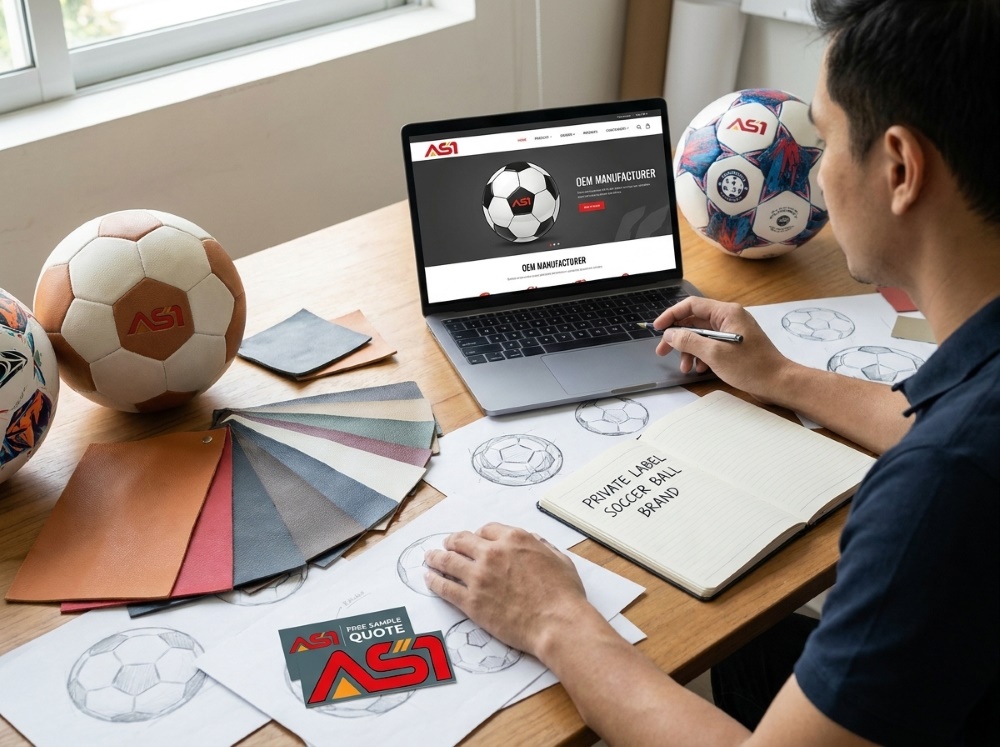
Panel Pattern. Traditional 32-panel (classic black-and-white look), 18-panel, 12-panel, or thermally bonded seamless designs. More panels usually mean more customization space for graphics.
Colors. Stick to 2–4 brand colors max. Too many colors raise production costs and can look cluttered.
Logo Placement. Standard spots are the “cap” panels (the ones that don’t touch the ground much during play), so your logo doesn’t wear off fast.
Packaging. Don’t skip this. A branded box or mesh bag with your logo makes your product look premium, even at a mid-range price point.
A Simple Design Checklist
- Finalize your brand color codes (get exact Pantone or CMYK values)
- Choose panel style and ball size (Size 5 standard, Size 4 youth, Size 3 mini)
- Decide logo placement and size
- Pick your packaging style (box, bag, or both)
- Request a digital mockup from your manufacturer
- Approve the mockup before requesting a physical sample
Common Mistake to Avoid
Don’t rush from digital mockup straight to bulk order. Colors on a screen rarely match colors on a real ball. Always request one physical sample first, even if it costs a little extra and adds a few days.
Step 5: Understand Costs and Pricing Strategy
Let’s talk numbers, because this is what most buyers actually care about.
Typical Cost Breakdown (Per Unit, Mid-Range PU Ball)
| Cost Component | Approximate Share |
|---|---|
| Raw materials (PU, rubber bladder, thread) | 40–50% |
| Labor (stitching, assembly) | 20–25% |
| Branding (printing, logo application) | 5–10% |
| Packaging | 5–10% |
| Shipping and duties | 10–20% (varies heavily by destination) |
Setting Your Retail Price
A common rule of thumb in private label sports equipment is a 2.5x to 4x markup from your landed cost (product cost + shipping + duties) to retail price. This covers your marketing, platform fees, and profit margin.
Example:
- Landed cost per ball: $6
- Retail price at 3x markup: $18
Adjust based on your market. Premium eco-friendly balls can support higher markups because buyers expect to pay more for sustainable materials.
Step 6: Sampling and Quality Control
Never skip this step, no matter how much you trust the factory.
The Sampling Process
- Request a pre-production sample based on your approved design.
- Inspect it physically. Check stitching, roundness, weight, and color accuracy.
- Test it. Bounce it, kick it, check the bladder for air retention over 48 hours.
- Approve or request revisions. Don’t move to bulk production until you’re fully satisfied.
Quality Control Checklist for Bulk Orders
- Weight consistency (should match FIFA standard of 14–16 oz for Size 5 balls)
- Circumference accuracy (27–28 inches for Size 5)
- Roundness (roll test — it should roll straight, not wobble)
- Air retention (test after 24–48 hours)
- Stitching or bonding integrity (no loose threads or gaps)
- Print and logo durability (rub test to check ink or dye doesn’t smudge)
Many buyers hire a third-party inspection service for large orders. This costs a few hundred dollars but can save you from a shipment full of defective balls.
Step 7: Shipping, Import, and Logistics
Getting your balls from factory to warehouse involves a few moving parts.
Shipping Method Comparison
| Method | Speed | Cost | Best For |
|---|---|---|---|
| Sea freight | 30–45 days | Lowest cost | Large bulk orders (500+ units) |
| Air freight | 5–10 days | Higher cost | Smaller or urgent orders |
| Express courier | 3–7 days | Highest cost | Samples or small trial batches |
Don’t Forget These Details
- Import duties and taxes vary by country and product classification. Check your local customs code (HS code) for soccer balls before ordering.
- Incoterms (like FOB, CIF, or EXW) determine who pays for what during shipping. Clarify this with your factory before signing any agreement.
- Insurance. Always insure bulk shipments. It’s a small cost compared to losing an entire container.
Step 8: Marketing Your Private Label Soccer Ball Brand
Once your balls arrive, the real work of building a brand begins.
Quick Marketing Wins
- Tell your sustainability story if you’re using eco-friendly materials. Buyers respond strongly to this in 2026.
- Use lifestyle photography, not just product shots on a white background. Show the ball in use.
- Bundle products. Pair your soccer ball with branded pumps, bags, or cones for higher order values.
- Target academies and clubs directly. Bulk B2B orders often bring more stable revenue than one-off retail sales.
Private Label vs. Full OEM: Which Should You Choose?
Here’s a side-by-side to help you decide where to start.
| Factor | Private Label | Full OEM |
|---|---|---|
| Startup speed | Faster (existing base design) | Slower (design from scratch) |
| Cost to start | Lower | Higher |
| Customization level | Branding only | Full design control |
| Minimum order | Often lower | Usually higher |
| Best for | New brands, testing the market | Established brands scaling up |
Our advice: Start with private label to test demand. Once you have sales data and know what your customers want, move into full OEM soccer ball manufacturer partnerships for deeper customization.
Frequently Asked Questions
Q: How much does it cost to start a private label soccer ball brand?
A: Startup costs vary, but many sellers begin with $2,000–$8,000, covering sample orders, a small first bulk run, and basic branded packaging. Costs rise with premium materials or lower MOQs.
Q: What’s a typical minimum order quantity (MOQ) for custom branded soccer balls?
A: Most factories require 100–500 units per design. Some offer trial MOQs as low as 50 units for new brands, especially for sample runs.
Q: How long does it take to launch a private label soccer ball line?
A: From first factory contact to receiving your finished product, expect 60–90 days. This includes design approval, sampling, bulk production, and shipping.
Q: Can I get FIFA-certified soccer balls for my private label brand?
A: Yes. Ask your manufacturer if they offer FIFA Quality or FIFA Quality Pro certified balls. Note this usually raises the price and requires stricter quality testing.
Q: What’s the difference between PU and PVC soccer balls?
A: PU (polyurethane) is softer, more durable, and feels closer to real leather. It costs more. PVC is cheaper and more rigid, making it a common choice for economy and promotional balls.
Q: Are eco-friendly soccer balls more expensive to produce?
A: Usually, yes, by about 10–20% compared to standard materials. But this cost is often offset by higher retail prices, since sustainability-focused buyers are willing to pay more.
Final Thoughts: Your Next Move
Launching a private label soccer ball brand isn’t complicated, but it does take the right partner. Pick your materials carefully. Vet your manufacturer. Never skip the sample stage. And tell a real story with your branding, especially if sustainability is part of your pitch.
The demand for custom-branded soccer balls, private label sports equipment, and eco-friendly options is only growing. Brands that move now, with the right sourcing partner, will own this space before it gets crowded.
ASI Soccers has helped brand owners, e-commerce sellers, and academies do exactly this, from first sample to full container shipment. Whether you need custom PU leather footballs, FIFA-certified match balls, or sustainable training balls, ASI Soccers can bring your private label vision to life.
Ready to Launch Your Own Custom Soccer Ball Line?
Request a free sample pack and custom branding quote today.