

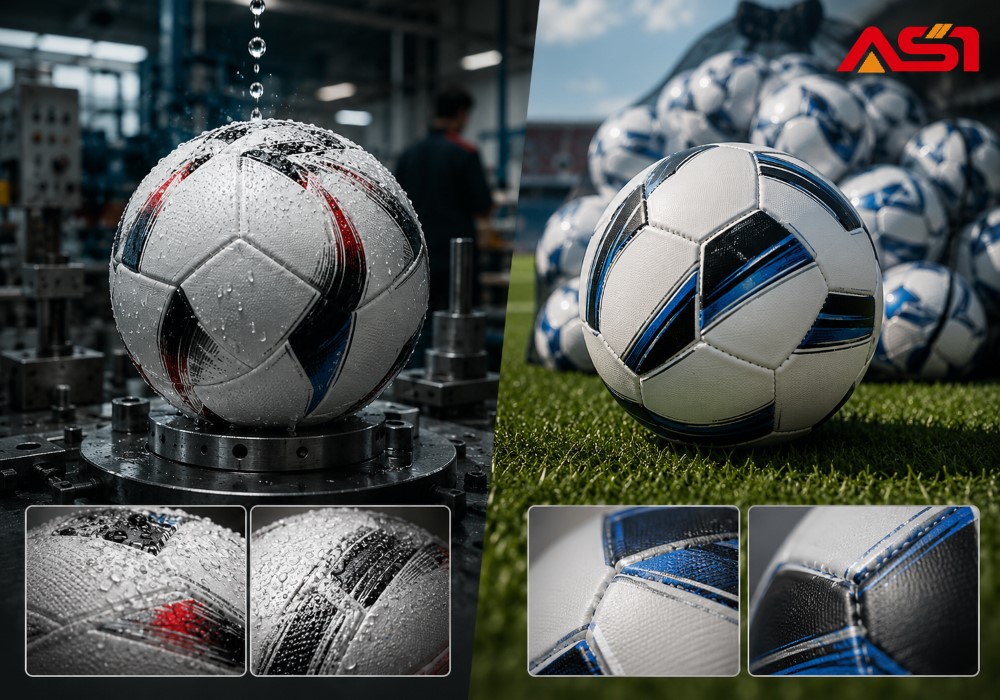
Thermal-Bonding vs. Hybrid Soccer Balls (Dual-Bonded Seams): Engineering Structural Longevity
Thermal-bonded balls use heat and pressure to fuse panels into one smooth surface. They keep out water, hold their shape, and cost more to make.
Hybrid soccer balls (commonly known as dual-bonded or stitched-and-glued balls) stitch the panels first, then apply glue over the seams. They are tougher against rough fields but let in more water over time.
If your teams play in wet climates or need consistent flight in tournament play, thermal bonding wins. If your budget is tight and your fields are dry and rough, a hybrid soccer ball (dual-bonded construction) still earns its place.
This guide breaks down both methods so procurement teams can match the right ball to the right program.
Why Seam Construction Matters More Than You Think
A soccer ball is only as strong as its seams. The panels can be top-grade PU or TPU, but if the seams fail, the ball fails.
Seams control three things buyers care about most:
- How the ball holds air pressure over a season
- How much water it soaks up in rain or on wet grass
- How long it lasts before panels lift or split
Two seam methods dominate the market today: thermal bonding and hybrid soccer ball construction (also called dual-bonded or stitched-and-glued construction). Each one solves the seam problem in a different way, and each one has real trade-offs for teams, leagues, and clubs buying in bulk.
What Is Thermal Bonding?
Thermal bonding uses heat and pressure to melt panel edges together. There is no thread and no visible stitch line. The panels form one continuous skin around the bladder.
How the Process Works
- Panels are cut with precision molds.
- Heat softens the panel edges.
- A bonding agent is applied to the seam line.
- Pressure presses the panels into a single unit.
- The ball cools and sets into its final shape.
Because there are no needle holes, water has almost nowhere to enter. This is why thermal bonded balls are the standard for professional matches, including balls used in top-level FIFA competitions.
Strengths of Thermal Bonding
- Seamless surface: Fewer bumps mean truer flight and bounce.
- Low water pickup: No stitch holes means less weight gain in rain.
- Consistent roundness: The ball holds its shape match after match.
- Better for high-level play: Referees and players notice flight consistency.
Weaknesses of Thermal Bonding
- Higher cost: The machines and molds needed are expensive.
- Less repairable: A damaged seam is harder to patch in the field.
- Can crack in extreme cold: The bonding layer is less flexible below freezing.
What Is a Hybrid Soccer Ball (Dual-Bonded)?
A hybrid soccer ball takes the old-school stitched ball and adds a layer of glue over the seam. This dual-bonded construction is a hybrid method built to fix the classic weakness of hand-stitched balls: water soaking through the thread holes.
How the Process Works
- Panels are cut and pre-shaped.
- Panels are hand- or machine-stitched together, usually with waxed polyester thread.
- A waterproof glue or polyurethane coating is applied over each seam line.
- The coating cures and seals the stitch holes.
The stitching gives the ball its base strength, while the dual-bonded glue layer is the backup defense against water and wear.
Strengths of Hybrid Soccer Balls (Dual-Bonded)
- Strong seam grip: Thread plus glue resists ripping under heavy kicks.
- Field-friendly: Handles rough, gravelly, or turf pitches well.
- More repairable: Stitched seams can sometimes be resewn.
- Lower production cost: No thermal molding machinery required.
Weaknesses of Hybrid Soccer Balls (Dual-Bonded)
- Water still gets in: Glue wears down over time, and stitch holes reopen.
- Slightly heavier when wet: Extra water weight affects flight in rain.
- Seam bumps: Stitching creates a texture that can affect roll and bounce slightly.
Seam Integrity Soccer Comparison: Side-by-Side Table
| Factor | Thermal Bonded | Hybrid Soccer Ball (Dual-Bonded) |
| Seam type | Heat-fused, no thread | Stitched, then glue-sealed |
| Water resistance | Excellent | Good, weakens with age |
| Shape retention | Very high | High |
| Flight consistency | Very high | Moderate to high |
| Field durability (rough turf) | Good | Very good |
| Repairability | Low | Moderate |
| Cold-weather flexibility | Lower | Higher |
| Production cost | Higher | Lower |
| Best use case | Match play, wet climates | Training, rugged fields |
Water Resistance: Thermal Bonded vs. Dual-Bonded Hybrid Seams
Water resistance is often the deciding factor for equipment managers buying for outdoor programs. Let’s break down what dual-bonded hybrid construction really means for water resistance.
Thermal Bonded Water Performance
Because thermal seams have no needle holes, water has no clear path into the ball. Independent lab tests on match-grade thermal balls typically show water absorption under 10% of the ball’s dry weight after simulated rain exposure. That keeps weight and flight stable across a wet match.
Hybrid Soccer Ball (Dual-Bonded) Water Performance
A fresh hybrid soccer ball performs well too. The dual-bonded glue layer seals stitch holes at first. But here is the catch: glue coatings wear down with repeated flexing, sun exposure, and ball-to-ground contact. Over a season of heavy use, small cracks can form in the glue layer. Water then finds its way through the old stitch holes underneath.
This does not mean hybrid (dual-bonded) balls fail fast. Quality dual-bonded balls can still handle a full season of typical rain. But for programs in consistently wet regions, thermal bonding holds its water resistance for a longer stretch of use.
Quick Reference: Water Pickup Over Time
| Ball Age | Thermal Bonded Water Pickup | Hybrid / Dual-Bonded Water Pickup |
| New (first use) | Very low | Low |
| After 3 months regular use | Very low | Low to moderate |
| After 6–12 months regular use | Low | Moderate |
| After 1+ season of heavy use | Low to moderate | Moderate to high |
These are general trends based on construction type, not guaranteed figures. Actual performance depends on material quality, weather exposure, and care.
Seam Durability Under Load
Procurement managers need to think past day one. What happens after 500 kicks? After a season of practice drills? Here is how each method holds up under stress.
Thermal Bonded Under Stress
Thermal seams distribute stress evenly across the fused line. There is no single weak point like a thread that can snap. The main risk is a full seam separation, which is rare but harder to fix once it happens. When it does happen, it is usually from a manufacturing defect rather than normal wear.
Hybrid / Dual-Bonded Under Stress
Stitched seams flex more naturally, which helps them absorb sudden impacts, such as a hard shot at close range. The thread can stretch slightly before breaking. This makes hybrid soccer balls (dual-bonded) a strong pick for rough training environments, sand, gravel-adjacent pitches, and youth programs where balls take a beating.
The trade-off is gradual wear. Thread can fray. Glue can peel at the edges after repeated exposure to sun and moisture. This is a slow decline, not a sudden failure, which gives teams time to catch problems before a full breakdown.
Flight and Play Feel: Does Seam Type Change the Game?
Seam construction affects more than durability; it changes how the ball moves.
Thermal Bonded Flight
- Truer curve and spin due to the smooth, seamless surface
- More predictable bounce off the ground
- Preferred for competitive matches and referee-level consistency
Hybrid Soccer Ball (Dual-Bonded) Flight
- Slightly more surface texture from the stitch lines
- Can affect spin at high speeds, though most players at training level won’t notice
- Performs consistently well for skill-building, passing drills, and everyday practice
Thermal-Bonded vs. Hybrid Soccer Balls
How two seam-building methods affect water resistance, durability, and cost.Thermal bonding seals out water and holds shape longest. Dual-bonding costs less and survives rough fields best.
Two Seams, Two Strategies
Thermal Bonded
- Seam buildHeat-fused, no thread
- Water resistanceExcellent
- Best forMatch play, wet climates
- Unit costHigher
Hybrid Dual-Bonded
- Seam buildStitched + glue-sealed
- Water resistanceGood, fades with age
- Best forTraining, rough fields
- Unit costLower
Water Pickup After 1 Season
Quick-Scan Comparison
| Factor | Thermal Bonded | Dual-Bonded |
|---|---|---|
| Shape retention | Very High | High |
| Rough-field toughness | Good | Very Good |
| Repairable | Low | Moderate |
| Flight consistency | Very High | Moderate-High |
Which Fits Your Program?
Wet Climate
Choose Thermal Bonded
Rough Field, Tight Budget
Choose Dual-Bonded
Mixed Program
Stock both types
Ready for match-day-grade seams? ASI Soccers builds both constructions to order.
Explore Hybrid Dual-Bonded Ball Line A product line by ASI SoccersCost and Procurement: What Equipment Managers Should Budget For
Buying in bulk changes the math. Here is how the two methods usually compare on cost per unit and long-term value.
Upfront Cost
Thermal-bonded balls generally cost more per unit. The machinery, molds, and quality control needed for heat fusion drive up manufacturing cost. Hybrid soccer balls use dual-bonded, traditional stitching lines, keeping production costs lower.
Cost Per Season of Use
A thermal-bonded ball that holds its shape and stays dry longer may need replacing less often in wet-weather leagues. A dual-bonded hybrid ball that wears out its glue seal after one hard season may need replacing sooner in the same conditions.
Simple Procurement Formula
| Question | Leans Thermal | Leans Hybrid (Dual-Bonded) |
| Is the climate wet most of the season? | Yes | No |
| Is this for match play or training? | Match play | Training |
| Is budget the top priority? | No | Yes |
| Are fields rough, rocky, or unfinished? | No | Yes |
| Do you need year-round consistent flight? | Yes | No |
Most equipment managers land on a mixed strategy: thermal-bonded balls for matches and top-tier training, and hybrid (dual-bonded) balls for daily drills and youth programs.
Which One Should You Buy? A Quick Decision Guide
Choose Thermal Bonded if you:
- Run competitive matches or tournaments
- Play in a region with regular rain or high humidity
- Need consistent ball flight for skill development at a high level
- Can invest more per unit for fewer replacements
Choose Hybrid Soccer Balls (Dual-Bonded) if you:
- Run high-volume youth or recreational programs
- Play on rough, unfinished, or gravel-adjacent fields
- Need a lower cost-per-unit for large team orders
- Want visible wear signs before full ball failure
Maintenance Tips to Extend Seam Life (Either Construction)
- Store balls dry. Wet storage speeds up seam wear on both types.
- Avoid rough surfaces when possible. Concrete and gravel wear down seams faster than grass or turf.
- Check pressure regularly. Over-inflated balls put extra stress on seams.
- Rotate your ball stock. Don’t run the same balls every single practice; rotation spreads out wear.
- Clean with mild soap and water. Harsh chemicals can break down glue coatings faster.
Frequently Asked Questions
Q: What is a hybrid soccer ball (dual-bonded)?
A hybrid soccer ball (or dual-bonded ball) is stitched together first, then coated with a waterproof glue over the seams. It combines the strength of stitching with a sealed, water-resistant layer on top.
Q: Is thermo-bonded really better than dual-bonded hybrid construction?
It depends on your use case. Thermo-bonded balls generally offer better water resistance and flight consistency. Hybrid (dual-bonded) balls often offer stronger impact resistance on rough fields. Neither is “better” in every situation.
Q: How long do thermal-bonded seams typically last?
With proper care, thermal-bonded seams can last several full seasons without separating, especially in dry to moderately wet climates.
Q: Can a dual-bonded hybrid seam be repaired if it starts leaking water?
Sometimes. If the stitching is still intact, a fresh coat of waterproof sealant can extend the ball’s life. Once the thread itself frays badly, repair options are limited.
Q: Are thermal-bonded balls required for official matches?
Most top-level leagues and tournaments require thermal-bonded or thermally molded balls to meet flight and roundness standards. Always check your specific league’s equipment rules before ordering.
Final Take for Procurement Teams
Both seam methods do their job. Thermal bonding gives you a sealed, weatherproof, high-performance ball built for serious match play. Hybrid soccer balls (dual-bonded) give you a tougher, more budget-friendly option built to survive rough daily use.
At ASI Soccers, we manufacture both thermal-bonded and dual-bonded hybrid balls to match different program needs, from professional match day to daily youth training. Browse our full product range to compare thermal-bonded vs. dual-bonded hybrid options side by side and order with confidence for your next season.