

The Science of the Sphere: How Material Density Governs Elite Soccer Ball Manufacturing
Consistent material density is the single most important hidden factor in the performance of match football or soccer balls. It controls how a ball flies, bounces, and holds its shape under stress. Small density differences inside a ball’s panels, bladder, and seams can throw off flight paths by several inches over a 30-yard shot. That is why FIFA Quality Pro testing exists. That is why premium manufacturers spend more on materials and quality control. And that is why professional players can feel the difference between a $5 ball and a $60 to $80 or Euro 5 to Euro 60 ball, even with their eyes closed.
This article breaks down the physics, chemistry, and manufacturing steps behind density control in match soccer or footballs. This topic is written for ASI engineers, our premium soccer coaches, professional soccer football designers, and serious fans who want the real technical story, not marketing fluff.
Why Density Is the Hidden Variable in Ball Performance
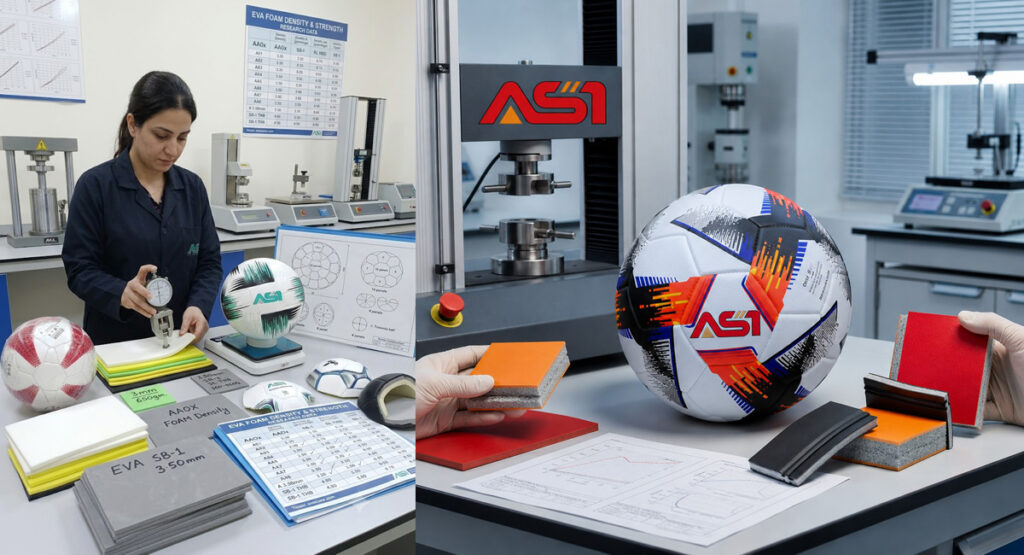
Most people think a soccer ball is a simple, round shape. Well, air retention. Kick it, it goes. But a match ball is a precision object. It has layers of material, with the upper material being the most important, and Eva Foam density, lamination fabrics for durability, pressurized patches or a winding bladder, and dozens of stitched or bonded panels. Every one of those parts has a density value, meaning how much mass is packed into a given volume.
If density varies across the ball’s surface, the ball is no longer a true, uniform sphere in terms of mass distribution. That imbalance changes how the ball spins, how air flows around it, and how it responds to impact. A ball with inconsistent density might curve unpredictably, wobble in flight, or bounce differently depending on which side hits the ground.
Elite competition cannot tolerate this. A goalkeeper diving to save a free kick needs to trust that the ball’s flight follows the laws of physics, not manufacturing flaws. A striker curling a shot into the top corner needs the ball to respond the same way every time. This predictability is only possible when material density stays consistent, panel to panel, ball to ball, batch to batch.
What “Material Density” Actually Means in Ball Manufacturing
Density is mass divided by volume. In a soccer ball, 04 main components carry density values that matter:
- Outer Panels: usually polyurethane (PU) synthetic leather
- Eva Foam: the most important, better density
- Bladder: the inner air-holding chamber, typically latex or butyl
- Seams: thermally bonded or stitched connections between panels
Each layer must hit a target density range. If the PU foam backing on the panels is too dense in one area and too light in another, the ball’s skin becomes uneven. If the bladder wall thickness varies, air pressure retention becomes unpredictable. If seam bonding is inconsistent, some seams absorb more water or flex differently than others.
Table 1: Match Soccer Ball Components and Their Density Roles
| Component | Typical Material | Role of Density Consistency |
| Outer panel | Polyurethane (PU) synthetic leather | Controls surface weight, water resistance, and spin grip |
| Panel backing/foam | PU or EVA foam layer | Affects touch, compression response, energy return |
| Bladder | Latex or butyl rubber | Governs pressure retention and rebound consistency |
| Seams | Thermally bonded or stitched thread | Prevents water absorption and shape distortion |
| Lining layers | Polyester/cotton blend | Maintains structural rigidity under repeated impact |
Polyurethane (PU) Synthetic Leather: The Skin That Must Behave the Same Everywhere
Most premium match soccer balls or footballs, use polyurethane synthetic leather for the outer panels. PU is chosen because it can be engineered to a very tight density range. Unlike natural leather, which varies from hide to hide, PU is manufactured in controlled sheets. This is the main reason ASI Soccers develops our own PU leather in high-end quality from Japan and Korea.
But PU is not automatically consistent. Manufacturers apply the material in layers, and each layer’s thickness and curing process affect the final density. Mostly the upper material is 1.2 mm to 1.4 mm thick, with Eva foam 4 mm thickness, with a patch bladder and a hybrid professional ball 1.4 mm upper material with 2mm+3mm foam, total 5mm backing foam with lamination in PV on the back and winding bladder. A panel that is 0.2mm thicker in one spot than another will weigh slightly more there. Multiply that across 20 or more panels, and small errors add up to a ball that is heavier on one side.
High-end production lines use laser thickness scanning and weight-check stations after each panel is cut. Panels outside the acceptable density window are rejected before they ever reach the stitching or bonding stage. This is expensive. It is also why premium match soccer balls, or footballs, cost significantly more than recreational balls, which often skip this level of quality control.
Why PU Density Affects Water Absorption
PU panels are designed to resist water absorption. But density inconsistency changes this. A slightly less dense patch of PU has more microscopic air pockets, which can soak up moisture during wet-weather matches. A ball that absorbs water unevenly becomes heavier on one side mid-match. That changes its flight and bounce behavior in real time is a serious problem in professional competition.
Thermally Bonded Seams vs. Traditional Stitching
Seams are another density-critical zone. Traditional stitched balls use thread to join panels, leaving small gaps where water and air can pass through. Thermally bonded seams use heat and pressure to fuse panel edges directly, creating a smoother, more watertight surface.
Thermal bonding also produces more consistent seam density because there is no thread bulk and no stitching-tension variation from one worker or machine to the next. This matters for two reasons:
- Aerodynamics: Raised or uneven seams disrupt airflow, creating drag on one side of the ball more than another.
- Structural uniformity: Bonded seams behave the same under compression, so the ball doesn’t develop soft spots near seam lines over time.
FIFA Quality Pro testing checks seam height variance as part of the shape and roundness retention criteria. Soccer balls or footballs with inconsistent seam bonding often fail these tolerance checks.
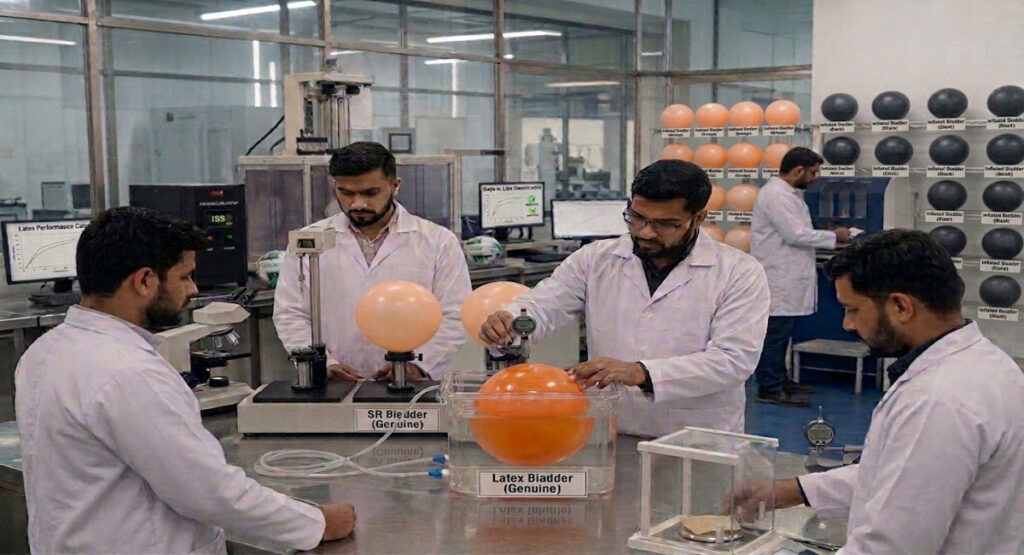
Bladder Materials and Their Density Characteristics
Not all soccer ball bladders have the same density or performance characteristics. The material used to manufacture the bladder directly influences air pressure retention, elasticity, rebound, weight distribution, and overall playing performance. Professional manufacturers select different bladder materials depending on the intended use of the soccer ball.
Latex Bladder
A Latex Bladder is manufactured from natural rubber and is widely regarded as the softest bladder available. Its lower material density provides exceptional elasticity and a more responsive feel, making it the preferred choice for many professional hand-stitched match balls.
Density Characteristics
- Lower material density
- Extremely high elasticity
- Softer touch and better ball control
- Excellent rebound performance
- Faster natural air diffusion requires more frequent inflation
Best For: Professional hand-stitched match balls where touch and responsiveness are the highest priorities.
Butyl Bladder
A Butyl Bladder is produced from synthetic butyl rubber, a material known for its dense molecular structure and excellent resistance to air diffusion. Its higher density significantly improves air pressure retention while increasing durability.
Many premium soccer ball manufacturers use high-grade Taiwan Butyl Bladders, recognized for their consistent rubber compound, precision molding, and reliable manufacturing quality.
Density Characteristics
- Medium to high material density
- Excellent pressure retention
- Stable internal air pressure
- Good durability
- Slightly firmer playing feel than latex
Best For: Training balls, academy balls, and match balls requiring long-lasting pressure retention.
SR (Synthetic Rubber) Bladder
An SR Bladder (Synthetic Rubber Bladder) is engineered to combine the flexibility of latex with the durability of butyl. The rubber compound is formulated to achieve balanced density, providing both reliable air retention and comfortable playing characteristics.
Density Characteristics
- Medium-high density
- Balanced elasticity
- Good air retention
- Stable rebound
- Excellent durability
Best For: Premium training balls, recreational match balls, and high-quality machine-stitched or hybrid soccer balls.
HA (High Air Retention) Bladder
The HA (High Air Retention) Bladder is an advanced synthetic bladder specifically designed to maximize pressure retention while maintaining excellent elasticity. Through optimized rubber compounds and precision manufacturing, HA bladders achieve highly uniform density, making them ideal for premium thermal-bonded soccer balls.
Density Characteristics
- High and highly uniform density
- Outstanding pressure retention
- Excellent shape stability
- Consistent rebound performance
- Superior long-term durability
Best For: Professional thermal bonded match balls and elite competition soccer balls.
Why Density Differs Between Bladder Materials
Each bladder material has a different molecular structure, resulting in different density characteristics.
| Bladder Type | Relative Density | Air Retention | Elasticity | Typical Use |
|---|---|---|---|---|
| Latex | Low | Moderate | Excellent | Professional hand-stitched match balls |
| Butyl | Medium-High | Excellent | Moderate | Training and match balls |
| SR (Synthetic Rubber) | Medium-High | Very Good | Very Good | Premium training and hybrid balls |
| HA (High Air Retention) | High & Uniform | Excellent | Excellent | Professional thermal-bonded match balls |
Why Bladder Density Is So Important
The density of the bladder is one of the most important engineering factors in a soccer ball. It determines how efficiently the bladder stores compressed air, how consistently the ball rebounds, and how well it maintains its shape during play.
A bladder with uniform density provides:
- Longer air pressure retention
- Better roundness
- Consistent bounce
- Stable flight trajectory
- Balanced weight distribution
- Improved durability
- Reliable performance throughout the life of the ball
For this reason, professional soccer ball manufacturers focus not only on selecting the right bladder material but also on controlling density consistency, rubber formulation, wall thickness, and vulcanization quality during manufacturing. Uniform density, not simply higher density, is the key to producing a high-performance soccer ball.
How Density Consistency Affects Flight and Trajectory Stability
This is the part players actually feel. A ball’s flight through the air depends on:
- Mass distribution: how weight is spread across the sphere
- Surface texture and seam pattern: how air flows around the ball
- Spin behavior: how the ball rotates after being struck
When density is uneven, the ball’s center of mass shifts slightly away from its geometric center. Even a shift of a few millimeters can cause a phenomenon similar to what engineers call “wobble” in rotating objects. At high speeds, like a 70 mph free kick, this wobble becomes visible as an unpredictable curve or dip, sometimes called the “knuckleball effect” when unintentional.
Professional players rely on predictable aerodynamics to execute curved shots, long passes, and driven crosses accurately. A ball with consistent density lets the same technique produce the same result every time. A ball with poor density consistency introduces random variation that even elite skill cannot fully compensate for.
Real-World Example
Wind tunnel and robotic kicking-leg tests conducted by sports engineering labs have shown that balls with uneven panel density can deviate from a straight, spin-stabilized flight path by several centimeters over a 25-meter free kick, compared to balls built to tight density tolerances. In a game where inches decide goals, that difference is significant.
FIFA Quality Pro Standards: The Density-Related Checkpoints
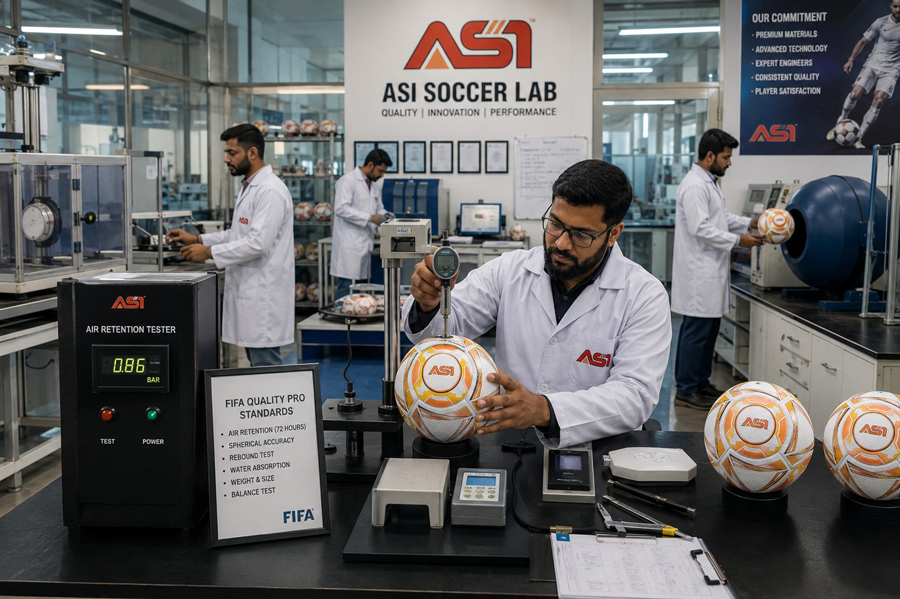
FIFA Quality Pro is the highest certification level for match balls. It requires labs to test balls across several categories that directly or indirectly measure density consistency.
- Weight: Balls must weigh between 420 and 445 grams.
- Circumference: Must measure 68.5–69.5 cm, checked at multiple points for roundness.
- Sphericity (roundness deviation): Maximum deviation of 1.5% across measured diameters.
- Water absorption: Less than 10% weight increase after immersion testing.
- Pressure loss: Less than 20% pressure loss over 72 hours.
- Rebound consistency: Bounce height must stay within a tight range across multiple drop tests from a fixed height.
Every one of these tests is, at its core, a density consistency test. A ball cannot pass the sphericity and rebound tests if its internal materials are unevenly distributed.
Comparing Manufacturing Approaches: Premium vs. Standard Match Soccer Balls
Not every ball on the market undergoes the same level of density control. Here is a general comparison of manufacturing rigor.
Table 3: Density Control Practices by Ball Tier
| Practice | Premium/FIFA Quality Pro Balls | Standard/Recreational Balls |
| Panel weight scanning | Every panel was individually checked | Batch-level sampling only |
| Seam bonding method | Thermally bonded | Often stitched |
| Bladder material | High-grade latex or butyl, tightly toleranced | Standard butyl, wider tolerance |
| Water absorption testing | Required, under 10% threshold | Rarely tested |
| Roundness/sphericity checks | Machine-tested at multiple points | Visual or basic checks |
| Price impact | Higher production cost | Lower production cost |
This is not about one approach being “wrong.” Recreational balls serve their purpose for casual play. But when performance precision matters, professional matches, academy training, competitive tournaments, and density-controlled manufacturing are non-negotiable.
The Manufacturing Process: How Consistency Is Actually Achieved
Achieving consistent density is not one step. It is a chain of quality checkpoints across the entire production process.
- Raw material testing: PU sheets and rubber compounds are tested for density before cutting begins.
- Panel cutting with laser precision: Automated cutters reduce human error in panel size and thickness.
- Weight verification per panel: Panels outside tolerance are rejected immediately.
- Controlled lamination: Foam backing layers are applied under set pressure and temperature to avoid uneven bonding.
- Thermal bonding of seams: Heat-pressed seams reduce variability compared to hand stitching.
- Bladder inflation testing: Bladders are pressure-tested before final assembly.
- Final ball testing: Completed balls go through weight, roundness, bounce, and water absorption tests.
A single failed checkpoint can send a ball back for rework or rejection. This is why top-tier manufacturing facilities report rejection rates that would surprise casual consumers, sometimes 10% or more of panels never make it into a finished match ball.
Common Density Defects and Their On-Field Consequences
| Defect Type | Cause | On-Field Effect |
| Uneven panel weight | Inconsistent PU layer thickness | Unpredictable curve on shots and crosses |
| Bladder thin spots | Poor vulcanization or material flaw | Uneven pressure loss, soft zones |
| Seam bulging | Weak thermal bond or stitching tension | Air turbulence, altered flight path |
| Water-logged panels | High-porosity PU in defective zones | The ball becomes heavier mid-match |
| Off-center mass | A combination of the above | Wobble, knuckleball effect, bounce inconsistency |
Why This Matters Beyond the Pitch
Density consistency is not just a performance issue. It is also a safety and fairness issue. In professional competition, if one team’s ball behaves differently than expected due to manufacturing flaws, that is a competitive disadvantage. Referees and match officials rely on certified balls precisely because certification removes this variable from the game.
For coaches and academies training the next generation of players, using density-consistent balls also matters for skill development. A young player learning to strike a free kick needs consistent feedback on the ball’s flight. If the ball behaves randomly due to poor manufacturing, the player cannot properly calibrate their technique.
Frequently Asked Questions
Q: Does material density affect how far a ball travels when kicked?
A: Yes, indirectly. Density affects overall weight and mass distribution, which influences how energy transfers from the foot to the ball. Even small density differences can slightly change distance and accuracy on longer strikes.
Q: Can I tell if a ball has inconsistent density just by looking at it?
A: Usually not. Density issues are often invisible to the eye. They show up in lab testing through weight, roundness, and bounce consistency checks.
Q: Why do FIFA Quality Pro balls cost more than regular balls?
A: The extra cost comes from tighter manufacturing tolerances, more testing steps, premium materials like thermally bonded seams, and higher rejection rates during quality control.
Q: Does temperature affect ball density during a match?
A: Temperature affects air pressure inside the bladder more than the density of solid materials, but extreme cold or heat can still influence how consistent materials perform under stress.
Q: Are thermally bonded seams always better than stitched seams?
A: For water resistance and density consistency, yes. Thermally bonded seams generally outperform stitched seams in professional-grade balls, though stitched balls remain common and reliable for training and recreational use.
Bringing the Science to Training
Understanding material density explains why elite clubs choose certified match balls for both competition and training. But equipment is only half the equation. Top academies now pair precision-engineered balls with data-driven tracking to measure exactly how those balls perform under real match conditions.
Final Takeaway
Consistent material density is not a minor manufacturing detail. It is the foundation of predictable ball flight, fair competition, and player trust. From PU panel thickness to bladder wall uniformity to thermally bonded seams, every layer of a match ball must meet tight density tolerances to perform at the professional level.
ASI Soccers understands this science deeply, which is why every match ball in our catalog is selected and tested against these exact standards. Whether you are outfitting a professional academy, a competitive club, or a serious training program, ASI Soccers offers density-verified, FIFA Quality Pro-aligned match balls built for consistent, reliable performance.
Ready to feel the difference precision manufacturing makes? Browse the full match ball lineup at ASI Soccer’s product category pages and find the ball engineered for your level of play.