

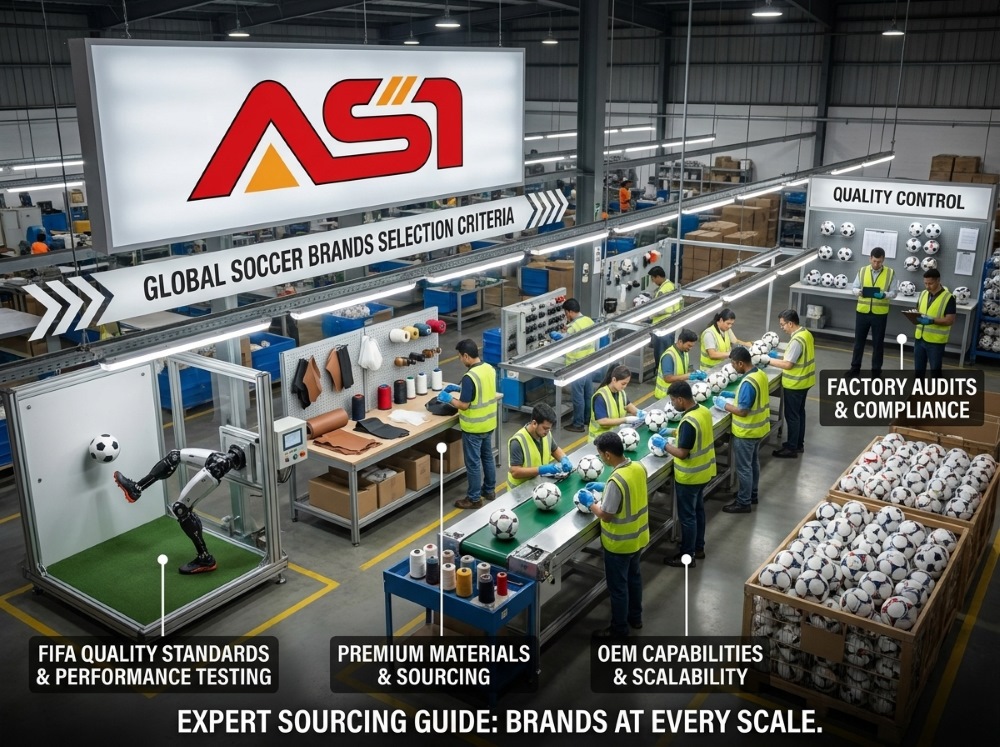
How Global Soccer Brands Choose Their Manufacturing Partners — And What Separates the Best Suppliers from the Rest
Soccer global brands, from startup labels to established giants, choose their manufacturing partners based on four non-negotiable pillars: regulatory compliance (FIFA quality standards), material integrity, production scalability, and OEM/private-label flexibility. Getting any one of these wrong results in rejected inventory, lost retail contracts, or reputational damage at scale. The sourcing decision isn’t just operational — it’s a strategic brand move.
Why the Right Manufacturing Partner Defines a Soccer Brand
The global soccer ball market is projected to surpass $1.1 billion USD by 2028, driven by rising youth participation, expanding professional leagues, and growing demand across emerging markets in Asia, Africa, and Latin America. Behind every ball that reaches a professional pitch, a school field, or a retail shelf is a manufacturing relationship built on precision, compliance, and trust.
For brands entering the market — or scaling within it — the choice of manufacturing partner is arguably more important than logo design or marketing spend. A manufacturer that cannot meet FIFA’s material and performance standards will disqualify a brand from professional league supply chains immediately. One who can’t scale production blocks revenue growth. One without private-label or OEM capabilities kills a brand’s competitive flexibility.
This article unpacks exactly how global soccer brands evaluate and select their manufacturing partners, what regulatory standards govern the process, and what separates a long-term supplier from a costly short-term mistake.
Part 1: The Regulatory Foundation — What FIFA Actually Requires
Before any brand discussion, the ball must meet the game’s laws. The Laws of the Game, governed by the International Football Association Board (IFAB) and administered through FIFA, set the baseline for what constitutes a legal match ball.
FIFA Quality Standards: Two Certification Tiers
FIFA operates a two-tier ball certification program:
| Certification Level | Use Case | Key Requirements |
|---|---|---|
| FIFA Quality Pro | Professional matches, top-tier leagues | Highest performance tolerances; used in World Cup, UEFA Champions League, etc. |
| FIFA Quality | Amateur and recreational leagues, youth competitions | Slightly relaxed tolerances; suitable for most organized play |
Both certifications require balls to pass a battery of standardized tests conducted by FIFA-accredited laboratories (such as SGS, Bureau Veritas, or Hohenstein Institute).
The 6 Core FIFA Performance Tests
Manufacturers must demonstrate compliance across the following:
- Circumference — Between 68 cm and 70 cm (27–28 inches) for a size 5 match ball
- Sphericity — Maximum deviation across multiple diameter measurements must fall within tolerance
- Rebound — Ball must rebound between 1.2 m and 1.4 m when dropped from 2 m onto a steel plate at 20°C
- Water Absorption — Weight increase after water immersion must not exceed 10% (FIFA Quality Pro: 15% after 30 mins)
- Pressure Loss — Must retain pressure within defined limits over 72 hours
- Shape & Size Retention — Must maintain structural integrity after repeated impacts (between 2,000–3,500 shots depending on tier)
Manufacturer implication: A factory without certified testing equipment and documented quality control processes cannot reliably produce balls that pass these tests at scale. Brands must verify laboratory access, not just verbal assurances.
Size Chart by Age Group (FIFA & National Federation Guidelines)
| Ball Size | Age Group | Circumference | Weight |
|---|---|---|---|
| Size 1 | Skills/Freestyle (any age) | 43–46 cm | Varies |
| Size 2 | Ages 3–5 (Toddlers) | 54–56 cm | Varies |
| Size 3 | Ages 5–8 | 58–60 cm | 300–320 g |
| Size 4 | Ages 8–12 | 63–66 cm | 350–390 g |
| Size 5 | Ages 12+ / Professional | 68–70 cm | 410–450 g |
Source: FIFA Laws of the Game, IFAB 2024/25 edition
Part 2: Material Matters — What Goes Into a Match-Grade Soccer Ball
Brands sourcing soccer balls must understand the construction hierarchy because material decisions directly affect performance, price point, and compliance.
Layer-by-Layer Construction
1. Outer Cover (Casing)
- PU (Polyurethane): Premium choice for match and training balls; soft touch, excellent durability, used in FIFA-certified balls
- PVC (Polyvinyl Chloride): Lower cost; used in recreational and promotional balls; less responsive
- TPU (Thermoplastic Polyurethane): Emerging material; high abrasion resistance; popular in futsal and street soccer balls
2. Lining (Under-layer)
- Typically, 2–4 layers of polyester and/or cotton are bonded to the outer cover
- Higher-quality balls use more lining layers for better shape retention and energy transfer
3. Bladder
- Butyl Bladder: Best air retention; industry standard for recreational and training balls
- Latex Bladder: Superior touch and rebound response; used in premium match balls; requires more frequent inflation
4. Panel Construction
- Hand-stitched: Most durable and precise; standard for match-grade and professional balls; typically 32 panels (traditional), or fewer in modern thermally bonded designs
- Machine-stitched: Cost-efficient; consistent for mid-range training balls
- Thermally Bonded (Seamless): No stitching; fully fused panels using heat; used in top-tier match balls (e.g., Adidas Brazuca, Nike Ordem series)
The Stitching Standard
For hand-stitched balls, the quality benchmark is 5-ply twisted polyester thread, with stitch counts typically between 5–6 stitches per inch. Fewer stitches per inch = higher risk of seam separation under match conditions.
Part 3: How Global Brands Actually Evaluate Manufacturers
Here is where sourcing decisions diverge sharply. Large global brands apply a structured evaluation framework before signing any manufacturing agreement.
The 7-Factor Evaluation Framework
1. Certification & Compliance Track Record
Brands require documented proof of FIFA Quality or FIFA Quality Pro certification for relevant product lines. Beyond FIFA, they look for:
- ISO 9001 (Quality Management Systems)
- ISO 14001 (Environmental Management)
- OEKO-TEX® Standard 100 (harmful substance testing on materials)
- BSCI or SA8000 (social compliance audits)
2. OEM & Private Label Capability
One of the most critical — and underrated — factors. Brands need manufacturers who can:
- Produce under the brand’s own logo and specifications (OEM)
- Develop white-label products for new market entrants (private label)
- Support custom colorways, panel designs, and size variants
- Handle custom packaging, including retail-ready hang tags and display boxes
A manufacturer without a strong OEM infrastructure forces brands into generic product ranges, eliminating competitive differentiation.
3. Minimum Order Quantities (MOQs)
MOQs determine which brands a manufacturer can realistically serve:
| Brand Stage | Typical MOQ Need | Ideal Manufacturer Response |
|---|---|---|
| Startup / New Brand | 200–500 units per SKU | Flexible, low-MOQ with sample options |
| Mid-size Regional Brand | 1,000–5,000 units | Standard production runs |
| Global Distributor | 10,000–50,000+ units | Dedicated production line, volume pricing |
Manufacturers who only accommodate large volume runs effectively block smaller brands — limiting their own market reach.
4. Factory Audit Results
Major brands conduct or commission third-party factory audits before finalizing supplier agreements. Key audit areas:
- Worker conditions and wage compliance
- Fire safety and infrastructure standards
- Child labor policies (critical: Pakistan’s Sialkot region has FIFA’s Child Labour Monitoring Programme specifically for soccer ball manufacturing)
- Production capacity verification
5. Sample Development Process & Turnaround
Elite manufacturing partners provide pre-production samples within 10–21 days of approved artwork. Brands evaluate:
- Color accuracy against Pantone specifications
- Panel alignment and seam quality
- Weight and circumference conformance
- Bladder valve placement and inflation ease
6. Lead Times & Production Capacity
Standard production lead times for custom soccer balls range from 45 to 90 days after sample approval, depending on order volume and complexity. Brands preparing for seasonal launches (pre-World Cup, start of domestic season) need manufacturers who can commit to and meet hard deadlines.
7. Communication, Documentation & Transparency
Professional sourcing teams flag any manufacturer who cannot provide:
- Clear production schedules with milestone tracking
- Material safety data sheets (MSDS)
- Country of origin documentation for customs compliance
- Quality inspection reports per production batch
Part 4: Where Soccer Balls Are Made — The Geography of Manufacturing
The overwhelming majority of the world’s soccer balls are manufactured in Sialkot, Pakistan — a city that produces an estimated 40–70% of all soccer balls worldwide, including balls used in FIFA World Cups since 1982.
Why Sialkot Dominates
- Over 500 soccer ball manufacturers are operating in and around the city
- Multi-generational craftsman expertise in hand-stitching
- Vertically integrated supply chains (material sourcing, cutting, stitching, quality control)
- FIFA’s long-term partnership through the Sialkot Chamber of Commerce and independent monitoring bodies
Other notable manufacturing hubs include:
- China — High-volume machine-stitched and thermally bonded balls; strong in promotional and mid-tier categories
- Thailand & Vietnam — Emerging production capacity for sporting goods broadly
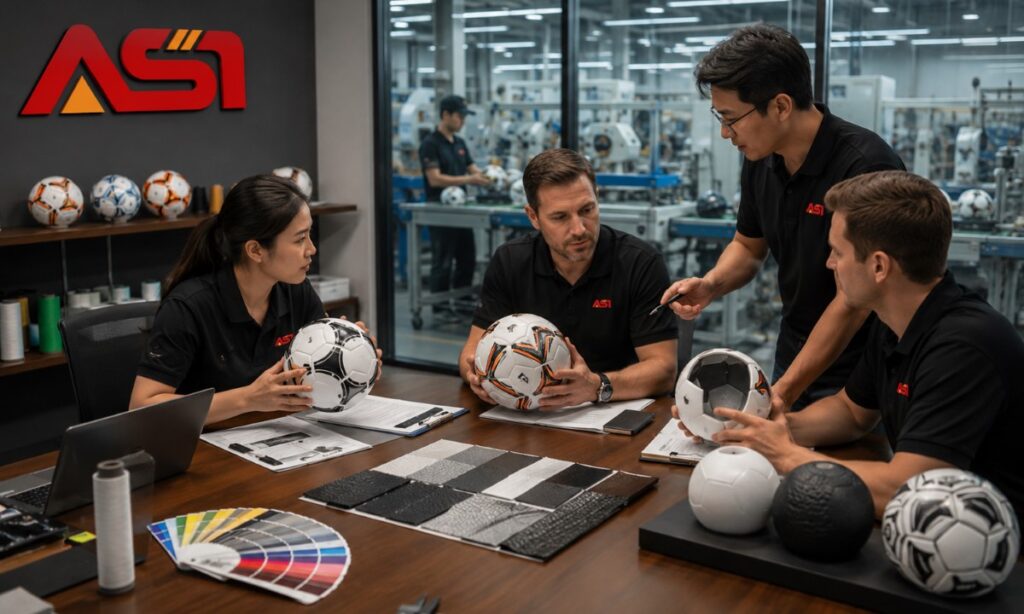
Part 5: OEM vs. Private Label vs. Custom Development — Understanding the Three Models
Brands entering manufacturing conversations often conflate these three models. They are distinct:
| Model | Brand Owns Design? | Manufacturer’s Role | Best For |
|---|---|---|---|
| OEM (Original Equipment Manufacturer) | Yes | Produced to the brand’s exact specification | Established brands scaling proven products |
| Private Label | No (uses manufacturer’s existing designs) | Applies brand’s logo to existing product | New brands launching quickly |
| Custom Product Development | Collaborative | Co-develops new products with the brand | Brands seeking differentiated, exclusive lines |
A manufacturer capable of supporting all three models gives brands maximum flexibility across their product lifecycle — from rapid market entry (private label) to long-term brand equity building (custom development).
Part 6: Red Flags Brands Watch For in Supplier Selection
Experienced sourcing teams recognize warning signs early:
- ❌ No verifiable FIFA certification — Any manufacturer claiming compliance without documentation is a liability
- ❌ Inability to provide third-party audit reports — Especially for brands selling into EU or North American retail markets
- ❌ No sample policy or high sample fees without credit on bulk order — Signals low confidence in product quality
- ❌ Vague lead time commitments — “Around 60 days” is not a production commitment
- ❌ No reference list of existing brand clients — Legitimate manufacturers have verifiable partnerships
- ❌ Resistance to pre-shipment inspection — Professional suppliers welcome independent QC inspection
Part 7: Real-World Example — What a Brand Partnership Actually Looks Like
Consider a hypothetical mid-size European sports brand launching a new soccer line targeting youth academies across the UK and Germany.
Their sourcing checklist:
Step 1 — Define Product Range Size 3, Size 4, and Size 5 balls across three categories: match, training, and skills. Target retail price points: £12–£45.
Step 2 — Identify Certification Requirements Youth academies affiliated with national federations require, at a minimum, FIFA Quality certification. Balls for recreational/school use require no certification but must meet local safety standards (EN 71 in EU markets).
Step 3 — Shortlist Manufacturers Criteria applied: Sialkot-based preferred, minimum 5 years of international brand experience, documented OEM capability, flexible MOQs down to 500 units per SKU.
Step 4 — Request Samples: Three manufacturers shortlisted; samples requested against brand-specified panel design (10-panel, machine-stitched for training; 32-panel hand-stitched for match).
Step 5 — Audit & Final Selection: Preferred manufacturer visited or third-party audited. Production timeline confirmed. Payment terms negotiated (typically 30% deposit, 70% before shipment).
Step 6 — Production & QC Pre-shipment inspection commissioned through SGS or similar; 5–10% of production batch tested against FIFA performance parameters.
A manufacturer like ASI Soccer — with over three decades of production experience and partnerships spanning more than 44 international brands — would check every box in this framework, making the qualification process faster and lower-risk for both new entrants and established companies.
Part 8: Sustainability — The Emerging Sourcing Criterion
Increasingly, major brands are adding environmental and ethical criteria to supplier evaluation:
- Recycled PU/PVC materials — Some manufacturers now offer outer covers made with post-consumer recycled content
- Water-based inks — For panel printing, replacing solvent-based alternatives
- Fair wage documentation — Especially critical following scrutiny of Sialkot supply chains
- Carbon footprint reporting — Required by major EU retail partners under emerging ESG disclosure frameworks
Brands sourcing through manufacturers who proactively address sustainability are better positioned for EU retail partnerships, where ESG criteria are becoming purchasing requirements, not just preferences.
FAQ: Soccer Ball Manufacturing & Brand Sourcing
Q: Do all soccer balls need FIFA certification?
No. FIFA certification is required for balls used in officially sanctioned FIFA competitions and most professional leagues. Recreational, promotional, and school-use balls are not required to be certified, though they must meet local toy/sports equipment safety standards.
Q: How many panels does a regulation soccer ball have?
The traditional design features 32 panels (20 hexagons and 12 pentagons). However, FIFA does not mandate a panel count — modern match balls from Adidas, Nike, and Puma use fewer, larger panels (8–14) with thermal bonding. What is mandated is the resulting shape, size, weight, and performance.
Q: What is the difference between hand-stitched and machine-stitched soccer balls?
Hand-stitched balls offer tighter seams, greater durability, and better water resistance — making them standard for match and training balls used in organized play. Machine-stitched balls are produced faster and at lower cost, making them suitable for recreational use.
Q: What MOQ should a new soccer brand expect?
Experienced manufacturers working with new brands typically start at 200–500 units per SKU for private label, rising to 1,000+ units for fully custom OEM products. Minimum orders vary significantly by manufacturer.
Q: How long does it take to produce a custom soccer ball from scratch?
From approved design to shipment: typically 45–90 days, including 10–21 days for pre-production samples, client approval time, and production lead time. Rush production is possible at a premium cost.
Q: Can small or new brands access professional-grade manufacturing?
Yes — manufacturers experienced with international brand development offer tiered services that accommodate both new entrants and established companies. The key is finding a partner with genuine OEM and private-label flexibility, not just high-volume production capability.
Q: What materials make a soccer ball last longer?
Butyl bladders (for air retention), multi-layer polyester lining (for shape stability), and PU outer covers (for durability and touch) consistently outperform cheaper alternatives. For match conditions, hand-stitched construction with 5-ply thread provides the best longevity.
Q: How do brands verify a manufacturer’s claims about FIFA compliance?
Request the actual FIFA certification certificate with the certificate number and issuing lab. Brands can cross-reference valid certifications directly through FIFA’s official licensee database.
The Manufacturing Partnership Is the Brand
For any soccer brand — startup or scale-up — the manufacturing partner isn’t just a vendor. They are the physical embodiment of the brand promise. A ball that fails to hold pressure, deforms under repeated heading, or fails a water absorption test doesn’t just get returned — it damages the brand’s credibility with coaches, clubs, and retailers who may not give a second chance.
The best sourcing decisions combine regulatory knowledge, material understanding, and a rigorous supplier evaluation process. Brands that invest time upfront in identifying manufacturing partners with verified compliance histories, flexible OEM capabilities, transparent operations, and scalable production consistently outperform those who optimize purely on unit cost.
With decades of production history, ASI Soccer represents exactly the kind of manufacturing foundation that allows both emerging and established brands to enter markets confidently, differentiate through custom product development, and scale without sacrificing quality or compliance.
The game is won before the ball is kicked — at the scoring table.
All FIFA regulations referenced are based on FIFA’s Laws of the Game (IFAB 2024/25) and FIFA Quality Programme for Footballs documentation.