

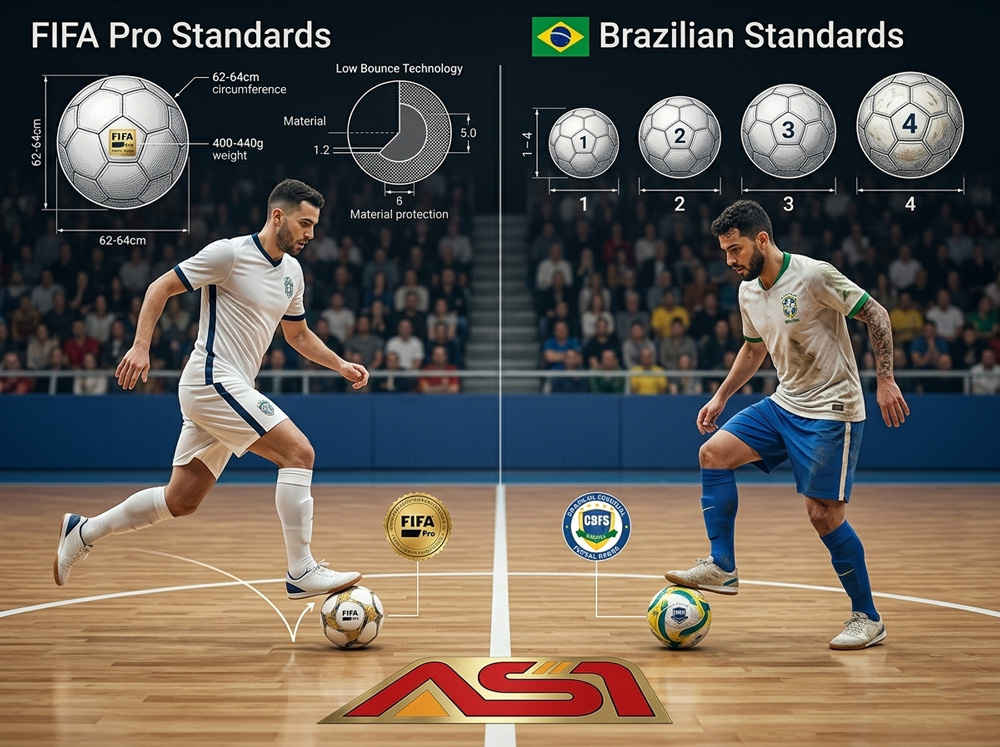
The Science of the Low Bounce: Understanding FIFA Pro and Brazilian Futsal Balls Standards
In the cramped, high-speed corridors of a futsal court, the ball is not merely a piece of equipment—it is a calibrated tool of precision. Unlike its outdoor cousin, which is designed to soar and skip across grass, a futsal ball is engineered for the “floor game.” To understand why the world’s greatest technical players—from the streets of São Paulo to the professional arenas of Europe—possess such supernatural control, one must look at the rigorous standards set by FIFA and the Brazilian Confederation of Futsal (CBFS).
Futsal is a game of millimeters, and the regulatory bodies ensure that every ball, from a Size 1 training sphere to a FIFA Quality Pro match ball, behaves with absolute predictability.
1. The Anatomy of Low Bounce Technology
The most defining characteristic of a futsal ball is its low bounce. While a standard football is filled with pressurized air that causes it to leap off the turf, a futsal ball contains a specialized core—often stuffed with synthetic fibers or foam to dampen its elasticity. This “dead” bounce is what allows for the rapid-fire sole traps and intricate toe pokes that define the sport. Without this specific engineering, the ball would be impossible to control on hard indoor surfaces.
The Internal Dampening System
Unlike traditional soccer balls that rely purely on a latex or butyl bladder filled with high-pressure air, the futsal ball utilizes an internal dampening system.
- The Bladder Wrap: High-quality bladders are often wrapped in polyester or cotton layers to maintain a perfect spherical shape under the stress of high-impact kicks.
- Foam or Fiber Filling: To achieve the “low rebound” required for hard-court play, manufacturers insert specialized foam or synthetic wool fibers inside the bladder. This material absorbs kinetic energy upon impact, preventing the ball from rebounding too high.
The 2-Meter Rebound Test
To meet the rigorous FIFA Quality Pro and Brazilian (CBFS) standards, the ball must pass a specific gravity-drop test.
- The Procedure: The ball is dropped from a height of 2 meters onto a steel or hard-court surface.
- The Standard: According to official regulations, the first rebound must be between 50 cm and 65 cm.
- Aerodynamic Consistency: This specific rebound range ensures that the ball stays close to the floor, facilitating the “sole-of-the-foot” ball control technique that is fundamental to futsal tactics.
Surface Friction and Outer Casing
The outer material also plays a vital role in technology and performance.
- Microfiber Composites: Modern balls use advanced synthetic composites that provide a “tacky” grip on polished wood or PVC floors, ensuring the ball doesn’t slide uncontrollably during a pass.
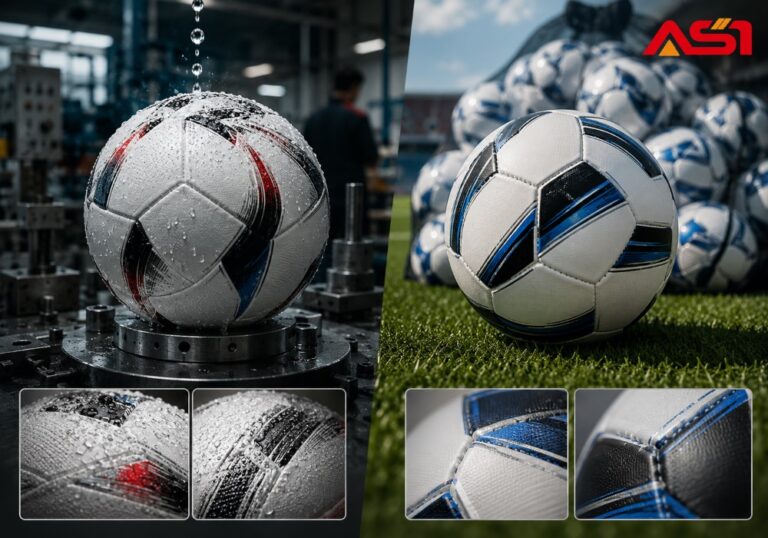
- Panel Construction: Most professional futsal balls utilize 32 panels, which are often hand-stitched or thermally bonded. Thermal bonding reduces water absorption and ensures the seams do not interfere with the ball’s rolling trajectory on smooth surfaces.
2. Futsal Ball Sizes & Specifications (Size 1–4)
Not all futsal balls are created equal. The progression from a child’s first touch to a professional volley is marked by a shift in circumference and mass to ensure safety and skill development.
Size 4: The Official Match Ball (Adults 13+)
This is the gold standard used in professional leagues and international tournaments. It is the heaviest of the sizes relative to its circumference, ensuring it stays glued to the court during high-speed play.
- Circumference: 62–64 cm.
- Weight: 420–440 g.
- Rebound: 50–65 cm.
- Usage: Professional matches, high school, and adult amateur leagues.
Size 3: The Youth Development Ball (Ages 8–12)
As young players transition into competitive play, Size 3 provides a bridge. It maintains the low-bounce profile but reduces the physical strain on developing joints by utilizing a lighter mass.
- Circumference: 59–60 cm.
- Weight: 360–380 g.
- Usage: Junior matches and elite youth academy training.
Size 2: The Junior Skill Ball (Under 8 Years)
At this age, the focus is entirely on the “soft touch.” Size 2 balls are lighter to encourage kids to try technical moves without fearing the “heavy” impact of an adult ball.
- Circumference: 50–52 cm.
- Weight: 320–330 g.
- Rebound: Controlled low-bounce for beginner skill development.
Size 1: The Skill & Control Specialist
Often referred to as a “futsal mini,” this ball is used across all age groups—including professionals—for specialized technical drills.
- Circumference: ~48–50 cm (varies by brand).
- Weight: ~220–240 g.
- Usage: Reflex training, control drills, and juggling practice to enhance “close-quarters” ball handling.
Size and Weight Comparison Table
| Ball Size | Targeted Age Group | Circumference | Weight Range |
| Size 4 | 13+ (Professional) | 62–64 cm | 420–440 g |
| Size 3 | 8–12 Years | 59–60 cm | 360–380 g |
| Size 2 | Under 8 Years | 50–52 cm | 320–330 g |
| Size 1 | All Ages (Training) | 48–50 cm | 220–240 g |
3. Regulatory Comparison: FIFA vs. Brazilian Standards
While FIFA provides the global blueprint for professional equipment, the Brazilian Confederation of Futsal (CBFS) often leads the way in nuanced development. Because futsal is deeply woven into the cultural fabric of Brazil, the CBFS emphasizes a ball that is slightly “tighter” and more consistent in its feel to facilitate the trademark Ginga style—a playstyle characterized by rhythm, flair, and exceptional ball control.
Technical Variance in Professional Specs
The following table highlights the subtle yet critical differences between the global FIFA Quality Pro requirements and the local Brazilian (CBFS) standards. These variances dictate how the ball reacts to high-intensity floor play and player interaction.
| Feature | FIFA Quality Pro | Brazilian (CBFS) Standard | Why it Matters |
| Weight Range | 400g – 440g | 420g – 440g | A “stricter floor” in Brazil ensures the ball feels consistently dense, preventing it from feeling “light” during long passes. |
| Internal Pressure | 0.6 – 0.9 bar | 0.6 – 0.8 bar | Lower max pressure in Brazil allows for a slightly softer touch, facilitating easier sole-traps. |
| Water Absorption | < 10% | < 8% | Optimized for high indoor humidity, ensuring the ball does not gain weight or lose grip during intense matches. |
| Sphericity | Max 1.5% deviation | Max 1.2% deviation | Higher precision in sphericity ensures a perfectly true roll on polished wood or smooth synthetic surfaces. |
The Brazilian Influence on Global Play
Brazilian standards prioritize a ball that rewards technical proficiency. By mandating a maximum sphericity deviation of only 1.2%, the CBFS ensures that the ball moves with absolute mathematical predictability. This allows players to execute no-look passes and complex dribbles with the confidence that the equipment will not “vibrate” or deviate from its intended path.
Furthermore, the stricter weight floor (420g) is a tactical choice. It forces players to use more precise leg power, which translates to better muscle memory and skill when transitioning to larger pitch formats or international FIFA competitions.
4. ASI Soccer: International Quality for Every Court
At ASI Soccer, we recognize that the difference between a great player and a legendary one often comes down to the quality of their training tools. We don’t just sell balls; we provide engineered instruments that adhere to the strict international standards expected by professionals. Our operational philosophy is built on the understanding that every stitch and panel contributes to the player’s ultimate performance on the court.
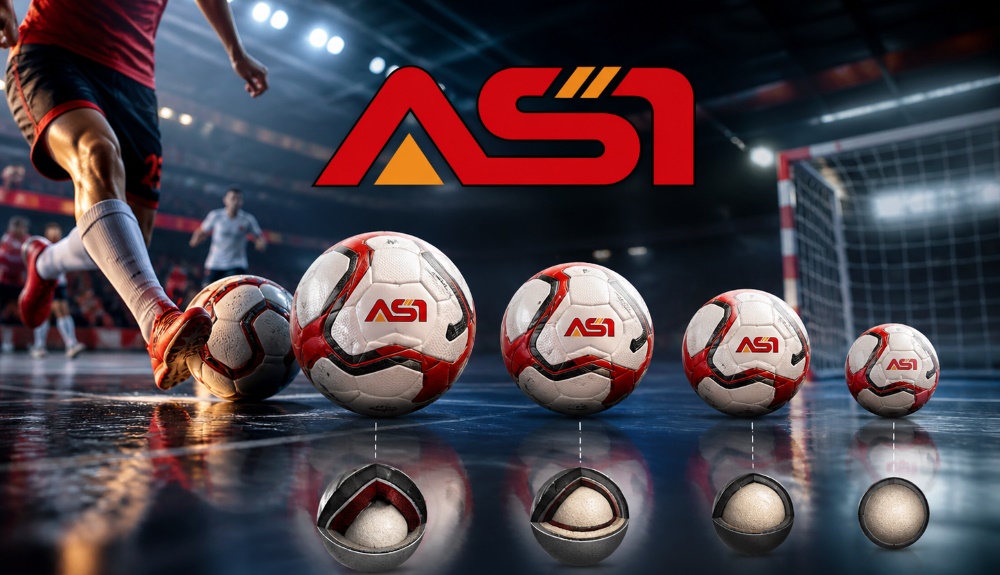
Precision Engineering and Global Expertise
Whether you are a coach in an elite academy or a club manager looking for match-day gear, ASI Soccer offers sports balls and sportswear that prioritize durability and precision.
- Strategic Manufacturing: We leverage manufacturing expertise from global sports hubs, such as Sialkot, known for high-quality sporting goods and surgical-grade precision.
- Consistent Performance: ASI Soccer ensures that every futsal ball—from Size 1 to Size 4—delivers that perfect, predictable low bounce required for professional-level floor play.
- Accessibility: We believe that professional-grade equipment should be accessible, which is why we provide international standard gear at a reasonable price.
A Commitment to Material Science
Choosing ASI Soccer means investing in years of material science research. Our products are designed to ensure your game is never limited by your gear, whether you are utilizing our advanced synthetic leather volleyballs or our low-rebound futsal balls. We bridge the gap between high-end professional requirements and the needs of everyday athletes, ensuring that every product—from soccer balls to sportswear—holds its shape and performance through rigorous use.
5. FAQ: Expert Insights into Futsal Gear
Understanding the technical nuances of your equipment is the first step toward mastering the high-speed dynamics of the court. Here are the most common questions regarding FIFA Pro and Brazilian (CBFS) futsal standards.
Q: Why is a futsal ball smaller than a soccer ball but heavier?
A: A Size 4 futsal ball has a smaller circumference of 62–64 cm compared to a Size 5 soccer ball, which measures 68–70 cm. However, the futsal ball is significantly denser, weighing between 420–440 g. This “dense” construction is a mechanical necessity; it keeps the ball low on hard courts and prevents it from bouncing uncontrollably out of play in tight, indoor spaces.
Q: Can I use a futsal ball on grass?
A: You can, but the performance will be poor. The specialized low-bounce core—designed for hard surfaces—will make the ball feel “dead” on grass. Futsal balls are engineered strictly for hard-court surfaces such as polished wood, PVC, or smooth concrete to ensure proper rolling and rebound characteristics.
Q: What does the “FIFA Quality Pro” stamp actually mean?
A: It is a certification that the ball has passed seven rigorous laboratory tests to ensure elite-level performance. These tests include:
1- Weight Consistency: Ensuring the ball stays within the strict 400–440 g range.
2- Circumference & Sphericity: Maintaining a near-perfect circle to ensure a true roll.
3- The Rebound Test: Dropping the ball from 2 meters to verify a bounce of 50–65 cm.
4- Water Absorption: Testing to ensure the ball gains less than 10% weight in damp conditions.
5- Pressure Retention: Confirming the bladder holds air consistently over time.
6- Durability: Shape and size retention after being fired against a steel plate 2,000 times at high speed.
Q: Does the color of the ball matter for professional standards?
A: Yes. Much like volleyball standards, the FIFA and CBFS prioritize high-contrast colors to ensure the ball is visible to players and officials during the lightning-fast transitions of the game. This is especially critical in televised matches where arena lighting can create significant glare on polished floors.
👉 Ready to master the court with professional-grade gear? Contact ASI Soccer on WhatsApp today to explore our full range of international standard futsal and soccer balls.