

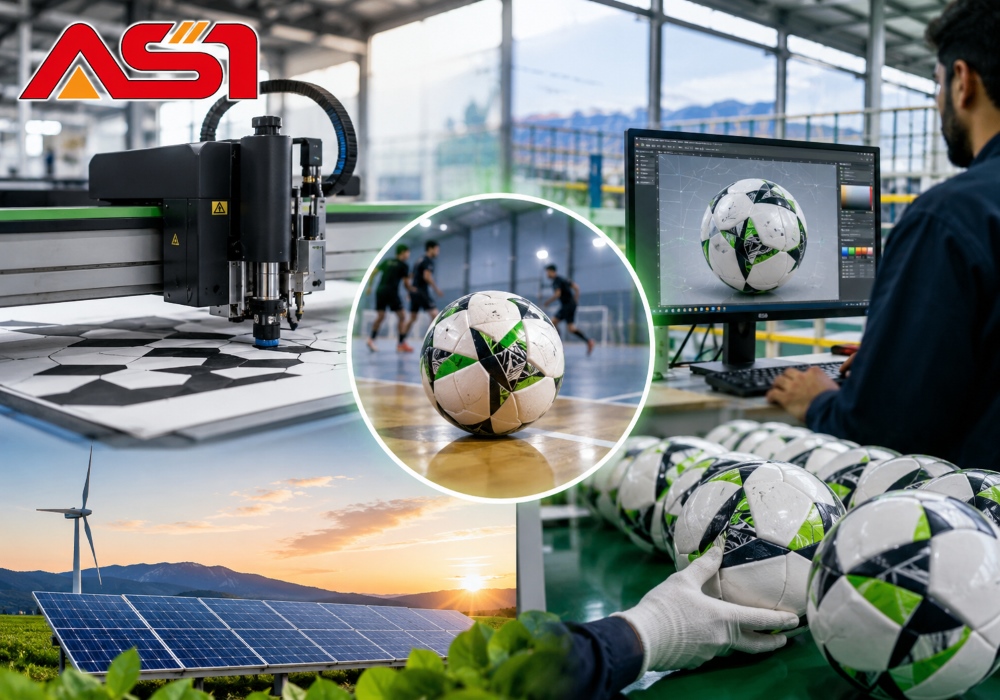
The Future of Sustainable Inflatables: How Pakistan’s Premium Futsal Manufacturer Is Automating the Game
For over a century, the historic city of Sialkot has stood at the global epicenter of craftsmanship, proudly hand-stitching the world’s most iconic footballs. Generations of skilled artisans have woven heritage into every stitch, supplying the beautiful game to international tournaments and local pitches alike. However, the winds of change are sweeping rapidly across the region’s industrial landscape. Today, traditional craftsmanship is meeting cutting-edge technology as Sialkot transitions from labor-intensive methods to smart, mechanized production lines. Leading this industrial evolution is ASI Soccers, a pioneering manufacturer redefining how modern footballs are crafted, engineered, and delivered to a global clientele.
1. Precision Engineering: Mechanized Cutting and Smart Assembly
The most visible shift in Sialkot’s factories lies in the adoption of advanced automation. Gone are the days of entirely manual pattern tracing and hand-cutting, which often resulted in high material waste and minor human inconsistencies.
- Laser Cutting: New computerized machinery now cuts synthetic panels with absolute precision, dramatically reducing scrap material and optimizing fabric utilization.
- Robotic Integration: Automated systems and specialized presses assist in gluing, shaping, and bonding panels together.
- Enhanced Durability: This technological shift ensures that every football meets strict international standards for sphericity, water resistance, and flight trajectory, giving buyers faster and more accurate custom designs.
2. Sustainable Operations: Green Factory Upgrades
As global demand for eco-friendly supply chains intensifies, Sialkot manufacturers are proactively reducing their environmental impact. Modernizing production is no longer just about speed; it is about corporate responsibility and energy efficiency.
- Renewable Energy: Forward-thinking factories are heavily investing in commercial solar power installations to run heavy machinery cleanly.
- Energy Efficiency: The widespread adoption of smart LED lighting systems and energy-optimized heating elements significantly cuts daily power waste.
- Eco-Friendly Materials: Alongside energy upgrades, manufacturers are increasingly sourcing recycled polymers and water-based adhesives, drastically lowering the overall carbon footprint of each manufactured ball.
3. Digital Transformation: Streamlining Global Collaboration
Distance is no longer a barrier for international brands partnering with Sialkot suppliers. The integration of robust digital tools has completely transformed client communication and product development cycles.
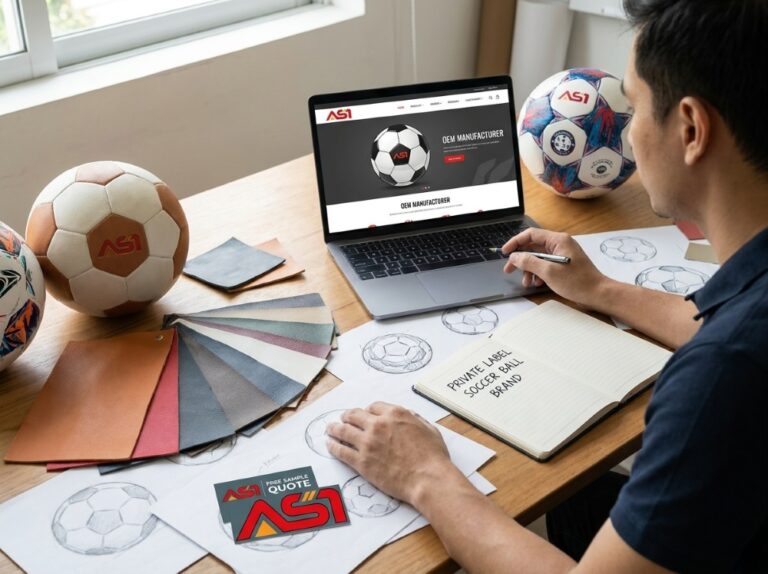
- Virtual Prototyping: Advanced digital proofing tools allow overseas clients to visualize and approve complex custom designs via 3D renders before physical production begins.
- Rapid Sampling: Digital prototyping eliminates the costly and time-consuming shipping of physical trial samples across continents.
- Streamlined Workflows: By bridging the gap between digital design and automated factory floors, manufacturers ensure shorter lead times and seamless execution for global orders.
If you buy futsal balls, sala balls, or custom soccer balls for a team, school, or brand, this shift matters to you. It means better quality, lower cost over time, and a smaller environmental impact.
Why Sialkot Still Matters in 2026
Sialkot, Pakistan, has proudly held its crown as the world’s undisputed hub for football and futsal ball production for decades, supplying the gear that powers matches across the globe. Even as international manufacturing shifts, major sporting brands continue to rely on the city’s deep-rooted expertise.
However, the global sports equipment market is evolving at an unprecedented pace. Today’s international buyers demand a trifecta of modern standards:
- Rapid Turnaround: Shortened supply chains and lightning-fast delivery schedules to keep pace with dynamic retail markets.
- Exact Customization: Highly precise custom designs that match brand-specific color palettes, graphics, and logos down to the millimeter.
- Verified Sustainability: Ironclad proof that factories operate with minimal waste and adhere to strict environmental and ethical guidelines.
Traditional hand-stitching methods, while rich in heritage, struggled to deliver all three demands simultaneously while scaling for global mass markets. That is why forward-thinking manufacturers like ASI Soccers have stepped up to bridge the gap, merging over a century of local craftsmanship with smart automation, solar-powered facilities, and digital prototyping to redefine what Sialkot manufacturing can achieve.
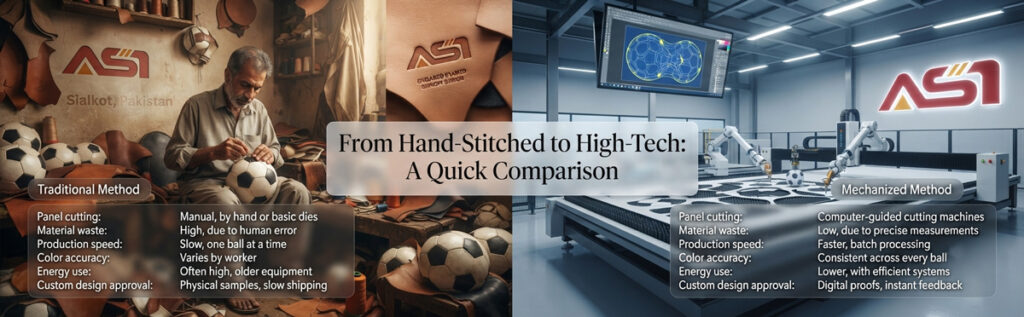
From Hand-Stitched to High-Tech: A Quick Comparison
Here is a simple table showing how things have changed.
| Feature | Traditional Method | Mechanized Method |
|---|---|---|
| Panel cutting | Manual, by hand or basic dies | Computer-guided cutting machines |
| Material waste | High, due to human error | Low, due to precise measurements |
| Production speed | Slow, one ball at a time | Faster, batch processing |
| Color accuracy | Varies by worker | Consistent across every ball |
| Energy use | Often high, older equipment | Lower, with efficient systems |
| Custom design approval | Physical samples, slow shipping | Digital proofs, instant feedback |
This table shows the direction the whole industry is moving. Companies that adopt these changes early gain an edge.
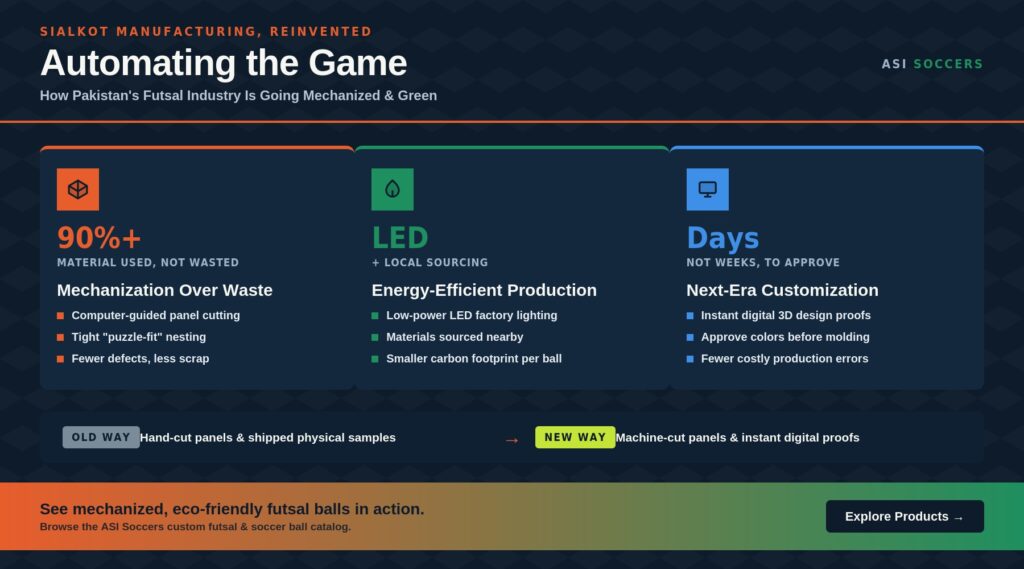
Mechanization Over Waste: Cutting Smarter, Not Harder
The Old Problem
Hand-cutting panels for a football or futsal ball is tricky. Workers use paper patterns and scissors or small dies. Even skilled workers leave scraps behind. Multiply that by thousands of balls, and the waste adds up fast.
This waste costs money. It also costs the environment. Synthetic leather and rubber scraps often end up in landfills.
The New Approach
ASI Soccers shifted much of its panel cutting to computer-guided machines. These machines use exact measurements. They arrange panel shapes tightly together, like a puzzle, to use almost all of the material sheet.
This is sometimes called “nesting.” It is a common idea in manufacturing, but it is fairly new to Sialkot’s ball industry.
The Benefits
- Less raw material scrap per ball.
- Lower material costs over time.
- Fewer defects, since machines cut the same way every time.
- Faster cutting speed, since machines don’t get tired.
A Simple Example
Imagine cutting 100 hexagon panels by hand. A worker might waste enough material for 10 extra panels due to small errors. A machine cutting the same 100 panels wastes material for maybe 1 or 2 panels. Over a year, making thousands of balls, that difference is huge.
Energy-Efficient Production: The Green Factory Model
Why Energy Matters in Ball Manufacturing
Making a futsal ball involves heat, pressure, and lighting. Molding rubber bladders needs heat. Pressing panels together needs pressure. Running a factory floor needs light, all day, every day.
All of this uses electricity. In Pakistan, energy costs and reliability can be unpredictable. So saving energy is not just good for the planet. It is good business.
What Green Factories Are Doing
Modern Sialkot manufacturing facilities, spearheaded by industry leaders like ASI Soccers, are actively transforming operational standards to champion environmental responsibility without sacrificing output. Moving far beyond traditional methods, these progressive production plants are adopting rigorous, eco-friendly practices across every tier of the manufacturing lifecycle:
- Advanced Energy-Efficient Lighting: Facilities have completely phased out legacy fluorescent and incandescent fixtures in favor of high-efficiency LED lighting systems, drastically cutting daily power consumption and extending fixture lifespans.
- Localized Material Sourcing: Supply chains have been streamlined through the localized sourcing of high-grade rubber, specialized threads, and synthetic exterior materials, directly minimizing transport distances to lower overall fuel consumption and shipping emissions.
- Next-Generation Molding Technology: Production lines now utilize modern, efficient molding and pressing equipment engineered to heat up faster and cool down significantly quicker, optimizing thermal regulation and using less energy per manufacturing cycle.
- Optimized Thermal Insulation: Structural upgrades include enhanced building insulation across factory floors, stabilizing indoor temperatures naturally to minimize heavy reliance on industrial heating and cooling systems.
The Bigger Picture
Every ball made this way has a smaller carbon footprint. That means less pollution per unit produced. For brands and buyers who care about sustainability, this is a real selling point, not just a marketing phrase.
Quick List: Green Steps at a Glance
- Swap old lights for LEDs.
- Source materials from nearby suppliers.
- Upgrade molds and presses for efficiency.
- Track energy use per batch to find more savings.
- Recycle scrap material back into the production line where possible.
The Next Era of Customization: Design Before You Build
The Old Way of Custom Orders
In the past, if a club or brand wanted a custom futsal ball, they had to:
- Send a design idea by email.
- Wait weeks for a physical sample.
- Ship that sample overseas for approval.
- Wait again if changes were needed.
This process could take a month or more, just for approval. Then actual production would start.
The New Way: Digital Proofing
Now, digital tools let clients see their design almost instantly. Some manufacturers use rendering software, similar to trends seen in generative design tools, to build a realistic 3D preview of a ball. Multi-colored panels, logos, and text can all be placed on a virtual ball model.
Clients overseas can:
- View the design on a screen within hours, not weeks.
- Request color or layout changes instantly.
- Approve a final design before any material is cut or molded.
Why This Matters for Buyers
This shortens the whole order process. It also reduces mistakes. A wrong color or misplaced logo used to mean wasted material and a redo. Now, errors get caught on screen, before the tool-die molding stage even begins.
Simple Steps in Digital Proofing
- Client sends logo, colors, and design idea.
- Design team builds a digital mock-up of the ball.
- Client reviews and requests changes if needed.
- Client approves the final digital proof.
- Production begins using the approved design.
This process protects both the buyer and the manufacturer. It saves time, money, and material.
How These Three Trends Work Together
Mechanized cutting, green energy practices, and digital proofing are not separate ideas. They work as one system.
- Mechanized cutting reduces waste before production starts.
- Green energy practices reduce environmental impact during production.
- Digital proofing reduces mistakes before cutting and molding even begin.
Put together, this means fewer wasted materials, lower energy bills, and happier customers who get exactly what they wanted, faster.
ASI Soccers presents this as a full-circle approach. It is not just one green initiative. It is a rethink of the entire manufacturing chain, from design to delivery.
What This Means for Buyers Searching for These Products
If you are researching any of the following, this shift affects you directly:
- Eco-friendly custom soccer balls
- Automated sports ball manufacturing
- Next-gen sala ball production
- Premium futsal exporters in Pakistan
- Customized sports equipment
Buyers today are not just comparing price. They are comparing process. A factory that wastes less material, uses less energy, and gives faster design approval is often a smarter long-term partner, even if the sticker price looks similar to a traditional supplier.
FAQ
Q: What does “mechanized manufacturing” mean for a football or futsal ball?
A: It means machines, not just hands, do key steps like cutting panels. This makes the process faster and more precise, with less wasted material.
Q: Are mechanized balls lower quality than hand-stitched balls?
A: Not necessarily. Many mechanized steps actually improve consistency. Panel shapes are more exact, which can lead to a rounder, more balanced ball.
Q: How does digital proofing help with custom team orders?
A: It lets a client see their exact design, colors, and logo placement on a screen before production starts. This avoids costly mistakes and speeds up approval.
Q: What is a “green factory” in ball manufacturing?
A: It is a factory that uses energy-saving equipment, like LED lighting, and sources materials locally to cut down on transport emissions and waste.
Q: Does mechanization reduce jobs in Sialkot?
A: Mechanization changes the type of work more than it removes work. Skilled workers are still needed to run machines, manage quality checks, and handle finishing steps.
Q: How long does a custom futsal ball order take with digital proofing?
A: It varies by manufacturer and order size, but digital proofing can cut approval time from weeks down to a matter of days in many cases.
Final Thoughts
Sialkot’s ball-making industry is not disappearing. It is upgrading.
Mechanized cutting cuts waste. Green factory practices cut energy use. Digital proofing cuts approval time. Together, these changes are shaping a smarter, cleaner, faster way to make futsal and soccer balls.
Manufacturers who adopt these steps early, like ASI Soccers, are setting a new standard for the whole region. Buyers who understand this shift can make better choices for their teams, schools, or brands.
Ready to See These Changes in Action?
Explore ASI Soccers’ futsal and custom soccer ball product pages to see mechanized precision, eco-friendly production, and digital design proofing in action. Browse the current catalog, request a digital design proof for your team’s custom ball, and place your order with a manufacturer built for the next era of the sport.
👉 For more information, contact the ASI Soccers support team.