

Decoding the “Sala” Grip: Why International Leagues Source Custom Indoor Balls from ASI Soccers
Indoor courts punish equipment that wasn’t built for them. Dust, sweat, and hard walls change how a ball behaves in ways outdoor turf never does. Futsal — often called “sala” football in international circles- demands a ball engineered for grip, weight stability, and shock absorption at the same time. League buyers and academy coaches increasingly source customized indoor soccer gear from ASI Soccers because the company builds match-grade futsal balls around court physics, not generic football templates.
The three factors that matter most are surface friction control, a tight weight-to-size ratio, and impact cushioning. This article breaks down each factor from a player-performance and coaching lens, then explains how a customized football factory in Sialkot turns these requirements into a repeatable product line.
Why Futsal Balls Cannot Be Treated Like Small Footballs
A common buying mistake is assuming a futsal ball is simply a smaller, low-bounce football. It isn’t. Futsal is played on a hard, flat, indoor surface — wood, polished concrete, or synthetic court flooring — inside a much smaller playing area than an 11-a-side pitch. Every touch, pass, and shot happens at closer quarters, at higher speed, and with less time to adjust.
This changes three things a manufacturer must solve for simultaneously:
- Grip under variable court conditions — dust and sweat accumulate fast in enclosed courts.
- Predictable weight behavior — low bounce only works if the weight distribution stays constant match after match.
- Structural durability — walls, boards, and hard floors return far more force to the ball than turf does.
Coaches evaluating a ball for a league contract are really asking one question: Will this ball behave the same way in minute 40 as it did in minute 1? That consistency is the entire design brief.
The Surface Friction Challenge
How Court Conditions Alter Ball Control
Indoor courts are not neutral environments. Two conditions recur across venues worldwide:
- Dampness — from player sweat, humidity, or recently mopped floors, especially in enclosed gyms with poor ventilation.
- Dust and fine debris — from wood flooring, synthetic court coatings, or foot traffic, which builds up over a match.
Both conditions reduce the natural friction between the ball’s surface and the floor, and between the ball and the player’s foot. On a standard smooth-panel ball, this shows up as:
- Reduced first-touch control during rapid dribbling sequences.
- Skidding on low, fast passes rather than a clean roll.
- Inconsistent spin on curled shots, since a slick panel grips unevenly.
The Texturing Solution
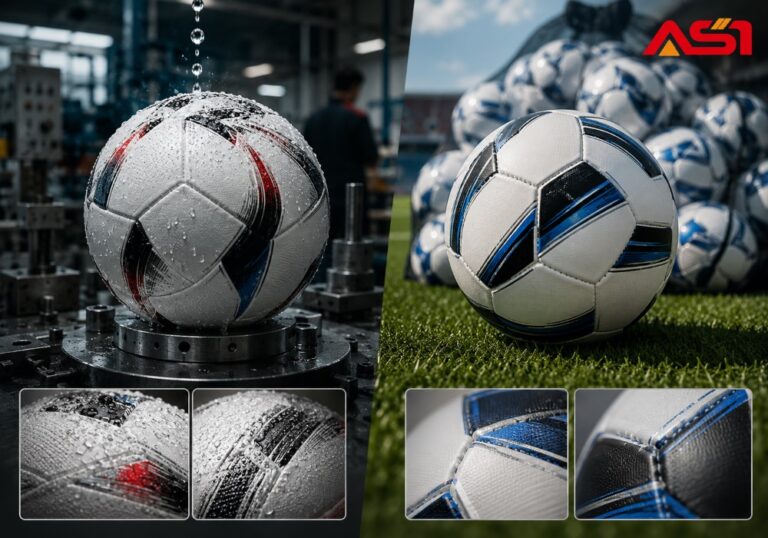
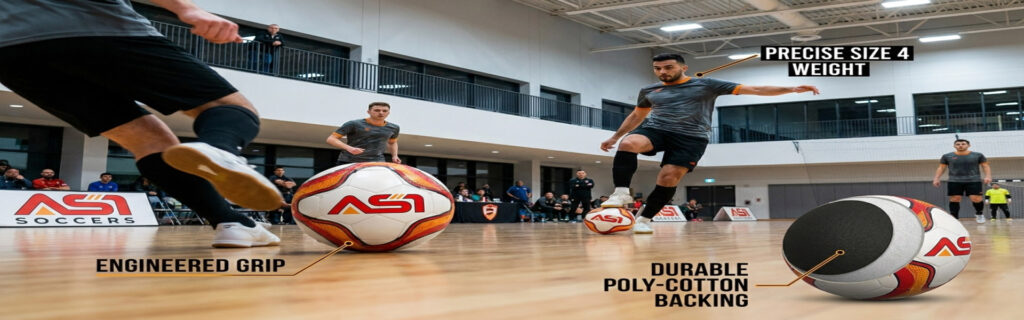
To counter this, ASI Soccers applies specialized outer surface texturing — a micro-patterned finish on the panel material that increases the contact points between foot and ball, even when the surface is slightly damp or dusty. The goal is not maximum grip in ideal conditions; it’s a stable grip across a range of conditions, because match environments are never ideal for all 40 minutes.
Why this matters for player performance:
| Scenario | Standard Smooth-Panel Ball | Textured Sala-Grip Panel |
|---|---|---|
| Close-control dribbling in tight spaces | Touch can slip under pressure | Consistent foot-to-ball contact |
| Low, fast ground passes on a dusty court | Skids unpredictably | Maintains truer roll |
| Damp conditions (humidity, sweat) | Grip drops noticeably | Grip loss minimized |
| Curled or spun shots | Uneven spin release | More predictable spin behavior |
For a coach, this is not a marketing detail — it’s a training variable. Drills built around close control, one-touch passing, and tight turns only translate to matches if the training ball and the match ball behave the same way underfoot.
Weight vs. Size Ratios: The Tight Technical Window
Why Futsal Size 4 Is a Narrow Specification, Not a Range
Regulation futsal balls use a Size 4 casing — smaller in circumference than a standard Size 5 football — but the weight specification is where the real engineering challenge sits. Match-grade Size 4 balls are expected to fall within a 400–440 gram window.
That 40-gram range sounds generous until you consider what it controls:
- Bounce height — futsal balls are designed for a low, controlled bounce (roughly 50–65% of a standard football’s bounce from the same drop height, depending on the specific standard applied). Weight is a primary driver of that bounce behavior.
- Flight stability — a ball at the lighter end of the range behaves differently in the air on long passes or shots than one at the heavier end.
- Foot feel — players calibrate touch weight through repetition; a ball that drifts outside its stated range, even slightly, throws off that calibration match to match.
The Manufacturing Answer: Multi-Layer Poly-Cotton Backing
Getting a ball to sit reliably inside a 400–440g window, ball after ball, batch after batch, isn’t achieved by the outer panel alone. It’s achieved through the backing layers underneath the surface material.
ASI Soccers uses multi-layer poly-cotton backing — several bonded layers of poly-cotton lining between the outer panel and the internal bladder. This backing does two jobs at once:
- Adds mass in a controlled, evenly distributed way, so weight is consistent across the entire sphere rather than concentrated near seams or valve points.
- Preserves shape retention, so the ball doesn’t gradually expand or soften in a way that would push its effective rebound radius upward over a season of use.
Why this distinction matters to coaches: A heavier ball is not automatically a “truer” ball. If added weight comes from uneven backing, the ball can gain weight in the wrong places, causing an oversized rebound radius, unpredictable bounce direction, or lopsided flight. Precision backing keeps the ratio of weight to size correct, not just the raw weight number.
Quick Reference: Size 4 Match Specification Window
| Parameter | Typical Match-Grade Range | Why It’s Controlled |
|---|---|---|
| Circumference | ~62–64 cm | Determines court spacing, touch surface area |
| Weight | 400–440 g | Directly affects bounce and flight behavior |
| Bounce height (from standard drop) | Low-bounce range, well below outdoor Size 5 balls | Enables the “on-the-deck” passing game, futsal is built around |
| Backing construction | Multi-layer poly-cotton | Maintains weight distribution and shape over match life |
Impact Cushioning: Absorbing the Punishment of Hard Surfaces
The Structural Stress Outdoor Balls Never Face
Outdoor football absorbs impact into turf, grass, or soil — surfaces with some natural give. Futsal removes that cushion. Boards, side walls, and hard floors return force to the ball almost fully, especially on:
- Power shots that strike a side wall or rebound board directly.
- Volleys and half-volleys against a hard floor at speed.
- Repeated close-range shooting drills in training, where the same ball absorbs hundreds of hard-surface impacts per session.
Over time, this repeated structural shock is what causes standard balls to lose shape, develop soft spots, or fail at the seams.
How Backing Layers Function as Shock Absorption
The same multi-layer poly-cotton backing that stabilizes weight also functions as a cushioning system. Each bonded layer spreads impact force across a wider area of the panel rather than letting it concentrate at a single point of contact. In practical terms:
- Seam stress is reduced because force is distributed before it reaches stitched or bonded joints.
- The bladder is protected, since the backing acts as a buffer layer between the outer shell and the internal air chamber.
- Shape recovery improves, meaning the ball returns to its intended sphere faster after a hard strike, rather than developing a temporary or permanent flat spot.
The performance payoff for coaches and clubs: a longer usable product life cycle. For academies and leagues running daily training sessions, this translates directly into cost-per-session value — fewer balls replaced mid-season, and more consistent ball behavior across the balls that remain in rotation.
Comparative Snapshot: Standard Indoor Ball vs. ASI Soccers Sala-Grade Ball
| Design Factor | Standard/Generic Indoor Ball | ASI Soccers Sala-Grade Ball |
|---|---|---|
| Surface grip in damp/dusty conditions | Inconsistent, degrades quickly | Specialized outer texturing maintains grip |
| Weight consistency (Size 4, 400–440g) | Can drift outside range batch to batch | Controlled via a multi-layer poly-cotton backing |
| Rebound radius over time | May expand as backing wears unevenly | Preserved through precision layering |
| Impact resistance vs. walls/boards | Higher seam and bladder stress | Distributed shock absorption |
| Product life cycle | Shorter, especially in daily training use | Extended through structural cushioning |
| Customization for club/league branding | Often limited to stock designs | Custom specification available at the factory level |
From Factory Floor to Match Day: The Sialkot Manufacturing Angle
Sialkot, Pakistan, has been a global hub for football and sporting goods manufacturing for decades, and it’s where ASI Soccers operates as a customized football factory. What distinguishes a customized factory model from off-the-shelf sourcing is the ability to adjust specifications at the request of the buyer — a league, an academy, or a distributor — rather than shipping a single fixed design to every market.
For buyers, this typically means being able to specify:
- Panel texturing intensity for grip, matched to typical court conditions in their region.
- Backing layer count and material weight, tuned toward the lighter or heavier end of the 400–440g window, depending on playing style preference (e.g., faster, more technical leagues sometimes favor the lower end of the range).
- Branding, colorways, and league or club identification are directly on the panel.
- Order volumes suited to professional training sala balls for daily academy use versus match-day balls for competition.
This is the practical reason international leagues and federations work directly with ASI Soccers rather than buying generic stock: the ball can be built around how their players actually play, not around a one-size-fits-all industry default.
FAQ: Sourcing Custom Futsal Balls
Q: What makes a futsal ball different from a standard football besides size?
A: The core differences are weight-to-size ratio, bounce behavior, and surface texturing. Futsal balls are engineered for a low, controlled bounce and close-range control on hard indoor courts, while standard footballs are built for outdoor turf and higher, more variable bounce.
Q: Why does the 400–440 gram range matter so much?
A: This range directly controls bounce height and flight stability. A ball outside this window — even slightly — behaves differently underfoot and in the air, which affects passing accuracy and shot control during fast, close-quarters play.
Q: How does poly-cotton backing improve durability?
A: Multi-layer poly-cotton backing distributes impact force across the panel rather than concentrating it at seams or the bladder. This reduces structural fatigue from repeated hard-surface strikes, extending the ball’s usable life cycle.
Q: Can leagues or academies request custom specifications?
A: Yes. Working with a customized football factory in Sialkot, such as ASI Soccers, allows buyers to request specific texturing levels, weight targeting within the regulation range, and branding — rather than accepting a fixed, generic stock product.
Q: Are high-grip sala balls suitable for daily training, or only for match use?
A: Both, with some differentiation. Professional training sala balls are typically built for higher-volume daily use and repeated impact, while match-grade balls may prioritize consistency and feel for competition. A customized order can specify which use case the ball is optimized for.
Building the Ball Around the Court, Not the Other Way Around
Futsal performance is decided in small margins — a touch that holds up under a defender’s pressure, a low pass that doesn’t skid off-target, a shot that survives contact with a hard wall without losing shape. None of that happens by accident. It happens because the ball was engineered around the actual conditions of an indoor court: dust, dampness, hard surfaces, and a tight technical weight window.
This is the standard ASI Soccers builds toward — match-grade futsal balls, customized indoor soccer gear, and professional training sala balls constructed with player control and structural durability as the starting point, not an afterthought.
Ready to equip your league, academy, or club with a futsal ball built for real court conditions? Explore the full range of match-grade and training sala balls on the ASI Soccers product category pages, and reach out for custom specifications and bulk order options tailored to your team’s playing style.
👉 For an informed decision, before placing the order, consult with the expert ASI Soccers support team!