

Quality Control Systems Used by Professional Soccer Ball Manufacturers: R&D, Innovation, and How FIFA Pro-Level Balls Are Developed and Tested
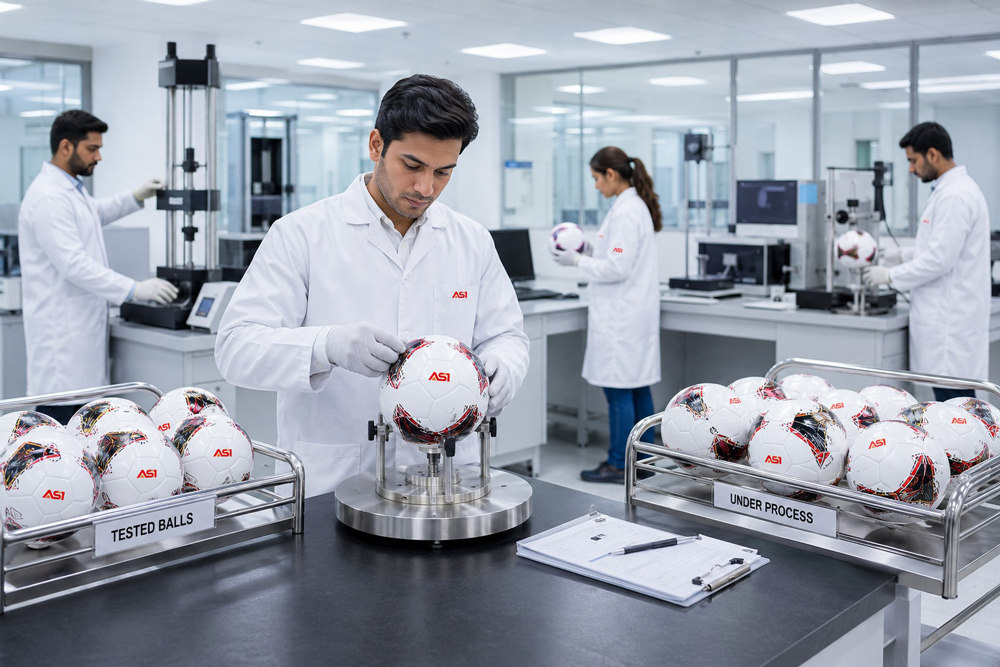
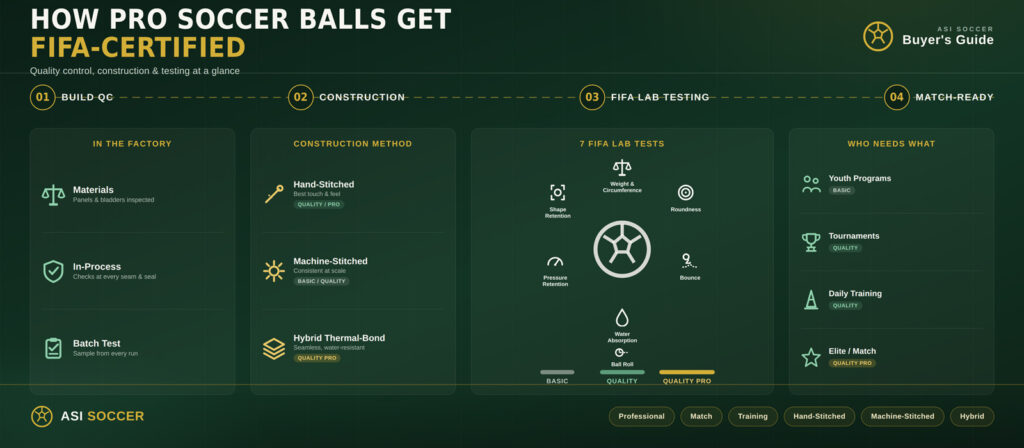
Professional soccer ball manufacturing runs on layered quality control: raw material testing, in-line production checks, and independent lab certification. The gold standard is the FIFA Quality Programme, which grades balls as FIFA Basic, FIFA Quality, or FIFA Quality Pro. FIFA Quality Pro balls must pass seven core lab tests — weight, circumference, roundness, bounce, water absorption, pressure retention, and shape/size retention — at an accredited institute such as EMPA in Switzerland, using a minimum of 10 production samples, not hand-picked prototypes. The construction method (hand-stitched, machine-stitched, or thermal-bonded hybrid) directly affects which tests a ball can realistically pass at the top tier. For coaches, tournament hosts, and youth coordinators, understanding this system is the fastest way to buy a ball that performs consistently and lasts a full season instead of failing mid-tournament.
Why Quality Control Matters for Buyers, Not Just Factories
A soccer ball looks simple. It is not. A size 5 match ball is a pressurized composite structure holding roughly 0.6–1.1 bar of internal air pressure inside layered synthetic panels, a lining, and a rubber or latex bladder. Small manufacturing defects — an uneven seam, an inconsistent panel thickness, a poorly cured bladder — change how the ball flies, bounces, and holds air.
For a youth soccer coordinator, this means the difference between a ball that survives a 10-week season and one that goes soft by week three. For a tournament host, it means balls that play the same in game one as they do in the championship final. For a coach, it means training balls that mimic match-ball behavior closely enough that practice actually transfers to game day.
Quality control (QC) systems exist to remove guesswork from these outcomes. They are the reason a certified ball performs predictably out of the box, every time.
The Three-Tier FIFA Quality Programme
FIFA does not manufacture balls. It certifies them through the FIFA Quality Programme for Footballs, first introduced in 1996 and updated regularly to keep pace with materials science and player demands.
There are three certification tiers:
| Mark | Purpose | Typical Use Case |
|---|---|---|
| FIFA Basic | Minimum performance and safety standards, focused on affordability | Grassroots, recreational, and school programs |
| FIFA Quality | Higher performance bar than Basic; circumference held to 68.0–70.0 cm; must not lose more than 20% of air pressure over time | Club training, amateur matches |
| FIFA Quality Pro | Highest tier; strictest tolerances; used in top professional competitions | World Cup, top-flight leagues, elite tournaments |
Each tier requires the ball to pass laboratory testing that is deliberately harsher than anything the ball would face in a real match.
The Seven Core Lab Tests
Manufacturers seeking any FIFA mark submit balls to a FIFA-accredited testing institute. For FIFA Quality Pro, a minimum of 10 balls from an actual production run must be tested — not specially built prototypes. This prevents brands from submitting a “perfect” hand-built sample while shipping an inconsistent product to market.
- Weight and Circumference — Confirms the ball sits within the legal size and weight window for match play.
- Roundness (Sphericity) — Lasers measure the ball across multiple dimensions. FIFA Quality Pro allows a maximum deviation of just 1.5%.
- Bounce (Rebound Testing) — The ball is dropped from a fixed height onto a steel plate; rebound height must fall in a tight, repeatable range.
- Water Absorption — The ball is soaked and re-weighed to ensure it does not become heavy or waterlogged in wet conditions.
- Pressure Retention — Tests how much air the ball loses over a set period; Pro-level balls must hold pressure far longer than Basic-level balls.
- Shape and Size Retention — Machines fire the ball against a steel wall thousands of times to confirm it does not warp or lose its spherical shape.
- Ball Roll — The ball is released on a controlled surface, and the rolling distance is measured for consistency; FIFA Quality Pro requires the roll to land within a defined range, generally cited around 4–8 meters.
Only balls that clear every test, at every tolerance, earn the mark. This is why a genuinely FIFA Quality Pro–certified ball costs more: the certification itself represents thousands of dollars in lab testing and a manufacturing process precise enough to pass it consistently.
Inside the Factory: How Manufacturers Build Quality In, Not Just Test It In
Passing FIFA’s lab tests once is easy for a skilled engineer. Passing them on every ball, every batch, for years requires quality control systems embedded throughout production. Reputable manufacturers use a layered approach.
1. Raw Material Inspection
Before any panel is cut, incoming materials are checked:
- Synthetic leather (PU or PVC) panels — tested for tensile strength, abrasion resistance, and colorfastness.
- Bladders (latex or butyl rubber) — checked for wall-thickness consistency and air-retention properties. Latex bladders give a softer touch but lose air faster; butyl bladders hold pressure longer with a slightly firmer feel.
- Lining fabric — inspected for weave density, since this layer controls shape retention under pressure.
2. In-Process Checks
During assembly, manufacturers run checkpoints at each stage:
- Panel-cutting tolerance checks (laser or die-cut precision)
- Stitching or bonding inspection at set intervals
- Bladder-insertion and valve-seal verification
- Pre-inflation leak testing
3. Finished-Product Batch Testing
Before balls ship, a sample from each production batch is pulled and tested in-house against the same criteria FIFA uses: weight, circumference, roundness, bounce, and pressure loss over 24–72 hours. Batches that fail internal thresholds are held back, not shipped.
4. Third-Party and Periodic Re-Certification
FIFA marks are not one-time approvals. Manufacturers must periodically resubmit production-line samples to maintain certification, which keeps ongoing quality honest rather than resting on an old test result.
Construction Methods: How the Ball Is Built Changes What QC Has to Catch
The construction method is not a cosmetic choice. It determines the specific failure points that quality control must guard against.
Hand-Stitched Balls
Panels are stitched together by hand, typically 32 panels through pre-punched holes, using waxed polyester thread.
- QC focus: Stitch tension consistency, thread durability, seam waterproofing.
- Strengths: Excellent touch and shape memory; the traditional standard for elite match balls for decades.
- Watch-outs: Labor-intensive, higher unit cost, and more dependent on skilled human consistency than machine processes.
Machine-Stitched Balls
Panels are stitched by industrial machines under controlled tension.
- QC focus: Machine calibration, needle-tension drift over long runs, panel-alignment accuracy.
- Strengths: More consistent seam tension than hand-stitching at scale; lower cost; good for high-volume training and youth-league use.
- Watch-outs: Seams can be a weak point for water absorption if not properly sealed.
Thermal-Bonded (Hybrid) Balls
Panels are heat-fused rather than stitched, creating a seamless outer shell. Many modern match balls, including recent FIFA World Cup balls, use this method.
- QC focus: Bond strength across the full panel surface, heat-consistency during bonding, delamination risk under repeated impact.
- Strengths: Superior roundness, minimal water absorption, very consistent flight — often the easiest construction method to push through FIFA Quality Pro’s tightest tolerances.
- Watch-outs: Requires precise industrial equipment; harder to repair if a bond fails, unlike a torn stitch.
Comparison Table: Construction Method vs. QC Priorities
| Construction | Primary QC Focus | Typical Certification Level | Best Use Case |
|---|---|---|---|
| Hand-Stitched | Stitch tension, seam sealing | FIFA Quality / Quality Pro | Elite match play, traditionalist preference |
| Machine-Stitched | Tension calibration, alignment | FIFA Basic / Quality | Club training, youth leagues, and tournaments |
| Thermal-Bonded Hybrid | Bond strength, delamination resistance | FIFA Quality Pro | Professional match balls, wet-weather play |
R&D and Modern Innovation in Soccer Ball Manufacturing
Quality control tells you whether a ball meets a standard. R&D is what raises the standard in the first place. Modern manufacturers invest heavily in a few key areas.
Aerodynamics and Panel Design
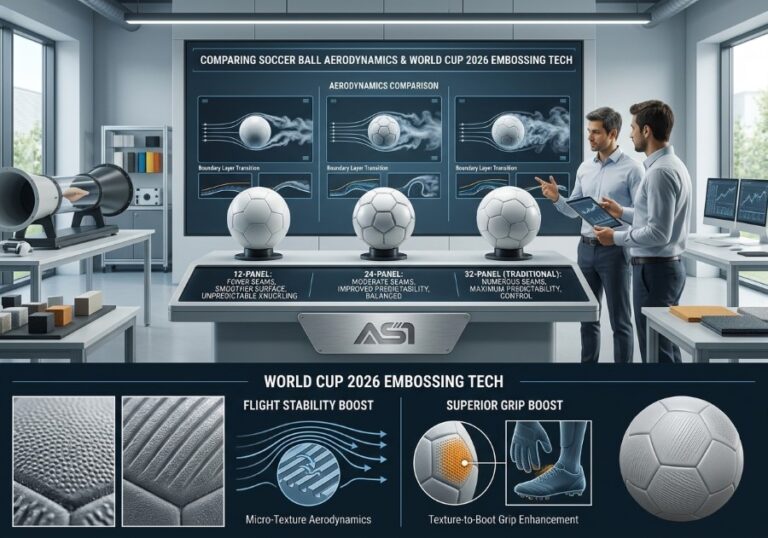
Panel count and seam geometry affect airflow around the ball in flight. Fewer panels with seamless thermal bonding reduce surface irregularities, which can make flight more predictable — though it also changes how the ball responds to spin, a tradeoff manufacturers test extensively with players and wind-tunnel simulation.
Grip Technology
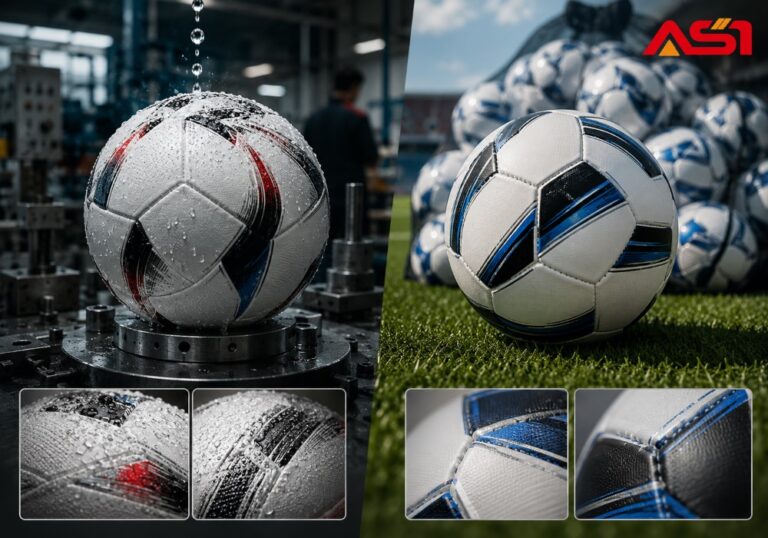
Surface texturing (micro-textured panels, raised grip patterns) is engineered to maintain foot-to-ball contact in wet or dry conditions. This is tested under simulated rain and humidity, not just in dry lab conditions.
Bladder Advances
Newer butyl-latex hybrid bladders aim to combine latex’s soft touch with butyl’s superior air retention, reducing how often a ball needs re-inflation during a season.
Sustainability Initiatives
Manufacturers are increasingly testing water-based adhesives and recycled synthetic materials to reduce environmental impact without sacrificing FIFA Quality Pro performance tolerances — an area of active R&D rather than a solved problem across the industry.
Data-Driven Testing
Sensor-embedded prototype balls (used in R&D, not in certified match play) let manufacturers gather real flight, spin, and impact data from actual training sessions, feeding directly back into panel and bladder design before a ball ever reaches FIFA’s lab.
Use Cases: Matching Ball Category to Your Actual Need
Not every buyer needs a FIFA Quality Pro ball. Matching the right QC tier and construction to your use case saves money and improves performance.
Youth Soccer Coordinators
- Priority: Durability for many hands, safety, and consistent, lighter weight for smaller players (size 3 or 4).
- Recommendation: Machine-stitched or hybrid balls at FIFA Basic or FIFA Quality level. Full Pro-tier certification is unnecessary for most youth programs.
Tournament Hosts
- Priority: Consistency across dozens or hundreds of balls in play simultaneously, so no team gets an unfair equipment advantage.
- Recommendation: A single batch of machine-stitched or hybrid balls from one certified production run, rather than mixing brands or batches.
Coaches (Training Environments)
- Priority: Ball behavior that closely mirrors match balls, so training transfers to game performance, at a price point that tolerates heavy daily use.
- Recommendation: Machine-stitched training balls with FIFA Quality certification; reserve Pro-level hybrid balls for match day and finals.
Competitive Clubs and Elite Programs
- Priority: Maximum performance consistency, professional-level flight behavior, sponsor or league compliance.
- Recommendation: FIFA Quality Pro thermal-bonded or premium hand-stitched match balls.
Frequently Asked Questions
What does the FIFA Quality Pro mark actually guarantee?
It guarantees the ball passed seven laboratory tests — weight, circumference, roundness, bounce, water absorption, pressure retention, and shape/size retention — at tighter tolerances than FIFA Basic or FIFA Quality, using samples pulled from real production batches, not hand-built prototypes.
Is a hand-stitched ball always better than a machine-stitched one?
Not necessarily. Hand-stitching offers excellent touch and a long performance track record, but well-calibrated machine stitching delivers more uniform tension at scale. The better choice depends on use case and budget, not construction method alone.
How often do manufacturers have to retest for FIFA certification?
Certification is not permanent. Manufacturers must periodically resubmit production samples to maintain their FIFA mark, which keeps quality control an ongoing process rather than a one-time achievement.
Do youth and training balls need FIFA Quality Pro certification?
Generally no. FIFA Basic or FIFA Quality tiers provide sufficient durability and consistency for youth play and daily training, at a lower cost than Pro-level match balls.
What is the biggest cause of ball failure mid-season?
Most commonly, pressure loss from bladder or seam defects, followed by shape distortion from repeated impact on hard surfaces — both of which are exactly what FIFA’s shape-retention and pressure-retention tests are designed to catch before the ball ever reaches a field.
Get the Right Ball for Your Program
Understanding quality control and certification tiers is only useful if it leads to the right purchase. ASI Soccer carries certified balls across every construction method and use case, so you can match the ball to the level of play instead of guessing.
Explore the categories built for your needs:
- Professional Balls — FIFA Quality Pro–level performance for elite match play
- Match Balls — Tournament- and league-ready consistency
- Training Balls — Durable, match-like feel for daily practice
- Hand-Stitched Balls — Traditional construction and touch
- Machine-Stitched Balls — Consistent, cost-effective performance at scale
- Hybrid (Thermal-Bonded) Balls — Seamless construction for maximum roundness and water resistance
👉 For more guidance about soccer and sports balls before making any decision to start your own soccer ball brand, feel free to contact our support team.