

The Trionda Effect: Decoding the Science Behind the 2026 World Cup Ball and the Future of Soccer Ball Manufacturing
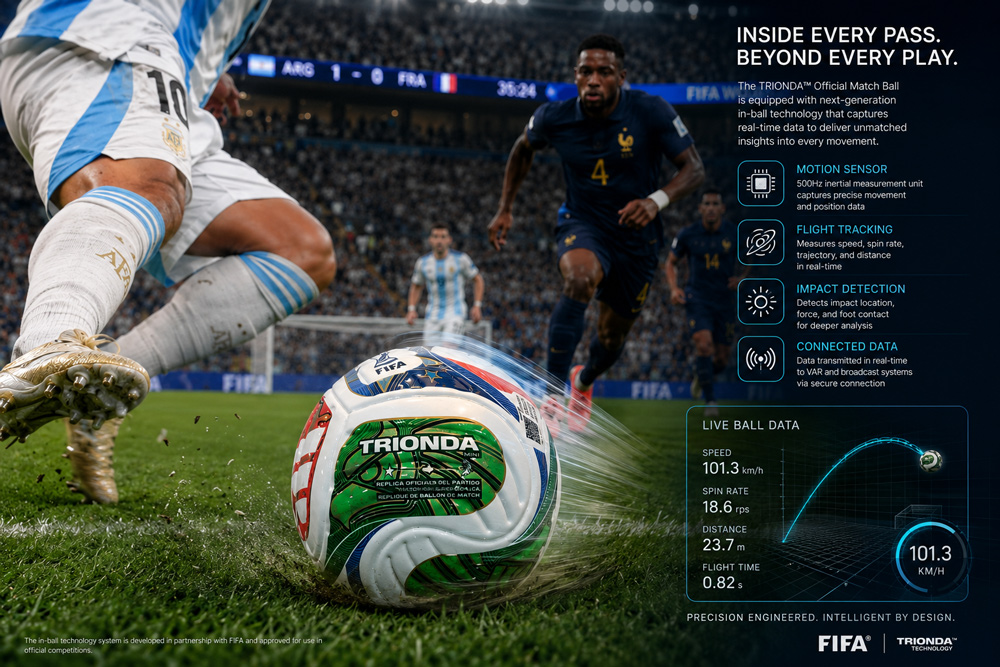
The Trionda — adidas’ official match ball for the 2026 FIFA World Cup — is built from just four thermally bonded polyurethane panels, the lowest panel count of any World Cup ball in history, and carries an embedded 500Hz motion sensor that feeds real-time data to VAR officials. That single design choice — fewer panels, smoother seams, smarter materials — represents the direction the entire football manufacturing industry is moving toward: predictable flight, consistent touch, and digitally verifiable quality.
For clubs, distributors, and academies sourcing footballs at scale, the takeaway is simple — the manufacturers who understand why these design choices matter are the ones capable of producing genuinely professional-grade balls, not just balls that look the part. This article breaks down that science in full, panel by panel, layer by layer, and explains how that same engineering discipline shows up on the production floor of a soccer ball manufacturer.
1. The Evolution of the Soccer Ball
A football has one job that sounds simple and is anything but: travel exactly where the player intends it to go, at the speed they intend, with the bounce, grip, and feel they expect — every single time, for ninety minutes, in rain, heat, or altitude. Getting that “simple” job right has taken more than a century of trial, error, and increasingly serious engineering.
The earliest footballs were stitched from animal bladders wrapped in leather panels. They absorbed water, swelled, became lopsided, and changed weight mid-match. A heavy, waterlogged leather ball in the second half of a rainy match could weigh nearly twice what it did at kickoff — and heading one was genuinely dangerous. Through the 20th century, manufacturers slowly replaced raw leather with treated and laminated materials, refined panel-stitching patterns, and began testing balls for roundness and water resistance.
The real inflection point came with the FIFA World Cup itself. Since 1970, every World Cup has introduced a new official match ball, and each one has functioned as a public showcase for the most advanced ball technology available at that moment — the Telstar’s black-and-white panel pattern (designed for early black-and-white television broadcasts), the Tango’s triad design, the Jabulani’s controversial aerodynamics in 2010, the Brazuca’s six-panel construction in 2014, and the Al Rihla’s 20-panel, low-water-absorption build in 2022. Each tournament effectively forces the entire industry to raise its standard, because the balls used by Messi, Mbappé, and Yamal on the world’s biggest stage become the benchmark every academy, club, and training program measures its own equipment against.
That brings us to 2026. For the first time, the World Cup is being co-hosted by three nations — the United States, Mexico, and Canada — and the ball built for that tournament, the adidas Trionda, reflects both that shared hosting and the most advanced ball-construction technology adidas has ever put into a match ball. Understanding what makes the Trionda tick isn’t just trivia for football fans. It’s a working blueprint for anyone who manufactures, sources, or evaluates soccer balls — because the same aerodynamic principles, material science, and bonding technology that go into a World Cup match ball also determine whether a training ball performs consistently on a wet Tuesday-night practice pitch in Lahore or Manchester.
2. Understanding the Trionda: A New Era of Football Engineering
The Trionda was unveiled on October 2, 2025, ahead of the 2026 tournament hosted across 16 cities in the United States, Mexico, and Canada. The name itself tells you the design brief: “Tri-” for the three host nations, and “onda” — Spanish and Portuguese for “wave” — together forming “Trionda,” loosely translated as “Triple Wave.” The visual identity follows through on that idea directly: three sweeping, wave-like arms in red, green, and blue, each carrying a host-nation symbol — a star for the United States, a maple leaf for Canada, and an eagle for Mexico — that converge into a triangle at the ball’s center.
Design philosophy
Where past World Cup balls layered complex panel patterns over a traditional spherical shell, Trionda’s design team worked backward from a simpler question: how few seams can a ball have while still holding a perfect, predictable sphere? The answer was four panels — fewer than the Brazuca’s six and dramatically fewer than the Al Rihla’s twenty. Fewer panels mean fewer seams, and fewer seams mean less surface disruption for air to catch on as the ball travels through space.
Panel configuration
The four panels are thermally bonded rather than stitched, meaning there is no raised thread line around each seam. Instead, the panels are fused edge-to-edge under heat and pressure, creating a structure that is, for practical purposes, seamless. This is the same fundamental approach used on the Al Rihla, refined further with the lower panel count.
Surface texture
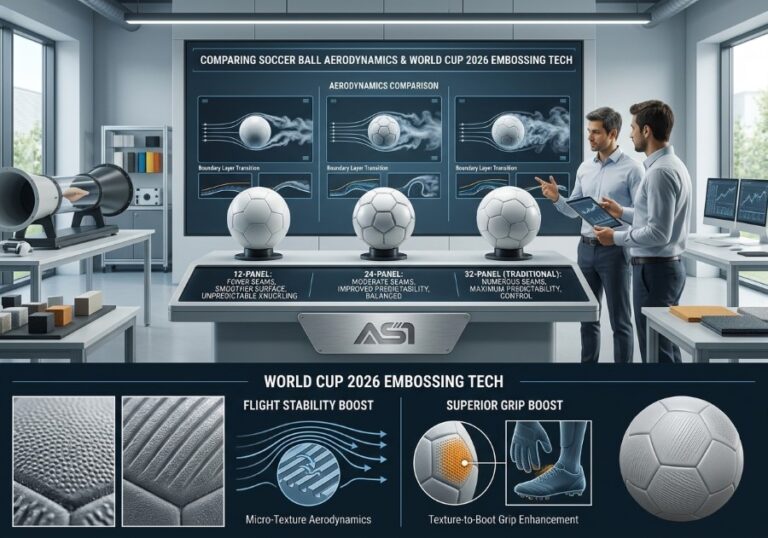
Rather than relying purely on panel count to manage airflow, the Trionda uses a debossed (pressed-in, not raised) macro and micro surface texture concentrated around the ball’s printed graphics and icons. This textured grip pattern is functionally similar to the dimples on a golf ball or the seams on a baseball — small, deliberate surface disruptions that actually help the ball fly straighter by managing the boundary layer of air around it, while also giving players’ boots more grip on the surface for swerve and spin, especially in wet conditions.
Flight stability, control, and accuracy
Combine a low panel count with a textured, seamless surface, and the practical result for a player is a ball that behaves the same way on the 40th strike of the match as it did on the first — no soft spots from worn stitching, no inconsistent panel give, and a flight path that responds predictably to spin and pace.
The technology inside
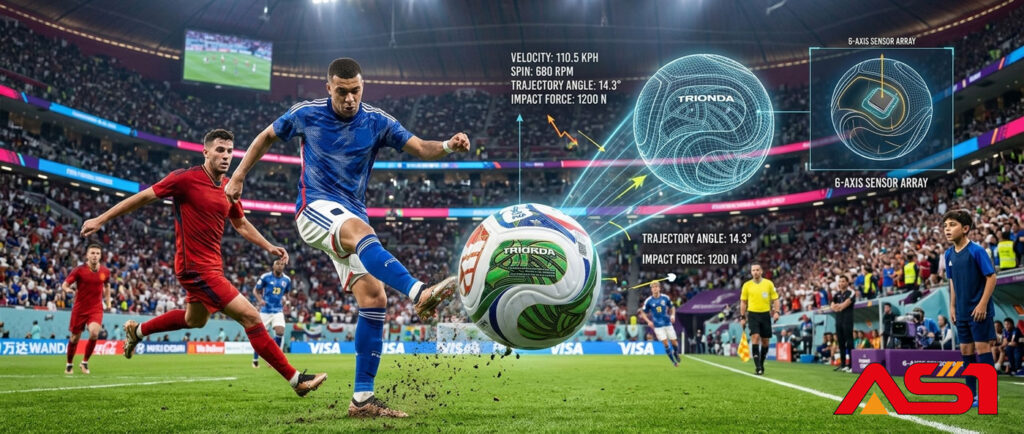
What sets the Trionda apart from every previous World Cup ball, however, isn’t on the surface at all — it’s inside. The Trionda houses adidas’ Connected Ball Technology: a motion sensor sampling at 500 times per second, mounted inside one panel and balanced by counterweights elsewhere in the ball so the sphere remains true and doesn’t develop a “heavy side.” That sensor transmits real-time touch, deflection, and strike data to a local positioning system used by match officials and the Video Assistant Referee (VAR) team, helping speed up tight offside and handball decisions. The sensor runs on a small rechargeable battery, topped up wirelessly on a charging dock — roughly 90 minutes of charging time delivers around six hours of in-match operation, comfortably covering a full fixture.
It’s worth being precise here, because the marketing language can blur the line: the embedded sensor is a match officiating and broadcast data tool, not a performance-altering mechanism — it doesn’t change how the ball flies. The aerodynamic gains come entirely from the panel geometry, the bonding method, and the surface texture. That distinction matters for manufacturers and buyers alike, because it tells you exactly which parts of this design are realistically replicable in professional and training-grade balls, and which part (the officiating sensor) is specific to top-flight, FIFA-administered competition.
3. The Science of Soccer Ball Aerodynamics
To understand why panel counts and surface texture matter so much, it helps to understand what actually happens to a football once it leaves a player’s foot.
As a ball moves through the air, a thin layer of air — the boundary layer — clings to its surface. How that boundary layer behaves determines almost everything about the ball’s flight. If the boundary layer separates from the ball’s surface too early (which happens more easily on a perfectly smooth sphere moving at moderate speed), the ball generates a large, turbulent wake behind it, which increases drag and makes flight unpredictable. A slightly textured surface — like the Trionda’s debossed pattern, or a golf ball’s dimples — actually keeps the boundary layer attached longer, narrowing the wake and reducing drag at the speeds a struck football typically travels.
Drag and lift forces
Two forces dominate a ball’s flight once it’s airborne: drag (which slows the ball along its direction of travel) and lift or side-force (which curves it). Drag is largely a function of the ball’s shape, surface texture, and speed. Side-force is a function of spin — when a ball spins, the boundary layer behaves differently on each side, creating a pressure differential that pushes the ball sideways. This is the Magnus effect, and it’s the entire physical basis of a curling free kick or a swerving corner.
Spin effect and the “knuckleball” problem
Here’s the counterintuitive part: a ball with very low spin, hit at speed, doesn’t fly true — it knuckles, wobbling unpredictably as the separation points of its boundary layer shift randomly around an almost-smooth surface. This was the well-documented criticism of the 2010 Jabulani, whose very smooth, low-panel-count surface made low-spin shots behave erratically. The lesson the industry took from that experience directly shaped every ball since: panel geometry and surface texture have to be tuned together, not separately. The Trionda’s macro/micro debossed texture is specifically designed to provide the ball with just enough surface grip in the air to stabilize its flight, even at low spin rates, without sacrificing the speed benefits of a low panel count.
Stability during high-speed shots
At the high spin rates typical of curled shots and crosses, panel symmetry becomes the dominant factor. A ball built from panels of uneven size or inconsistent bonding will curve slightly differently depending on which “face” of the ball strikes the boot — a flaw invisible to the eye but very noticeable to a professional striker. This is why panel symmetry and bonding consistency are tested obsessively at the manufacturing stage, not just the design stage.
Why predictability matters more than “speed.”
A common misconception is that ball technology is about making balls fly faster. It isn’t. Professional players don’t need a faster ball — they need a ball that does exactly what their technique tells it to do, shot after shot, match after match. A goalkeeper reading a shot’s trajectory in the 0.3 seconds available to react needs that trajectory to be governed by physics, not by a manufacturing inconsistency in panel thickness. That single requirement — predictability over novelty — is the organizing principle behind virtually every advance in ball aerodynamics over the last two decades.
4. Materials Behind Modern Soccer Balls
Aerodynamics gets the headlines, but materials science is what makes that aerodynamic design durable, weatherproof, and consistent across thousands of strikes.
From natural leather to synthetic leather.
Genuine leather was the standard for most of football’s history because it offered excellent touch and feel; however, it absorbed water, stretched unevenly, and varied from hide to hide. Synthetic leather solved the consistency problem: every panel from the same production batch behaves identically, strike after strike, and synthetic surfaces can be engineered for a specific level of softness, grip, and water resistance rather than relying on the inherent properties of an animal hide.
PU (polyurethane) and TPU (thermoplastic polyurethane)
These two materials dominate modern ball outer layers, including the Trionda’s. PU offers a softer touch favored for match balls used by elite players who prioritize feel and control. TPU is typically more abrasion-resistant and slightly firmer, often used on training balls and balls designed for harder surfaces like artificial turf or asphalt. The choice between PU and TPU outer layers is one of the first and most consequential decisions in any ball’s design brief.
Premium outer layers and reinforced backing
A quality match ball isn’t a single sheet of material — it’s a laminate. The visible outer layer (PU or TPU) sits atop one or more reinforcing fabric backing layers, typically polyester or cotton-blend weaves, that give the panel its structural strength and shape memory. The number, weight, and weave of these backing layers are a major (and largely invisible) determinant of how well a ball holds its shape over its working life.
Bladder technology: latex vs. butyl
Inside every panel structure sits the bladder — the air-retaining core of the ball.
- Latex bladders offer the softest touch and the best “give” on contact, which is why most top-tier match balls use them. The tradeoff is that latex is naturally more air-permeable, so latex-bladder balls need re-pumping more frequently.
- Butyl bladders hold air significantly longer — often weeks rather than days — making them the standard choice for training balls and balls intended for less frequent, lower-maintenance use, at a slight cost to touch and responsiveness.
Water resistance
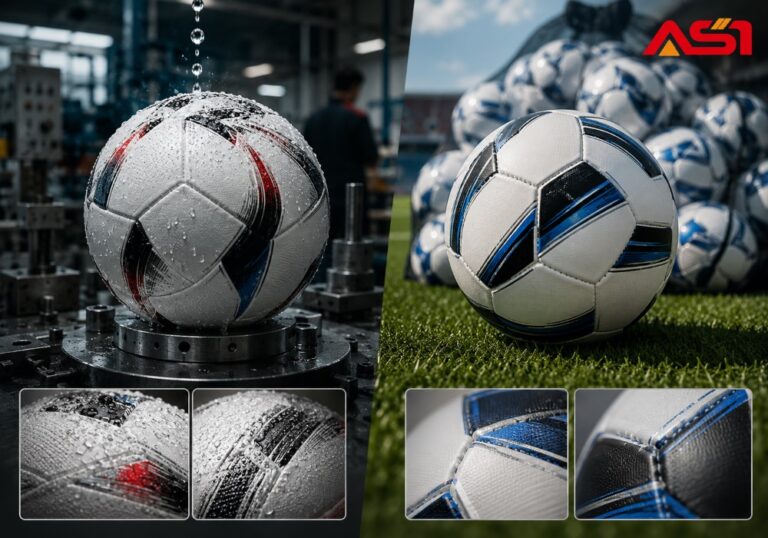
This is where the gap between a recreational ball and a professional-grade ball becomes most obvious. A laminated PU or TPU outer layer with thermally bonded (rather than stitched) seams dramatically limits the pathways water can use to enter the panel structure. Stitched seams, by contrast, create thousands of tiny needle perforations along every seam line — each one a potential entry point for moisture. This is precisely why FIFA’s testing protocols for top-tier balls include a water-uptake test: balls are mechanically struck while wet, then weighed, and a quality match ball is expected to absorb minimal additional weight from that abuse.
Durability testing
Reputable manufacturers don’t just build to a material spec sheet — they test against it. That typically includes:
- Repeated mechanical-strike testing (often tens of thousands of strikes at match-realistic force) to check for seam failure or shape distortion
- Shape and size retention testing after impact
- Abrasion testing for outer-layer wear resistance
- Pressure-loss testing over time to evaluate bladder and valve quality
| Material Component | Common Options | Primary Trade-off |
|---|---|---|
| Outer layer | PU (soft touch) vs. TPU (durable, abrasion-resistant) | Touch and feel vs. surface durability |
| Backing layers | Polyester, cotton-blend weaves | Shape retention vs. weight |
| Bladder | Latex (soft, premium feel) vs. Butyl (air retention) | Touch vs. low maintenance |
| Seam construction | Stitched vs. thermally bonded | Cost and repairability vs. water resistance and consistency |
5. Manufacturing Technology: From Design to Final Ball
Concept development
A finished football — whether it’s a World Cup match ball or a club training ball — passes through a long, precise production sequence before it ever touches a pitch. Every project starts with a brief: Is this a match ball, a training ball, or a promotional/branded ball? What’s the budget tier, the climate it will be used in, and the level of play it needs to support? These answers determine every material and construction decision downstream.
Artwork and printing
Graphics, sponsor branding, and team or tournament identities are printed onto the flat panel material before cutting, using processes that need to survive lamination heat, repeated flexing, and UV exposure without cracking or fading.
Cutting panels
Panels are die-cut or laser-cut from the printed material to extremely tight tolerances — even a fraction-of-a-millimeter inconsistency across panels compounds into a noticeably uneven sphere once assembled.
Lamination
The outer material is bonded to its backing layers under controlled heat and pressure, creating the composite laminate that will form each panel.
Stitching or thermal bonding
Depending on the ball’s construction type, panels are either hand- or machine-stitched together along pre-punched needle holes, or fused edge-to-edge directly using heat-activated bonding (more on this comparison in the next section).
Bladder installation
The latex or butyl bladder is inserted through the ball’s valve opening and carefully centered before the final seam or panel is closed, since an off-center bladder produces an unbalanced ball, no amount of external precision can fix.
Shape testing
Finished balls are checked against circumference and roundness tolerances — for FIFA-standard balls, that means a circumference of 68–70 cm and a near-perfect sphericity, tested using calibrated measuring rigs.
Weight and size testing
Match-quality balls must fall within a narrow weight band (FIFA’s Law of the Game specifies 410–450 grams at kickoff) and hold that weight even after the water-uptake testing described above.
Quality inspection
A final visual and mechanical inspection checks seam integrity, surface finish, valve function, and print quality before packaging.
This is the sequence that separates a genuinely professional-grade manufacturing operation from a basic assembly line — and it’s the same, refined over more than three decades of production experience, that underlies every ball that leaves a serious manufacturing facility, including ours at ASI Soccers.
6. Thermal Bonded vs. Traditional Stitched Soccer Balls
This is one of the most consequential construction decisions in modern ball manufacturing, and it’s worth a direct, honest comparison rather than declaring one method universally “better.”
Traditional Stitched Balls
Advantages:
- Time-tested, well-understood construction with predictable durability
- Generally more cost-effective to produce at scale
- Easier to repair in the field (a popped stitch can sometimes be re-sewn)
- Still capable of excellent performance for training, school, and recreational use
Limitations:
- Needle holes along every seam create entry points for water absorption
- Stitching adds raised seam lines, which slightly increase aerodynamic drag and inconsistency compared to a seamless surface
- Seams are a common failure point under heavy, repeated use
Best applications: Training balls, academy and grassroots-level balls, promotional and giveaway balls, and budget-tier products where cost efficiency matters as much as elite-level performance.
Thermal Bonded Balls
Seamless structure: Panels are fused directly to one another under heat and pressure, eliminating the raised stitch line and the needle perforations that come with it.
Better water resistance: With no needle holes to act as moisture pathways, thermally bonded balls absorb significantly less water during wet-weather play, helping maintain a consistent weight and bounce from the first minute to the last.
Improved consistency: Because the bond is a continuous, controlled industrial process rather than a manual or semi-manual stitching pattern, thermally bonded balls tend to show tighter manufacturing tolerances panel-to-panel.
Professional match performance: This is why virtually every recent World Cup match ball — including the Brazuca, Telstar 18, Al Rihla, and now the Trionda — has used thermal bonding rather than traditional stitching for the official match ball tier.
Side-by-Side Comparison
| Factor | Stitched Construction | Thermally Bonded Construction |
|---|---|---|
| Surface | Visible raised seams | Seamless / near-seamless |
| Water resistance | Lower (needle perforations) | Higher |
| Manufacturing consistency | Good, operator-dependent | Excellent, process-controlled |
| Typical cost tier | Training / recreational / mid-range | Match / professional-grade |
| Field repairability | Easier | Limited |
| Best suited for | Training, grassroots, schools | Match play, professional and semi-professional competition |
The industry trend is clear: as thermal bonding equipment becomes more accessible and cost-effective, more manufacturers are moving mid-tier and even training-tier products toward bonded or hybrid (bonded outer with reinforced stitched core) construction. But stitched balls aren’t disappearing — they remain the right, cost-effective choice for the volume end of the training and grassroots market, where durability-per-dollar matters more than the last percentage point of aerodynamic consistency.
7. How Advanced Soccer Balls Improve Player Performance
Ball technology isn’t an abstract engineering exercise — it changes how the game is actually played, position by position.
Strikers
Predictable flight at high spin and pace means a striker can trust that a shot struck a certain way will curve a certain amount, every time. Seamless construction also removes the small inconsistencies that, on a worn stitched ball, can cause a shot to dip or knuckle unexpectedly off-target.
Midfielders
Passing accuracy over medium and long distances depends heavily on consistent bounce and roll. A ball with even panel symmetry and consistent internal pressure rolls true across the pitch rather than drifting, which directly affects how reliably a midfielder can thread a pass between lines.
Defenders
Consistent bounce off turf and consistent behavior under heavy clearances both matter defensively — an unpredictable ball off a half-volley clearance is a liability, not just an inconvenience.
Goalkeepers
This is arguably where ball technology matters most. Goalkeepers read the seams, spin, and early trajectory of a shot in a fraction of a second. A ball that behaves erratically at low spin (the “knuckleball” problem discussed earlier) is genuinely harder — and in some documented cases, more dangerous — to read and handle, which is precisely why surface texture engineering has become such a priority since the Jabulani-era criticism.
Weather performance
A water-resistant, thermally bonded ball maintains its weight and bounce characteristics far better in rain than a stitched ball that gradually absorbs moisture — a difference players at every level notice the moment conditions turn wet.
In short: better ball technology doesn’t make the game easier — it makes the game fairer, in the sense that outcomes are determined by skill and decision-making rather than by which random batch of inconsistent balls happened to be on the pitch that day.
8. The Future of Soccer Ball Technology
The Trionda’s embedded sensor is a preview, not an endpoint. Several trends are already shaping what comes next:
Smart soccer balls with sensors
Connected Ball Technology, currently used for officiating and broadcast data at the elite level, is a natural candidate to filter down into training and performance-analysis products — imagine a club training ball that logs strike velocity, spin rate, and contact point for every session, feeding directly into a player’s development data.
AI-assisted ball design
Computational fluid dynamics (CFD) modeling — essentially simulating airflow over thousands of virtual panel-pattern variations before a single physical prototype is built — is becoming standard practice for serious ball manufacturers, dramatically shortening the design-to-prototype cycle.
Sustainable materials
Recycled PU and TPU outer layers, water-based (rather than solvent-based) adhesives in lamination, and reduced-waste cutting patterns are increasingly part of serious manufacturing conversations, driven both by brand sustainability commitments and by tightening import/export environmental regulations in key markets.
Eco-friendly manufacturing processes
Beyond materials, manufacturers are looking at energy use in thermal bonding equipment and water use in production and testing as areas for genuine efficiency gains — not just marketing claims.
Improved aerodynamics through fewer, smarter panels
The Trionda’s four-panel construction may not be the final word — expect continued experimentation with panel count, debossed texture patterns, and even variable-texture zones tuned to different parts of the ball’s surface.
Digital quality control
Automated optical and mechanical inspection systems — checking roundness, seam integrity, weight distribution, and surface consistency on every single unit rather than statistical sampling — are becoming more accessible to mid-sized manufacturers, not just the largest global brands.
Next-generation FIFA-quality balls
As FIFA’s Quality Programme testing standards evolve alongside the technology, expect tighter tolerances on water uptake, shape retention, and weight consistency to become the baseline expectation, not a premium differentiator, across the FIFA Quality and FIFA Quality Pro tiers.
The throughline across all of these trends is the same one that defined the Trionda: a continued push toward predictability through precision — using better data, better materials, and tighter manufacturing control to make the ball’s behavior something players can trust completely, anywhere in the world.
9. Pakistan’s Role in Global Football Manufacturing
Long before the Trionda became a tournament headline, Pakistan — and the city of Sialkot in particular — had already established itself as one of the world’s most important football manufacturing hubs, producing official match balls and training balls used in major tournaments and grassroots programs across continents. That regional expertise in panel cutting, lamination, stitching, and increasingly thermal bonding is a genuine, decades-deep industrial capability, not a recent development.
ASI Soccers has been part of that manufacturing story since 1992, working across both traditional stitched construction and thermally bonded production to supply professional-grade and training-tier footballs. Over more than three decades, that work has included partnerships with over 44 international brands, supporting both established companies and emerging brands through OEM production, private-label manufacturing, and fully custom product development — covering everything from match-ball-tier construction through training and promotional product lines.
The relevant point for buyers evaluating any manufacturing partner — Pakistani or otherwise — isn’t a country of origin or a single brand name. It’s whether the production floor actually implements the engineering principles covered in this article: tight panel tolerances, properly matched outer-layer and bladder materials for the ball’s intended use, genuine thermal bonding capability (not just stitched construction marketed as premium), and rigorous shape, weight, and water-resistance testing before a single ball ships. A manufacturer that can speak fluently to why a four-panel thermally bonded design behaves differently from a thirty-two-panel stitched one is a manufacturer that understands what it’s actually building.
10. Why Brands Choose Professional Soccer Ball Manufacturers
For clubs, distributors, and sports brands evaluating a manufacturing partner, a few factors consistently separate serious operations from the rest:
Quality control
Look for documented, repeatable testing protocols — shape retention, water uptake, weight consistency, and pressure loss — not just a finished product that “looks right.”
Genuine thermal bonding equipment and trained operators, alongside traditional stitching lines, provide a manufacturer with the flexibility to serve match-ball, training, and promotional tiers from a single facility.
Customization options
The ability to handle custom artwork, panel patterns, sizing (from youth Size 3 through professional Size 5), and material specifications without compromising structural quality.
Material expertise
A manufacturer that can clearly explain the trade-offs between PU and TPU, or latex and butyl bladders, for a specific use case is making deliberate engineering choices rather than defaulting to the cheapest option.
Consistent supply
For brands and distributors, reliable lead times and batch-to-batch consistency matter as much as the spec sheet on the first sample.
International standards compliance
Genuine FIFA Quality and FIFA Quality Pro certification testing, or equivalent international standard compliance for non-certified product lines, signals a manufacturer serious about match-grade performance rather than appearance alone.
FAQ: Soccer Ball Science and Manufacturing
Q: What makes the Trionda different from previous World Cup balls?
A: It uses just four thermally bonded polyurethane panels — the fewest of any World Cup ball to date — combined with a debossed surface texture for flight stability, and it houses a 500Hz motion sensor that feeds real-time positional data to match officials and VAR.
Q: Does the embedded sensor in the Trionda change how the ball flies?
A: No. The sensor is balanced with counterweights specifically so it doesn’t affect flight characteristics. The ball’s aerodynamic behavior comes from its panel geometry and surface texture, not the electronics inside it.
Q: What’s the real difference between a stitched ball and a thermally bonded ball?
A: Stitched balls use needle-and-thread seams, which are cost-effective and durable but allow some water absorption through the needle holes. Thermally bonded balls fuse panels directly together, creating a seamless, more water-resistant, and more dimensionally consistent surface — the standard for modern match balls.
Q: What is FIFA Quality Pro certification?
A: It’s the highest tier of FIFA’s ball-testing program, evaluating balls against strict standards for circumference, weight, sphericity (roundness), water uptake, shape and size retention, and rebound consistency.
Q: Is a thermally bonded ball always better than a stitched ball?
A: Not universally — it depends on the use case. Thermally bonded construction is generally superior for match-day, water-resistance, and flight-consistency performance, while well-made stitched balls remain a durable, cost-effective choice for training, schools, and grassroots programs.
Q: What should a club or distributor look for in a soccer ball manufacturer?
A: Documented quality testing, genuine thermal bonding capability alongside stitching, material expertise (PU/TPU, latex/butyl), customization flexibility, and consistent, reliable supply at scale.
11. The Future Is Being Manufactured Today
The Trionda will roll out across 104 matches and 16 host cities this summer, and most of the millions of people watching will never think about its panel count, its bladder type, or the heat-bonding process that fused its four panels into a seamless sphere. They’ll just see a ball that curls, dips, and finds the top corner exactly the way the player intended — which is, in the end, the entire point. Every layer of engineering covered in this article exists in service of that single moment of trust between a player and the ball at their feet.
That same engineering discipline — material science, aerodynamic precision, and manufacturing rigor — isn’t reserved for World Cup balls alone. It’s the same standard that should govern every training ball handed to a youth academy, every match ball used in a regional league, and every custom-branded ball a sports company puts its name on. From a manufacturing base in Pakistan with roots going back to 1992, ASI Soccers has spent more than three decades putting that exact principle into practice — building footballs the same way the world’s best manufacturers do, panel by panel, layer by layer, test by test. The future of the soccer ball isn’t a distant concept reserved for FIFA tournaments. It’s being manufactured today, on production floors that take the science as seriously as the players who’ll eventually put it to the test.