

The Invisible Science Inside Your Soccer Ball: Understanding Foam Hardness in Thermal Bonded Soccer Balls
The foam layer inside a thermal bonded soccer ball is not a manufacturing afterthought — it is the single most critical variable controlling a ball’s touch, rebound consistency, flight trajectory, and regulatory compliance. Foam hardness, measured in Asker C or Shore A units, must fall within tightly controlled ranges to satisfy FIFA, UEFA, and IFAB standards. Too soft, and the ball deforms unpredictably under a goalkeeper’s punch. Too hard, and it transmits excessive shock to players’ feet, increases injury risk, and fails rebound tests. Understanding this science helps coaches, procurement managers, club administrators, and serious players make smarter purchase decisions — and avoid counterfeit or substandard balls that look professional but perform dangerously.
1. What Is a Thermal Bonded Soccer Ball?
A thermally bonded soccer ball is manufactured without the traditional hand-stitched seams. Instead, panels are fused using heat and pressure, creating seamless or near-seamless outer surfaces. This process, pioneered at the elite level by the Adidas Teamgeist (2006 World Cup) and refined since, produces a ball with:
- Uniform aerodynamic symmetry — no raised stitch channels disrupting airflow
- Consistent water absorption resistance — seams don’t absorb moisture and add weight
- Greater structural integrity — the bond does not loosen like external stitching
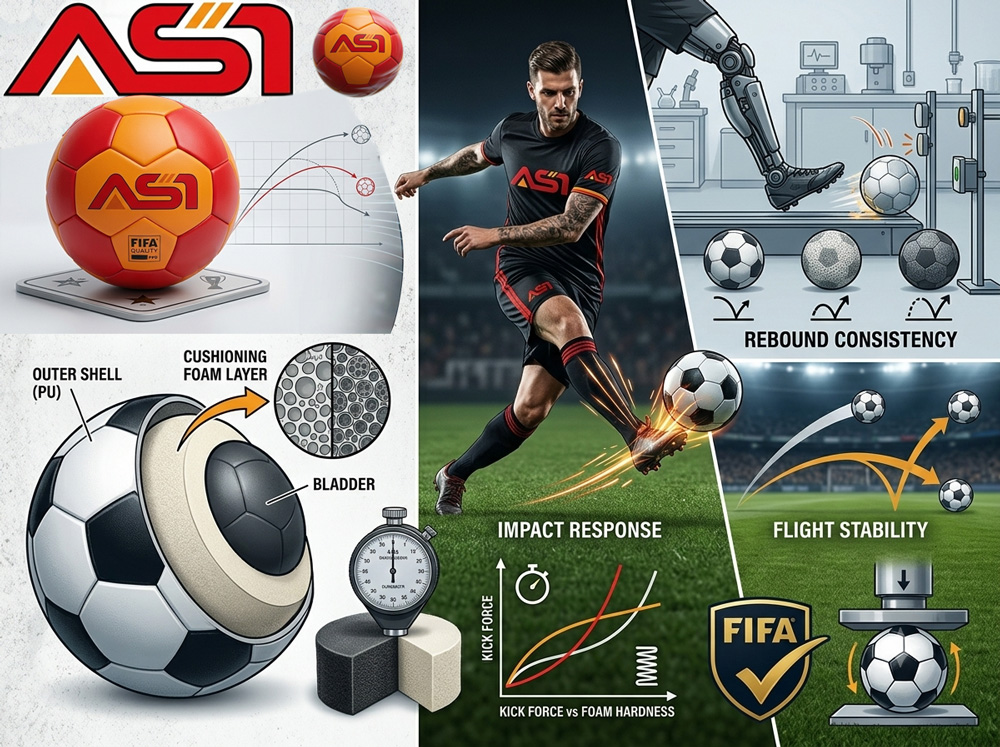
However, the thermal bonding process places enormous demand on the foam substrate layer sandwiched between the outer polyurethane (PU) casing and the inner bladder system. This foam layer must perform like an engineered shock absorber, and its hardness specification determines almost everything about how the ball plays.
2. The Anatomy of a Thermal Bonded Ball: Where Foam Lives
Understanding foam hardness requires first understanding where it sits in the ball’s construction.
| Layer | Material | Function |
|---|---|---|
| Outer Casing | Polyurethane (PU) or TPU | Abrasion resistance, surface texture, grip |
| Foam Sublayer | Polyurethane foam (EVA or PU foam) | Cushioning, rebound control, feel |
| Wound Backing | Polyester/cotton textile | Structural shape retention |
| Bladder | Latex or Butyl | Air retention, pressure management |
The foam sublayer is typically 3mm to 6mm thick in a match-quality ball. In premium thermal bonded balls meeting FIFA Quality Pro standards, this layer is engineered with extraordinary precision — hardness tolerances can be as tight as ±2 Asker C units across the entire surface.
3. How Foam Hardness Is Measured
Foam hardness in soccer ball manufacturing is expressed using one of two scales:
Asker C Scale
The dominant measurement in the foam and sporting goods industry. An Asker C durometer applies a standardized spring load to a truncated cone probe and measures resistance to indentation on a 0–100 scale.
- Lower number = softer foam
- Higher number = harder foam
Shore A Scale
Used interchangeably in some Asian manufacturing contexts. For practical comparison:
Asker C ≈ Shore A + 10 to 15 points (at the middle range relevant to soccer ball foam)
Typical Foam Hardness Ranges in Soccer Balls
| Ball Category | Foam Hardness (Asker C) | Typical Use |
|---|---|---|
| Training/Recreational | 45–55 | School, casual play, rough surfaces |
| Club Match Ball | 55–65 | Amateur league, youth competitions |
| FIFA Basic Certified | 60–68 | Sanctioned amateur competition |
| FIFA Quality Certified | 62–70 | Semi-professional leagues |
| FIFA Quality Pro Certified | 65–72 | Professional league, international |
4. FIFA and Regulatory Standards: What the Rules Actually Say
Governing bodies do not specify foam hardness directly as a numbered requirement in their published testing protocols. Instead, foam hardness is the upstream engineering variable that determines compliance or failure across the following FIFA Quality Programme tests:
FIFA Quality Pro — Key Physical Test Parameters
| Test | Requirement | How Foam Hardness Affects It |
|---|---|---|
| Circumference | 68–70 cm | Foam too soft = over-compression under pressure |
| Sphericity | Max 1.5% deviation | Non-uniform foam = asymmetric rebound |
| Rebound | 120–165 cm (drop from 200 cm) | Core determinant of bounce behavior |
| Water Absorption | Max 10% weight gain after 4 hours | Foam density affects moisture uptake |
| Loss of Pressure | Max 20% over 72 hours | Foam stability affects bladder seal integrity |
| Shape/Size Retention | Measured after 2,000 kicks at 50 km/h | Foam resilience determines longevity |
| Abrasion Resistance | Surface intact after 3,000 cycles | Foam sublayer provides structural backing |
Source: FIFA Quality Programme for Footballs, Technical Standards Document (current revision)
A ball with foam hardness below ~58 Asker C will typically fail the rebound height test — the ball deforms too much on impact and cannot return within the 120–165 cm window. A ball with foam above ~75 Asker C tends to fail shape retention after repeated high-velocity impacts, because the material becomes brittle and micro-cracks propagate through the sublayer.
5. The Physics of Foam Hardness and Ball Flight
Here is where the science gets genuinely fascinating for players and coaches.
Coefficient of Restitution (COR)
The COR measures how much kinetic energy is retained after impact. A perfectly elastic collision = COR of 1.0. A dead ball = COR of 0.
For FIFA Quality Pro balls, the COR must produce a rebound between 60%–82.5% of the drop height (i.e., 120–165 cm from 200 cm). Foam hardness directly controls COR:
- Soft foam (Asker C < 58): High energy absorption during compression → lower COR → ball “dies” on hard surfaces
- Optimal foam (Asker C 65–72): Balanced elastic return → consistent COR within FIFA window
- Hard foam (Asker C > 75): Reduced compression zone → inconsistent COR, erratic bounces
The Knuckleball Effect and Foam
Thermal bonding eliminates raised seams, which already amplifies the knuckleball trajectory. The foam hardness modulates this effect. Softer foam increases surface deformation during ball-air interface interactions, slightly dampening erratic movement. Harder foam produces a more rigid surface that amplifies unpredictable aerodynamic behavior — relevant to free-kick specialists and goalkeepers making tactical equipment decisions.
Temperature Sensitivity
Foam hardness is not static. Polyurethane foam exhibits temperature-dependent behavior:
| Temperature | Approximate Foam Hardness Change | Field Effect |
|---|---|---|
| -5°C (Winter) | +8 to +12 Asker C (stiffer) | Harder touch, reduced cushion, increased injury risk |
| 20°C (Optimal) | Baseline (manufacturer spec) | As tested, ideal performance |
| 35°C (Summer) | -5 to -8 Asker C (softer) | Sluggish rebound, reduced trajectory sharpness |
This is why top-level matches specify a pre-conditioning temperature for balls before FIFA testing — and why professional clubs store match balls in climate-controlled rooms before kickoff.
6. EVA Foam vs. PU Foam: The Material Debate
Two primary foam types compete in thermal bonded ball construction:
Ethylene-Vinyl Acetate (EVA) Foam
- Hardness range available: 35–65 Asker C
- Pros: Excellent shock absorption, lower cost, good water resistance
- Cons: Lower resilience (slower energy return), tends to compress permanently over time (“creep”)
- Typical use: Training balls, entry-level match balls
Polyurethane (PU) Foam
- Hardness range available: 50–85 Asker C
- Pros: Higher resilience, more consistent COR, better shape memory, superior durability
- Cons: Higher manufacturing cost, more sensitive to UV degradation
- Typical use: FIFA-certified match balls, premium training balls
The industry consensus among ball engineers is that PU foam at 65–70 Asker C represents the sweet spot for FIFA Quality Pro compliance — offering the resilience for consistent rebound while retaining sufficient cushioning for player comfort during headers and volley control.
7. How Foam Hardness Affects Player Safety
This is an under-discussed dimension of ball specification that deserves attention.
Header Injury Research
Multiple studies in sports medicine have examined the relationship between ball hardness and sub-concussive impact forces. Key findings include:
- Balls with foam hardness above 72 Asker C generate measurably higher peak impact forces during heading when inflated to the maximum FIFA pressure of 1.1 bar (16 psi)
- The combination of maximum inflation pressure AND hard foam is the worst-case scenario for head impact biomechanics
- Youth football governing bodies (including UEFA’s youth development guidelines) implicitly recommend softer, lower-pressure balls precisely because of this foam-pressure relationship
Foot and Ankle Loading
Instep kicks at match intensity generate impact durations of 8–15 milliseconds. During this window, foam compression accounts for 40–60% of total energy absorption before the bladder and structural layers engage. Harder foam shortens this absorption window, transferring more force to metatarsal bones and ankle ligaments.
Practical implication for coaches: If players report unusual soreness after matches with a new ball supply, foam hardness is among the first variables worth investigating.
8. Recognizing Quality Foam Construction: A Buyer’s Checklist
Whether you’re a club equipment manager or an individual player, these indicators help distinguish well-engineered foam layers from substandard alternatives:
Visual & Tactile Tests (Pre-purchase)
- Press your thumb firmly into the ball surface — it should resist cleanly without feeling like pressing into a pillow or a rock
- Release pressure — the surface should return to shape within 1–2 seconds with no visible indentation remaining
- Examine panel joints — in thermal bonded balls, there should be zero raised ridges at bond lines when the foam is properly calibrated
Drop Test (Quick Field Check)
- Drop the ball from exactly 2 meters onto a firm, flat surface
- A FIFA-compliant ball should rebound to 120–165 cm
- Consistent rebound across 5–6 consecutive drops indicates uniform foam density
Inflation Behavior
- Over-inflation sensitivity: a ball whose circumference distorts visibly above 0.8 bar likely has soft or non-uniform foam
- Under-pressure performance: a ball that feels “dead” below 0.6 bar has insufficient foam resilience to compensate
9. ASI Soccer: Engineering Foam Hardness to International Standards
Sourcing match balls that genuinely comply with FIFA physical specifications requires manufacturers who understand foam engineering at a materials level — not simply assemblers buying pre-cut foam sheets at the lowest available price.
ASI Soccer produces thermal-bonded soccer balls engineered with PU foam sublayers calibrated to 65–70 Asker C, verified against FIFA’s physical test protocol benchmarks. Each production batch undergoes rebound consistency testing, with a target deviation of less than ±5 cm across 10 consecutive drops — tighter than the FIFA minimum requirement.
Beyond ball construction, ASI Soccer extends this precision approach to goalkeeper gloves (latex foam hardness and thickness calibrated for impact absorption), shin guards (EVA foam density rated for impact distribution), and team kits built for movement biomechanics — all at pricing structures accessible to clubs operating without Premier League procurement budgets.
10. Common Misconceptions About Foam Hardness
“A harder ball performs better at the professional level.” False. Professional players prefer the tactile feedback of optimally calibrated foam — not the hardest available. Harder foam reduces first-touch control and increases unpredictable ball behavior at high velocity.
“Foam hardness doesn’t matter for training balls.” Incorrect. Training volume is dramatically higher than match volume for any player. Repetitive impact with incorrectly specified foam over thousands of training touches creates cumulative joint stress that matters for long-term player health.
“All FIFA-certified balls have identical foam.” No. FIFA certification tests outcomes (rebound height, shape retention, etc.) — not the specific foam hardness used to achieve those outcomes. Two FIFA Quality Pro-certified balls can use foam at different hardness levels if both achieve compliant test results. This is why two “certified” balls can feel noticeably different in play.
“Thermal bonding makes foam quality less important.” The opposite is true. Because thermal bonding eliminates the stitching that previously added structural compensation, the foam sublayer bears more responsibility for maintaining shape and performance consistency than in traditional hand-stitched balls.
FAQ: Foam Hardness in Soccer Balls
Q: What foam hardness does FIFA actually require?
FIFA does not publish a specific foam hardness number. It mandates performance outcomes (rebound height of 120–165 cm, shape retention after 2,000 kicks, etc.). Foam hardness in the 62–72 Asker C range is the industry standard for achieving these outcomes.
Q: Can I test foam hardness without specialist equipment?
Not precisely. A durometer instrument is required for accurate measurement. However, the drop test from 200 cm provides a reliable proxy — consistent rebounds of 120–165 cm indicate appropriately calibrated foam.
Q: Why do balls feel different in cold weather?
Foam hardens at lower temperatures. At 0°C, a ball calibrated to 67 Asker C at 20°C can effectively perform at 75–79 Asker C, producing a noticeably harder touch and altered rebound characteristics.
Q: Does foam harden with age?
Yes. Polyurethane foam undergoes gradual oxidative cross-linking over time, which increases hardness by approximately 3–5 Asker C units over 18–24 months of storage, or faster with UV exposure. This is why match balls stored improperly can feel noticeably different from freshly manufactured stock.
Q: What foam specification should youth clubs prioritize?
Youth and junior applications benefit from foam on the softer end of the compliant range — approximately 58–65 Asker C — combined with lower inflation pressures (0.4–0.6 bar for U10–U12 age groups per FIFA’s mini-football recommendations). This reduces peak impact forces during headers and instep kicks.
Q: Is there a difference between futsal ball foam and outdoor ball foam?
Yes. Futsal balls (FIFA Futsal specifications) are low-bounce balls designed for hard indoor surfaces. They use higher-density foam with significantly reduced internal air pressure to achieve a rebound of just 50–65 cm from 200 cm — dramatically lower than outdoor balls. The foam is specifically engineered to absorb rather than return energy.
Q: How do I know if a ball’s foam has degraded?
The most reliable indicator is the drop test. If a ball that previously rebounded to ~140 cm now rebounds to under 110 cm at correct inflation pressure (0.8–1.0 bar), foam compression set (permanent deformation) has likely occurred. Surface irregularities, panel delamination near seam bonds, or visible “dents” that don’t recover are also diagnostic signs.
Summary: The Key Numbers to Remember
| Parameter | Value |
|---|---|
| Optimal match ball foam hardness | 65–72 Asker C |
| FIFA rebound requirement | 120–165 cm (from 200 cm) |
| FIFA inflation pressure range | 0.6–1.1 bar (8.7–16 psi) |
| Foam thickness (match ball) | 3–6 mm |
| Temperature effect | ~+10 Asker C per -15°C |
| Foam type for premium match balls | Polyurethane (PU) |
| Youth recommended foam hardness | 58–65 Asker C |