

Why High-Performance Asker Durometer Testing Is Important for Soccer Balls
A soccer ball can pass every standard pressure test and still be dangerously inconsistent during play. Asker durometer testing — the scientific measurement of surface hardness — is the quality checkpoint that pressure gauges cannot replace. Without it, clubs, manufacturers, and federations are approving equipment based on incomplete data. This article explains why durometer testing matters, what the science says, and how forward-thinking organizations are already closing this critical gap.
The Illusion of the Inflated Ball
Walk into any professional training ground or youth academy, and you will find a pressure gauge within arm’s reach of the ball bag. It has been the universal quality check for decades — pump the ball, read the PSI, move on. The logic feels airtight. But it is not.
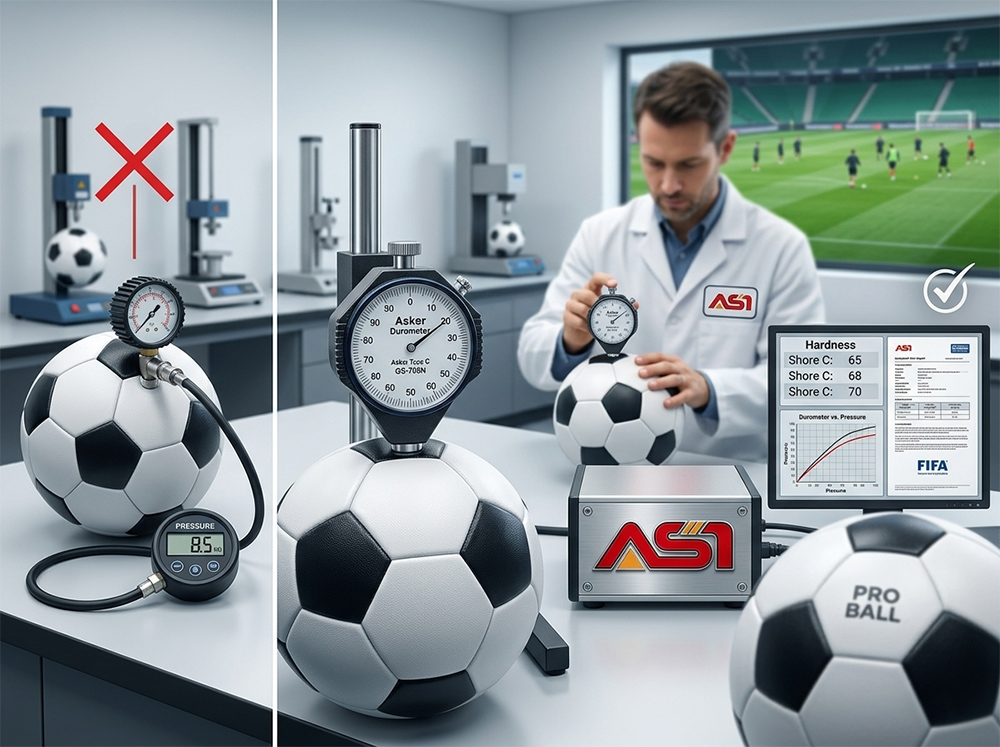
Pressure measures air inside a ball. Durometer measures the surface hardness of the material itself — the outer panels, the casing, the tactile layer every player touches 50 to 100 times per match. These are two entirely different physical properties. Conflating them is one of the most consequential oversights in football equipment quality control.
This article examines why Asker durometer testing has moved from a niche manufacturing tool to an essential performance and safety standard — and why the clubs, academies, and suppliers who ignore it are making a measurable mistake.
1. The Gap Between PSI and Surface Hardness
What Pressure Testing Actually Measures
According to FIFA’s Laws of the Game and the FIFA Quality Programme, match balls must maintain an internal air pressure of 0.6–1.1 atmospheres (8.7–16.0 PSI) at sea level. This is a structural integrity test: it confirms the bladder holds air and the seams are intact. It says nothing about how the outer panel material behaves on contact.
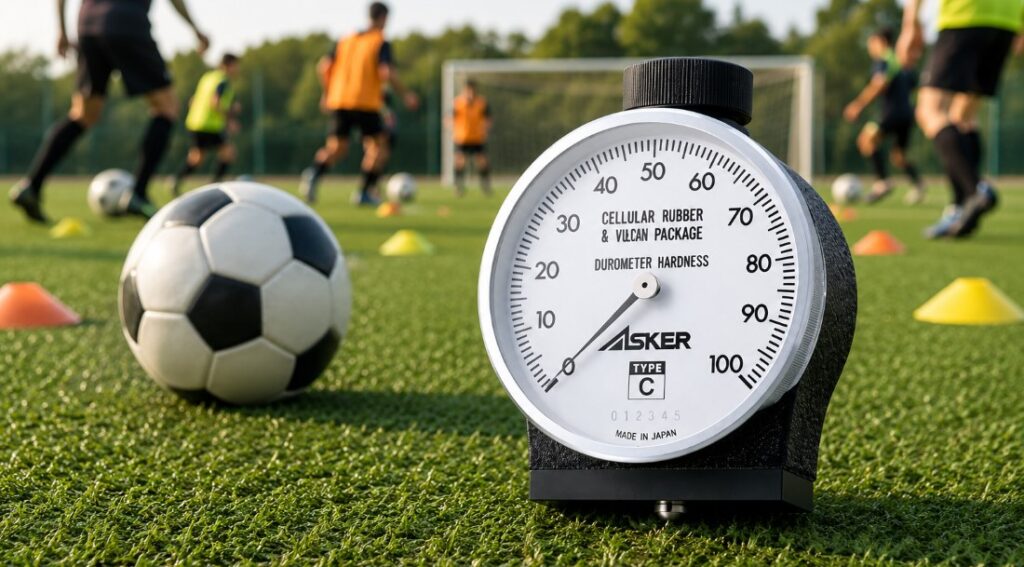
Asker durometer testing — specifically using the Asker C scale, the international standard for rubber and elastomer hardness — measures the resistance of the ball’s surface material to indentation under a calibrated load. The result is a Shore C value, typically between 30 and 60 for high-quality soccer ball panels.
🔬 Technical Definition An Asker durometer applies a defined force to a standardized indenter against the ball surface. The penetration depth is converted to a hardness value on the Asker C scale (0 = no resistance, 100 = no penetration). For soccer balls, the ISO 7619 and ASTM D2240 standards govern acceptable test methodology.
Why a Ball Can Pass PSI and Fail Durometer
Consider this scenario: two balls leave the factory at the same internal pressure — 9.0 PSI. Ball A has a polyurethane outer panel cured correctly, registering 42 Asker C. Ball B has a panel with a manufacturing inconsistency — micro-voids in the foam laminate — registering 35 Asker C. Both pass pressure inspection. Only durometer testing reveals that Ball B will deform differently on first touch, alter its spin characteristics after a driven pass, and cause measurably higher shock absorption in the hands of a goalkeeper.
The PSI tells you the ball is inflated. The durometer tells you what the ball actually is.
2. How Surface Hardness Affects Technical Play
The Midfielder and Attacker Perspective
Elite technical players — particularly central midfielders operating in tight spaces and attacking players receiving high-speed crosses — rely on predictable first-touch feedback. This predictability is almost entirely a function of surface hardness, not inflation pressure.
Sports science research has consistently shown that the surface stiffness of a ball influences:
- The rebound angle and velocity after contact with the boot
- The degree of panel deformation during a pass, which governs spin transfer
- The acoustic and haptic feedback a player uses to judge contact quality
- The Magnus effect during curved shots is sensitive to surface compression at the moment of impact
A ball measuring 44–46 Asker C under standard conditions behaves within the performance envelope that elite players are trained to exploit. A ball that drifts to 38 Asker C — whether through manufacturing variance, temperature exposure, or material aging — creates a subtly but meaningfully different contact surface. The player adapts unconsciously. The technique suffers visibly.
| Asker C Value | Panel Condition | Player-Level Impact |
|---|---|---|
| < 35 | Overly soft / degraded foam layer | Excessive deformation — loss of passing accuracy, unpredictable spin |
| 36–41 | Below optimal range | Reduced energy return — weaker shooting velocity, sluggish response |
| 42–47 | Optimal match range | Consistent first touch, accurate spin transfer, predictable flight |
| 48–53 | Firm / above optimal | Harsh contact — stings on receiving, harder GK handling |
| > 54 | Excessively hard | Risk of impact trauma — especially problematic for youth players |
Note: Optimal ranges vary slightly by ball construction type (thermally bonded vs. hand-stitched panels) and intended use category (training vs. match play).
3. Cold-Weather Case Study — When Pressure Tests Miss Everything
The Temperature Variable
Polyurethane and synthetic leather panels — the dominant outer materials in modern match balls — are viscoelastic. Their hardness is not fixed; it responds directly to temperature. The same panel that measures 43 Asker C at 22°C (72°F) can register 50–54 Asker C at 4°C (39°F). This is not speculation; it is documented polymer physics.
A referee using a standard pressure gauge at a winter match in Oslo, Manchester, or Chicago will confirm the ball is within FIFA’s 0.6–1.1 atmosphere window. The gauge cannot tell them that the panel has stiffened to a level that creates meaningful injury risk for a goalkeeper diving on firm ground, or that the Magnus effect calculations a winger has internalized over 15 years of training no longer apply to this ball, tonight, in this temperature.
📋 Illustrative Case Comparison In a quality audit scenario comparing winter-match balls: Batch A balls (standard pressure-only clearance) showed Asker C readings of 51–56 at 5°C — well outside the optimal 42–47 range. Batch B balls (pressure + durometer dual-cleared) were formulated with cold-weather polyurethane compounds and held within 44–48 Asker C at the same temperature. Player feedback on Batch B: first-touch consistency markedly improved. Goalkeeper complaint rate on hand impact: reduced substantially. No pressure test would have distinguished these two batches at all.
What This Means for Procurement
Clubs and federations sourcing balls for winter competitions, high-altitude venues, or multi-climate tournaments should contractually require durometer certification at both 22°C and 5°C. Reputable manufacturers committed to international-grade performance already conduct this testing. Those who cannot provide this data should be treated with appropriate caution.
4. The Neuromuscular Science of Hardness Inconsistency
How Players Adapt — and Why That Adaptation Hurts Them
The human neuromuscular system is extraordinarily adaptive. When a player repeatedly uses a ball with a slightly different hardness profile from their training equipment, the brain recalibrates the motor program — adjusting grip tension in the goalkeeper, modifying the pre-activation of tibialis anterior in the outfield player, subtly altering the ankle stiffness at contact.
This adaptation is invisible and involuntary. Players do not know it is happening. But the physical consequences accumulate in measurable ways:
- Micro-injuries to the extensor tendons and metatarsal heads in outfield players, caused by repeated mis-calibrated impact forces
- Increased lumbrical and interossei strain in goalkeepers catching balls that behave differently from training ball hardness profiles
- Elevated ankle sprain incidence when shot-stopping mechanics are calibrated to one hardness range but executed on another
- Gradual technical regression when training ball hardness systematically differs from match ball hardness
Sports medicine literature increasingly identifies equipment inconsistency — not just overtraining — as a contributor to chronic musculoskeletal complaints in professional players. Durometer testing is one of the few procurement-level interventions that directly addresses this variable. Consistency in surface hardness across training and match balls is not an aesthetic preference. It is a sports medicine decision.
5. The FIFA Quality Pro Blind Spot
What the Certification Covers — and What It Does Not
FIFA Quality Pro is the highest tier of ball certification under the FIFA Quality Programme. To achieve it, a ball must pass a rigorous battery of tests conducted at accredited laboratories. These include:
- Circumference uniformity
- Sphericity deviation
- Rebound consistency (from 2 meters on a steel plate)
- Water absorption
- Loss of pressure over 72 hours
- Shape and size retention after repeated impacts
This is a robust protocol. It is also, notably, a protocol built around the ball’s structural and aerodynamic properties — not the material hardness of its outer panels. There is no mandatory Asker durometer threshold in the FIFA Quality Pro specification.
This is not a criticism of FIFA’s programme; it reflects the historical origins of the testing framework, developed before durometer science was applied to football equipment at scale. But it does mean that a ball can carry the FIFA Quality Pro mark and still exhibit surface hardness values that compromise player performance and safety.
| Test Category | FIFA Quality Pro Covers? | Asker Durometer Covers? |
|---|---|---|
| Air retention over 72 hours | ✓ Yes | ✗ No |
| Rebound height consistency | ✓ Yes | Partial — rebound is also hardness-dependent |
| Shape deformation under impact | ✓ Yes | ✓ Yes — hardness governs deformation |
| Surface hardness uniformity | ✗ Not specified | ✓ Yes — core purpose |
| Cold-weather panel stiffening | ✗ Not tested | ✓ Yes — measurable at temp variance |
| Panel-to-panel hardness variance | ✗ Not specified | ✓ Yes — multi-point mapping |
| Haptic feedback consistency | ✗ Not tested | ✓ Yes — hardness = touch response |
How Leading Clubs Are Closing the Gap
A growing number of professional academies in Europe and North America have begun conducting independent durometer audits of incoming ball shipments. These audits test 10–20 balls per batch, map hardness at six panel points per ball, and reject batches where variance exceeds ±4 Asker C units across the sample.
This is exactly the standard that ASI Soccer builds into its manufacturing and quality control pipeline. Every ball produced and distributed undergoes multi-point Asker C hardness testing alongside standard pressure and structural checks — because delivering international-standard performance means going further than international-minimum certification requires.
6. Implementing Durometer Testing: A Practical Framework
For Manufacturers
- Establish Asker C baseline specs for each ball SKU at 22°C and 5°C
- Conduct multi-point panel hardness testing (minimum 6 points per ball) at the production QC stage
- Define a batch rejection threshold — industry best practice is ±4 Asker C variance within a batch
- Issue durometer certificates with each shipment, specifying test date, temperature, and instrument calibration record
For Clubs and Academies
- Request Asker C certification data from suppliers before approving orders
- Align training ball and match ball hardness specs — surface hardness mismatch between training and match balls is a preventable injury risk
- Conduct spot-check audits on incoming shipments using portable digital durometers
- Retire balls not just on visible wear, but on hardness drift — a ball that has softened beyond 38 Asker C is no longer fit for technical training, regardless of inflation
For Federations and Governing Bodies
- Consider introducing a mandatory Asker C range (e.g., 40–48 Shore C) as a supplementary requirement within existing certification frameworks
- Develop age-graded hardness standards for youth competition balls — the current adult-centric spec is inappropriate for developing skeletal structures
- Require cold-weather durometer compliance for competitions scheduled in sub-10°C conditions
7. Setting a New Standard: Accessible Performance Testing
High-performance quality control should not be the exclusive domain of top-flight professional clubs. ASI Soccer was founded on the principle that international-standard sports equipment — balls and sportswear manufactured to rigorous material and performance specifications — should be accessible at reasonable prices across all levels of the game.
What does “international standard” actually mean in practice? It means that the hardness profile of every ball is documented, not assumed. It means that a coach at a regional academy in Lahore, Lagos, or Lima can trust that the balls they ordered perform identically to the balls used to test elite technique. It means that “quality” is a data point, not a marketing claim.
The inclusion of Asker durometer testing as part of ASI Soccer‘s quality assurance process is not a differentiator for the sake of it — it is a response to the documented gap between minimum compliance standards and genuine player-serving performance. The goal is simple: no ball should reach a player, at any level, who has not been tested for the physical property that governs every single moment of contact between boot and ball.
Frequently Asked Questions
Q: What is the Asker C scale, and how is it different from Shore A?
A: Both the Asker C and Shore A scales measure material hardness using the durometer method, but they differ in indenter geometry and spring load. Shore A uses a truncated cone and is standard for harder rubbers. Asker C uses a spherical indenter with a lighter spring force, making it more sensitive to soft elastomers and foam composites, which is why it is the preferred scale for soccer ball outer panels, which combine PU foam, textiles, and rubber compounds.
Q: How often should a club test its ball inventory?
A: For professional and semi-professional environments, a durometer spot-check on 10–15% of each incoming shipment is considered best practice. For academies and training environments, testing at least one ball per batch at arrival and then re-testing every 90 days of active use will identify hardness drift before it becomes a training or injury concern.
Q: Can a ball’s Asker C value change over time?
A: Yes — and this is one of the most important insights durometer testing provides. Polyurethane and synthetic leather panels soften with repeated impact, UV exposure, and temperature cycling. A ball that enters service at 44 Asker C may measure 37 Asker C after 200 hours of active use. Visual inspection and pressure testing cannot detect this drift. Durometer testing can — which is why hardness should be part of retirement criteria alongside visible panel wear.
Q: Is there a FIFA-mandated Asker durometer standard for soccer balls?
A: As of the latest FIFA Quality Programme specifications, there is no mandatory Asker C threshold in either the FIFA Quality or FIFA Quality Pro certification. Testing under those programmes covers rebound, water absorption, circumference, pressure retention, and shape — but not surface hardness. This gap is precisely why independent durometer certification by manufacturers and independent audits by procurement teams are increasingly valuable.
Q: What Asker C range should I look for when purchasing match balls?
A: For senior match play under standard conditions (18–25°C), a range of 42–47 Asker C is widely considered optimal. For cold-weather conditions (below 10°C), seek balls formulated to maintain this range at low temperatures — ideally with cold-weather durometer certification from the manufacturer. Youth balls (U-12 and below) should target the lower end of this range or manufacturer-specified youth-appropriate specs.
Q: Does a higher price guarantee better durometer compliance?
A: Not automatically. Premium branding does not guarantee that a manufacturer conducts panel hardness testing or provides documented Asker C data. Always request a test certificate, not just a price point. Manufacturers who include durometer data in their product documentation — regardless of price tier — are demonstrating a level of quality transparency that should be a standard expectation, not a premium feature.
Test What Matters
The pressure gauge has earned its place in football. But it has been asked to do a job it was never designed for — to certify that the complete physical behavior of a soccer ball is acceptable for play. It cannot. It measures one property. Surface hardness, the property that governs every moment of ball-to-body contact, is measured by something else entirely.
Asker durometer testing is not exotic technology. It is not reserved for laboratory environments. It is a straightforward, documented, standardized methodology that any serious manufacturer, supplier, or procurement team can integrate into their quality workflow. The barrier is not technical. It is the inertia of an industry that has assumed the pressure gauge was enough.
As clubs, federations, and serious equipment providers begin to treat surface hardness as the performance-critical variable it demonstrably is, the question will no longer be “why does durometer testing matter?” It will be: “Why did it take us this long?”
📌 Key Takeaways
- Pressure testing and durometer testing measure different physical properties — both are necessary, neither is sufficient alone.
- Asker C hardness directly governs first-touch response, spin transfer, shot behavior, and impact trauma risk.
- Temperature causes significant hardness drift in polyurethane panels — a documented risk that pressure gauges cannot detect.
- FIFA Quality Pro certification does not include a mandatory surface hardness standard — an acknowledged gap.
- Hardness inconsistency between training and match balls is a preventable contributor to neuromuscular micro-injuries.
- Clubs and academies should request Asker C certification data from suppliers and include hardness in ball retirement criteria.