

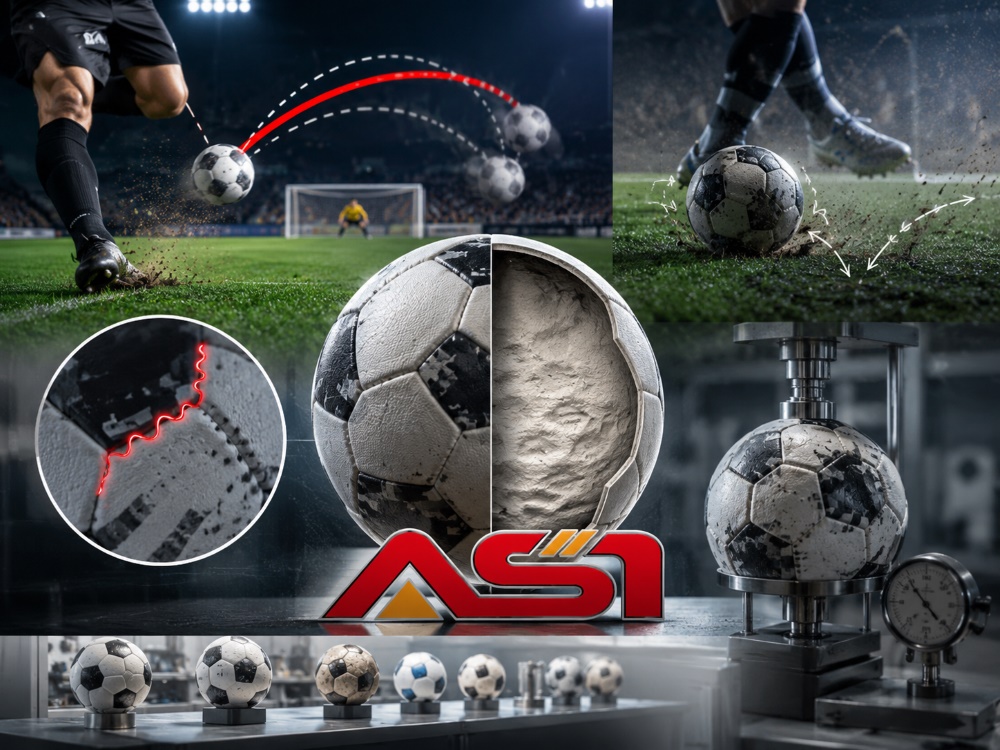
THE HIDDEN FLAW ON THE PITCH
How Uneven Materials Destroy Soccer Ball Performance
An Expert Analysis with Regulatory Standards, Real-World Impact & Buyer Guidance
Uneven material distribution in a soccer ball — whether in the bladder, casing panels, or stitching — directly compromises flight trajectory, bounce predictability, spin accuracy, and structural longevity. FIFA Quality Pro and FIFA Quality certification standards exist precisely to eliminate these flaws. Players at every level deserve balls built to specification. A ball that behaves unpredictably does not just frustrate athletes; it distorts training outcomes, skews match results, and poses injury risk. Material uniformity is not a luxury — it is a regulatory and performance necessity.
Introduction: The Ball is the Game
In soccer, everything starts and ends with the ball. It is the single piece of equipment that every player touches, every goalkeeper reads, and every referee inspects. Yet, despite its central importance, the science of what makes a ball perform predictably is often overlooked — until something goes wrong on the pitch.
When a Cristiano Ronaldo free kick knuckles unnervingly toward the goal, that is aerodynamics working as intended. When a straightforward pass veers sideways for no apparent reason, or a goalkeeper watches a routine save become a fumble because the ball bounced left instead of straight — that is material inconsistency at work.
Uneven materials inside and outside a soccer ball are not merely a manufacturing inconvenience. They are the invisible architects of poor performance, and understanding them is essential for coaches, players, referees, sporting goods buyers, and anyone serious about the game.
Anatomy of a Soccer Ball: Where Materials Live and Why They Matter
Before examining what goes wrong, we need to understand what a properly constructed ball looks like. FIFA’s Laws of the Game (Law 2) and the FIFA Quality Programme for Footballs define the structural and material requirements that every match ball must meet.
A regulation soccer ball is composed of four primary layers:
- Outer Casing (Cover): Typically made of polyurethane (PU) or PVC panels, this layer must be water-resistant, durable, and consistent in thickness across every panel.
- Lining Layers: Beneath the cover, multiple layers of polyester or cotton provide structure and cushioning. These layers reinforce the shape of the ball and affect its feel on contact.
- Bladder: The innermost air-holding chamber, usually made of latex or butyl rubber. The bladder’s wall must be uniform in thickness; any irregularity here is catastrophic for bounce and pressure retention.
- Stitching or Thermal Bonding: The seams that hold panels together — either hand-stitched with polyester thread or thermally bonded — must maintain consistent tension throughout.
Each of these components must be uniform in weight, density, and thickness. The moment one panel is 0.3 mm thicker than another, or one section of bladder wall is 2 grams heavier than the rest, the ball’s behavior becomes statistically unpredictable.
What the Regulations Actually Say: FIFA Standards Decoded
FIFA’s Quality Programme categorizes balls into two tiers — FIFA Quality and FIFA Quality Pro — with the Pro tier reserved for elite competition. Both require balls to pass a rigorous battery of laboratory tests, many of which specifically detect material inconsistency. Here is the regulatory breakdown:
| Test | FIFA Quality | FIFA Quality Pro | Why It Matters |
|---|---|---|---|
| Circumference | 68–70 cm | 68–70 cm | Ensures roundness; uneven panels distort this |
| Weight | 410–450 g | 410–450 g | Material inconsistency shifts weight off-center |
| Rebound (1 m drop) | 48–52 cm | 50–52 cm | Bladder uniformity critical for consistent bounce |
| Shape Retention | ≤1.5% deformation | ≤1.5% deformation | Panel & stitching evenness prevents sagging |
| Water Absorption | ≤10% weight gain | ≤10% weight gain | Uneven coating causes differential absorption |
| Pressure Loss (72 hrs) | ≤20% | ≤20% | Bladder wall uniformity prevents air migration |
It is worth noting that IFAB (International Football Association Board), which maintains the Laws of the Game, delegates ball quality standards to FIFA. Law 2 requires that the ball be spherical, made of leather or another suitable material, and of a circumference between 68 and 70 cm, weight between 410 and 450 grams at the start of the match, and a pressure between 0.6 and 1.1 atmosphere (600–1,100 g/cm²) at sea level.
What this means in practice: if your ball passes all FIFA tests but one seam is slightly looser than the rest, it will still fail in real-world play, even if it passed quality control on paper. The regulatory standards set a floor, not a ceiling.
How Uneven Materials Cause Poor Ball Performance: The Full Breakdown
1. Flight Path Deviation and Knuckling
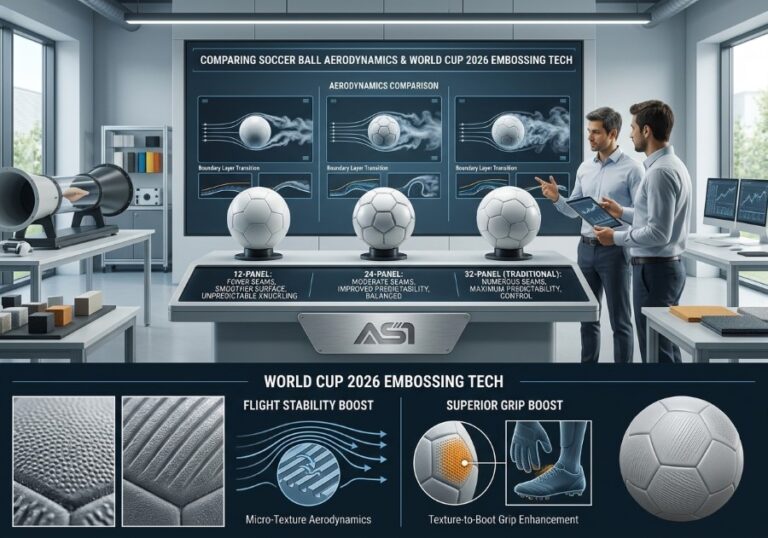
The Magnus effect is the physics principle that explains why a spinning ball curves. When a ball spins, one side moves with the airflow and the other against it, creating a pressure differential and directional lift. This is how bending free kicks and curling crosses are possible.
But the Magnus effect only works predictably when the ball is symmetrically balanced. Uneven panel weight or thickness shifts the ball’s center of mass off its geometric center. The result: unexpected mid-flight deviations, erratic trajectories, and the notorious “knuckleball” effect — where the ball wobbles through the air with no predictable arc.
Real-world example: The Jabulani ball used at the 2010 FIFA World Cup was widely criticized by goalkeepers, including Iker Casillas and Gianluigi Buffon. Aerodynamic research later confirmed that its non-standard panel design and lighter weight created unpredictable flight — a direct consequence of asymmetric aerodynamic properties.
2. Inconsistent Bounce and Rebound
FIFA’s rebound test drops a ball from exactly 2 meters onto a steel plate and measures how high it bounces. A FIFA Quality ball must rebound 48–52 cm, and a FIFA Quality Pro ball must rebound 50–52 cm — a tighter window reflecting elite-level demands.
If the bladder wall varies in thickness by even 1–2 mm, different parts of the bladder have different elasticity. When the ball hits the ground, the contact point determines whether it bounces from a thick wall section (lower rebound) or a thin wall section (higher rebound). The goalkeeper making a dive, or the striker attempting a volley, cannot account for this variance.
This is not a minor inconvenience. In a 90-minute match, this variance can affect dozens of ball contacts, and in youth development training, it creates incorrect muscle memory in young players who learn to compensate for unpredictable equipment.
3. Spin Distortion and Set-Piece Inaccuracy
Elite players train extensively to apply specific backspin, topspin, or sidespin. Corner kicks, free kicks, and penalty techniques all rely on the relationship between the player’s foot contact point and the ball’s surface response.
Uneven panel density means that when a player strikes the ball with a specific rotational intent, the angular momentum is unevenly distributed. A ball with one panel 5% denser than its opposite panel rotates off-axis, producing a spin that does not match the player’s intention. At the professional level, set-piece routines with intricate delivery zones become unreliable. At the youth level, the player never learns what good technique actually feels like.
4. Pressure Loss and Structural Integrity
A ball with an uneven bladder does not just bounce oddly — it leaks air at uneven rates. Thin spots in the rubber or latex bladder wall allow micro-permeation of air molecules faster than thick spots. Over the course of a match, especially in cold weather, the ball softens asymmetrically.
FIFA’s pressure loss test requires that after 72 hours, the ball retain at least 80% of its initial pressure. But a ball with a bladder wall variance of 2 mm across its surface may fail far earlier in real-world conditions. A ball that was correctly inflated at kick-off can be measurably deformed by the second half.
5. Water Absorption and Wet Weather Performance
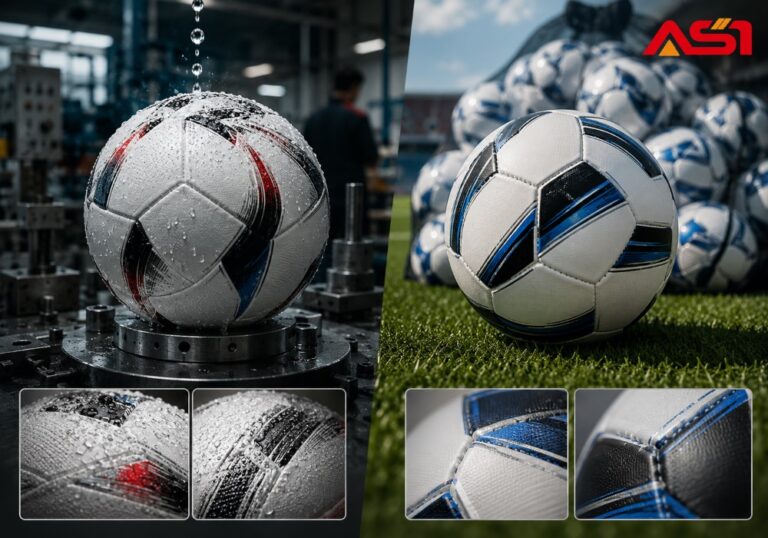
FIFA’s water absorption test soaks the ball for 3 hours and stipulates no more than 10% weight gain. But this test assumes uniform panel coating. When polyurethane panels are applied unevenly — common in low-quality manufacturing — some panels absorb moisture far faster than others.
A ball that gains 4% weight on three panels and 12% on one panel has shifted its center of mass to that one panel. In rainy match conditions, this transforms a straightforward through-ball into an unpredictable sideways skid.
Material Defects vs. Performance Impact: Quick Reference
| Material Defect | Performance Impact | FIFA Standard Violated | Severity |
|---|---|---|---|
| Uneven panel thickness | Inconsistent flight path / knuckling | FIFA Quality Pro – Shape & Size | High |
| Non-uniform bladder wall | Unpredictable bounce direction | FIFA Quality – Rebound Test | High |
| Variable panel density | Distorted ball spin & curve | FIFA Quality Pro – Water Absorption | Medium-High |
| Loose / uneven stitching | Seam separation under pressure | FIFA Quality – Shape Retention | Critical |
| Mismatched panel weight | Off-axis flight & swerve | FIFA Quality Pro – Circumference | High |
| Irregular foam padding | Poor energy transfer on strike | FIFA Quality Pro – Pressure Loss | Medium |
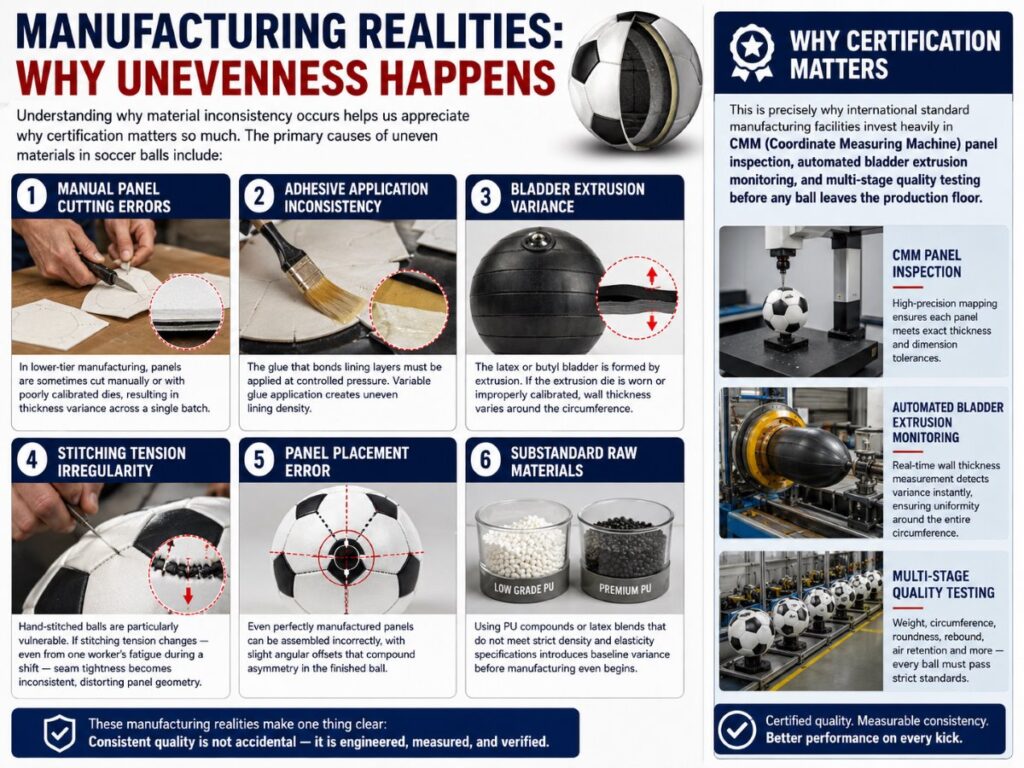
Manufacturing Realities: Why Unevenness Happens
Understanding why material inconsistency occurs helps us appreciate why certification matters so much. The primary causes of uneven materials in soccer balls include:
- Manual Panel Cutting Errors: In lower-tier manufacturing, panels are sometimes cut manually or with poorly calibrated dies, resulting in thickness variance across a single batch.
- Adhesive Application Inconsistency: The glue that bonds the lining layers must be applied at controlled pressure. Variable glue application creates uneven lining density.
- Bladder Extrusion Variance: The latex or butyl bladder is formed by extrusion. If the extrusion die is worn or improperly calibrated, wall thickness varies around the circumference.
- Stitching Tension Irregularity: Hand-stitched balls are particularly vulnerable. If stitching tension changes — even from one worker’s fatigue during a shift — seam tightness becomes inconsistent, distorting panel geometry.
- Panel Placement Error: Even perfectly manufactured panels can be assembled incorrectly, with slight angular offsets that compound asymmetry in the finished ball.
- Substandard Raw Materials: Using PU compounds or latex blends that do not meet strict density and elasticity specifications introduces baseline variance before manufacturing even begins.
This is precisely why international standard manufacturing facilities invest heavily in CMM (Coordinate Measuring Machine) panel inspection, automated bladder extrusion monitoring, and multi-stage quality testing before any ball leaves the production floor.
Real Player Impact: From Youth Academies to Professional Stadiums
Youth Development
The most overlooked consequence of poor ball quality is its effect on youth players. Coaches at academies use ball contact repetitions — sometimes 200 to 500 ball touches per session — to build muscle memory and technical skill. When the ball behaves inconsistently, the young player’s nervous system adapts to account for the inconsistency. They learn compensatory techniques that are entirely wrong for a proper match ball. This developmental distortion can persist for years.
Professional Match Play
At the elite level, goalkeepers prepare extensively for specific ball behaviors at their current stadium altitude, humidity, and temperature. Professional goalkeepers know, for example, that the match ball used at high altitude in La Paz, Bolivia (3,600 m) will require inflation adjustment per FIFA Law 2 allowances because lower air pressure changes rebound characteristics. An uneven bladder adds an uncontrollable variable onto an already complex calculation.
Referee and Match Official Inspection
Under FIFA Law 2, the referee has the authority to inspect and approve every ball used in a match. Referees are specifically trained to check ball pressure, circumference, and surface condition before play. A ball that fails the referee’s pressure check or circumference inspection due to material unevenness is removed from play. For lower-level competitions that do not have spare match balls readily available, this creates significant disruption.
How to Identify Poor Material Quality: A Practical Checklist
Whether you are a coach selecting training balls, a club equipment manager procuring match balls, or a referee conducting pre-match inspection, here are the indicators of material inconsistency:
Visual Inspection
- Check that all panels appear to have equal surface texture and sheen — inconsistent gloss indicates uneven PU coating application.
- Look for panel seams that appear wider on one side than the other — a sign of stitching tension variance.
- Examine the ball for any subtle flattening or bulging when fully inflated — this suggests bladder wall unevenness.
Tactile / Physical Inspection
- Roll the ball slowly across a flat surface. A ball with uneven material will wobble or deviate, whereas a properly constructed ball rolls in a straight line.
- Hold the ball at multiple points and squeeze with equal pressure. Firmness should feel identical at every contact point.
- Weigh the ball on a calibrated scale: FIFA regulation requires 410–450 g. Any ball outside this range before use should be investigated.
Rebound Test (Simple Field Version)
- Drop the ball from shoulder height (approximately 1.5 m) onto a flat, hard surface.
- Perform this test 5 times, rotating the ball 72 degrees between each drop to test different contact surfaces.
- Significant variation in rebound height across tests indicates bladder or panel inconsistency.
Choosing a Ball That Meets the Standard
Given everything we have examined, the question becomes: how do players, coaches, and clubs make informed purchasing decisions in a market flooded with balls of wildly varying quality?
The answer is certification, manufacturing transparency, and supplier credibility.
ASI Soccer supplies international standard sports balls engineered to meet FIFA Quality and FIFA Quality Pro test specifications — from circumference and weight tolerances to rebound consistency and water absorption resistance. Their product line spans match balls, training balls, and futsal balls, all manufactured with traceable quality processes and available at pricing structures that make professional-grade quality accessible to clubs at every tier.
When evaluating any ball supplier — not just for match play but for training — demand answers to these questions:
- Is the ball tested to FIFA Quality or FIFA Quality Pro standards? Ask for test certificates.
- What bladder material is used — latex (better feel, requires more maintenance) or butyl (better pressure retention, longer durability)?
- How are panels cut and assembled — automated die cutting or manual?
- What is the panel construction — hand-stitched, machine-stitched, or thermally bonded?
- What is the warranty or returns policy if the ball fails quality inspection upon arrival?
Training Implications: Quality Balls Are a Coaching Investment
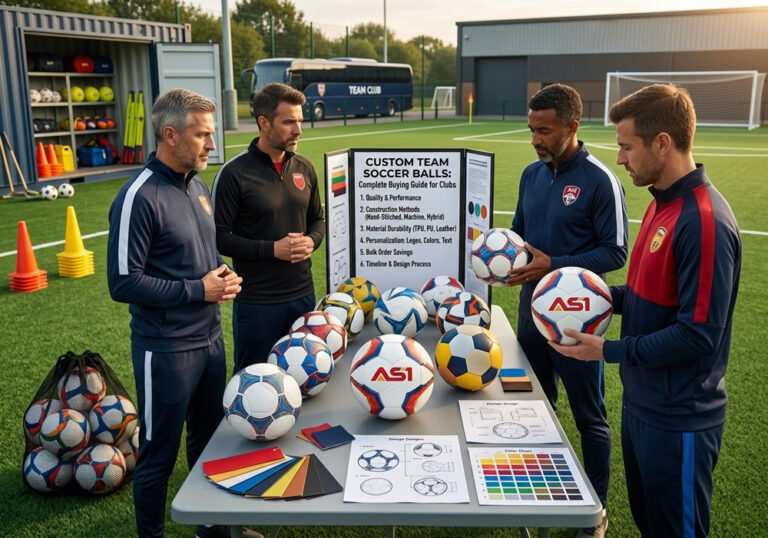
There is a persistent misconception in grassroots football that training balls need not match match-ball quality. This is incorrect, and the science supports it unambiguously.
When players train with inconsistent balls, they develop three harmful adaptations:
- Reactive Compensation: Players unconsciously adjust their strike technique to accommodate unpredictable ball response, developing habits they must “unlearn” when using a proper match ball.
- False Feedback Loop: Coaches cannot accurately diagnose technical errors because it is impossible to distinguish player error from ball error when the ball itself introduces variance.
- Reduced Confidence on Contact: Especially in young players, frequent unexpected ball behavior erodes confidence in their own technique, creating hesitation in match situations.
Clubs that use FIFA Quality or FIFA Quality Pro balls in training — the same standard they use on match day — consistently report better technical development metrics. The investment in quality training balls is not an expense; it is a multiplier on coaching hours.
Ball Size Reference by Age Group and Competition Level
Material requirements do not change by ball size, but size compliance is equally important. Here is the standard reference:
| Ball Size | Age Group | Circumference | Weight | Primary Use |
|---|---|---|---|---|
| Size 1 | All ages (skills) | 43–46 cm | 195–205 g | Skills training, freestyle |
| Size 2 | All ages (skills) | 54–56 cm | 275–285 g | Technical training |
| Size 3 | Under 8 | 58–60 cm | 300–320 g | Youth beginner matches |
| Size 4 | Under 12 – Under 14 | 63–66 cm | 350–390 g | Youth competitive matches |
| Size 5 | Under 15 to Adult | 68–70 cm | 410–450 g | All competitive & senior matches |
Note: Material uniformity requirements apply to all sizes. A Size 3 ball with uneven bladder construction is just as problematic for an 8-year-old’s development as a defective Size 5 is for a senior professional.
Beyond the Ball: How Sportswear Consistency Mirrors Ball Quality Principles
The same material uniformity principles that govern soccer ball performance apply directly to sportswear. Kit fabric weight consistency, seam tension in goalkeeper gloves, and padding density in shin guards all influence player performance and safety.
ASI Soccer’s sportswear line is engineered with the same attention to material specification that governs their ball production — consistent fabric weights, reinforced seam construction, and moisture-wicking properties that maintain performance across a full 90-minute match. This is not coincidental; it is a philosophy of precision that extends across every product in their catalogue.
Frequently Asked Questions
Q: How can I tell if my soccer ball has uneven materials without professional equipment?
A: Perform the roll test (roll the ball on a flat, hard surface and observe if it tracks straight), the squeeze test (squeeze multiple points with equal pressure to check for firmness variance), and a simple rebound test (drop from shoulder height at 5 different rotation points and compare bounce height). Significant variance in any of these tests suggests material inconsistency.
Q: Does FIFA certification guarantee perfect material uniformity?
A: FIFA certification guarantees that a production sample met the test specifications at the time of testing. It does not guarantee every individual ball in a batch is perfect. However, certified manufacturers use ongoing quality control that statistically minimizes defect rates to very low levels. Non-certified balls carry no such assurance.
Q: How often should match balls be replaced?
A: FIFA recommends that match balls be inspected before every match. Competitive match balls at the professional level are often replaced every 3–6 months of intensive use, or sooner if they fail pressure or shape retention tests. Training balls should be inspected monthly and replaced when they show consistent rebound or shape variance.
Q: Is a latex bladder better than a butyl bladder for consistency?
A: Latex bladders provide superior touch and feel, and are preferred in FIFA Quality Pro match balls. However, latex requires daily pressure checks as it naturally releases air faster. Butyl bladders offer better pressure retention (better for training environments) but slightly less sensitive touch. In both cases, bladder wall uniformity during manufacturing is the key quality variable — a poorly made latex bladder is worse than a well-made butyl one.
Q: Why do some cheap balls feel fine at first but deteriorate quickly?
A: Low-cost balls often use thinner or lower-density PU coatings and cheaper bladder compounds that may pass initial visual inspection but degrade rapidly under match conditions. Uneven coating thickness accelerates water absorption and UV degradation in certain panel sections, while the bladder loses elasticity unevenly, creating progressive bounce inconsistency that worsens over time.
Q: Can referees legally remove a ball from play mid-match due to material failure?
A: Yes. Under FIFA Law 2, the referee may replace the ball at any time during the match if it becomes defective (loses pressure, shape, or structural integrity). The match is restarted with a dropped ball at the location of the original ball when play was stopped, unless it was in the goal area, in which case it is restarted in the goal area.
Q: What is the most common material defect found in budget soccer balls?
A: Bladder wall thickness variance is the most common and most impactful defect in budget ball production. It is difficult to detect visually and directly causes the two most disruptive performance failures: inconsistent rebound and irregular pressure loss. The second most common defect is uneven panel thickness, which manifests as flight trajectory deviation.
Uniformity Is Not Optional — It Is the Game
The physics of soccer do not discriminate. A ball that is aerodynamically compromised by uneven materials will betray the Premier League midfielder just as readily as it betrays the Under-10 player at a Sunday morning session in the park. Material uniformity is the physical contract between the manufacturer and everyone who touches the ball.
FIFA and IFAB have embedded this principle into the regulatory framework for good reason. The standards are not bureaucratic formality — they are the distilled knowledge of decades of sports science, biomechanics research, and on-pitch experience. When a ball meets those standards because its materials are consistently applied from bladder to outer casing, the player can trust the game.
When it does not, the ball becomes the enemy of skill, training, and fair competition.
For players, coaches, clubs, and retailers who take this seriously — who understand that the right ball at the right standard is a non-negotiable investment in performance — the message is simple: demand certification, inspect your equipment, and trust suppliers who hold themselves to the standard the game demands.
About ASI Soccer
ASI Soccer provides international standard sports balls and sportswear engineered to FIFA Quality specifications — at pricing accessible to clubs and players at every level. From match balls to training equipment and performance apparel, every product is built on the principle that material consistency is the foundation of game performance.