


The Science Behind the Feel: How PU Cover Hardness Shapes Soccer Ball Touch and Control
The hardness of a soccer ball’s polyurethane (PU) cover — measured in Shore A units — directly determines how the ball feels at first touch, how much control a player has during dribbling and passing, and how the ball behaves in wet or high-pressure conditions. Softer covers (below Shore A 50) deliver superior touch and spin sensitivity; firmer covers (Shore A 55–65) offer durability and shape retention. Governing bodies, including FIFA, IFAB, and IHF, mandate strict performance thresholds that indirectly regulate this hardness range. Knowing how to read hardness specs puts players and clubs in full control of their equipment decisions.
Introduction
There is a moment every serious footballer knows — the instant a ball drops perfectly onto the instep, holds for a fraction of a second, and rolls exactly where intended. That sensation is not luck or pure talent. A significant part of it is material science. Specifically, it is the hardness of the polyurethane cover wrapped around the ball.
Yet almost no coach, player, or procurement officer at the club level can name the Shore A rating of the balls their squad trains with every day. That gap between what determines performance and what people actually know about their equipment is remarkable — and entirely fixable.
This article closes that gap. It explains what PU hardness is, how it is measured, what the international game’s regulatory bodies actually require, and how hardness translates into the qualities that decide matches: touch, control, spin, and aerial command.
1. What Is PU Cover Hardness?
Polyurethane — universally abbreviated as PU — is the outermost layer of virtually every premium soccer ball manufactured today. It displaced PVC (polyvinyl chloride) as the dominant outer material through the 1990s because it offers a demonstrably superior balance of softness, resilience, water resistance, and abrasion tolerance. The world’s best players noticed the difference immediately when it arrived on the professional stage.
PU is not a single, fixed material. It is a polymer family, and its mechanical properties — including hardness — are engineered through specific chemical formulations during production. Manufacturers adjust the ratio of polyols, isocyanates, and chain extenders to dial in exactly how soft or rigid the final foam or skin layer becomes. This means two balls that look identical and carry the same certification can feel materially different in the hand and underfoot.
Hardness, in this context, refers to the material’s resistance to indentation under a standardised load. A harder PU cover resists deformation more aggressively; a softer one yields under pressure, wraps fractionally around the striking surface, and then rebounds. That deformation behaviour — how much the cover compresses and how fast it recovers — is the precise physical mechanism behind everything a footballer calls “touch.”
The Role of Foam Backing
The outer PU skin does not act alone. Beneath it sits a layer of polyurethane foam backing, which amplifies or moderates the surface layer’s hardness effect. A soft outer skin over a dense backing foam can feel firmer than its Shore A rating implies. Conversely, a medium-hardness outer layer over a thick, open-cell backing foam can deliver the touch feel of a much softer ball. Professional manufacturers engineer the combination deliberately. Understanding this explains why Shore A values must always be read alongside backing foam density specifications in technical data sheets.
2. The Shore A Hardness Scale Explained
Hardness in PU materials is measured using the Shore A durometer scale, developed by Albert Ferdinand Shore in the 1920s and standardised under ASTM D2240. A standardised steel probe is pressed into the material surface under a defined force for a defined duration. The depth of indentation is read as a dimensionless number between 0 — where the probe fully penetrates — and 100, where no indentation occurs whatsoever.
For soccer ball PU covers, the practical range in use runs from roughly Shore A 35 (ultra-soft youth and beach balls) to Shore A 75 (low-cost recreational and promotional products). The competitive match ball window sits between Shore A 45 and 57.
Hardness reference points for context:
| Shore A Value | Reference Material |
|---|---|
| 20–30 | Soft gel wristpad |
| 35–45 | Pencil eraser / ultra-soft ball cover |
| 45–57 | Professional match ball PU cover |
| 55–65 | Training ball / hard rubber sole |
| 70–80 | Shoe heel / car tyre tread |
| 90–100 | Hard hat plastic |
The critical insight is that the match ball window (45–57) is engineered to sit just above the zone where material deformation becomes structurally problematic, while remaining soft enough to interact meaningfully with the boot during the millisecond-scale contact window of a kick.
3. How Hardness Affects Touch and Control
The relationship between PU hardness and player experience operates across four distinct performance dimensions. Each rewards different positions and playing styles.
First Touch
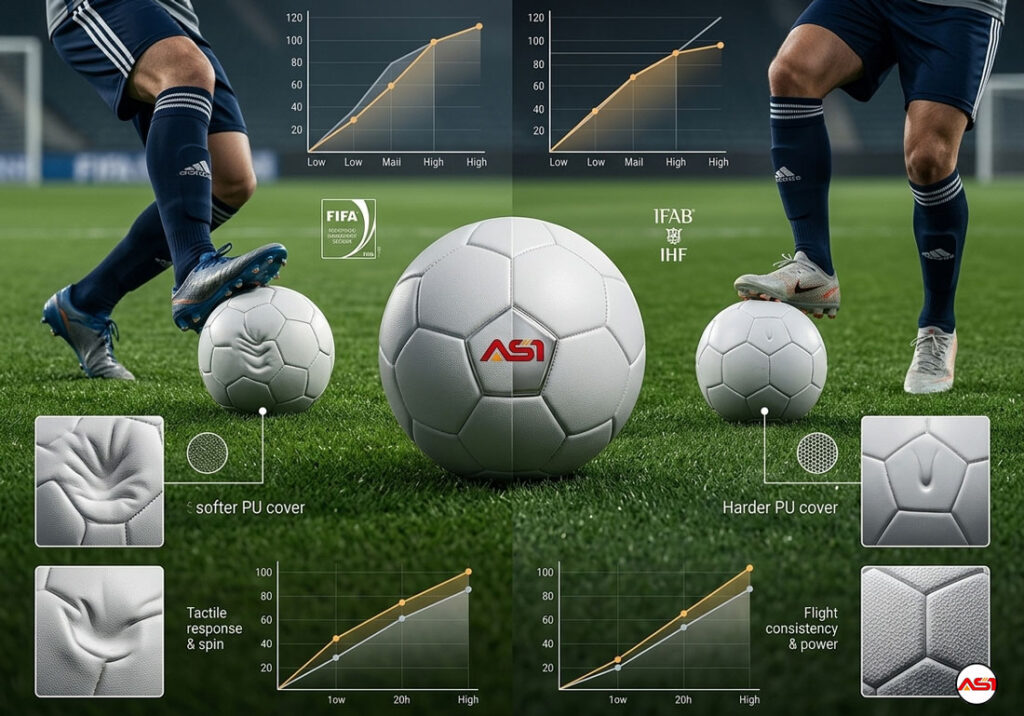
Softer covers conform fractionally to the foot, shin, or chest on contact, extending dwell time and reducing ricochet energy. Players consistently describe the ball as “sticking” rather than bouncing away. This is not a metaphor — it is the measurable consequence of the cover deforming around the contact surface and dissipating impact energy as heat rather than returning it as elastic rebound.
The dwell time between boot and ball during a typical pass is approximately 8 to 10 milliseconds. A five-point decrease in Shore A hardness can extend that contact window by 1 to 2 milliseconds. That sounds negligible. At the speeds of professional play, those extra milliseconds represent the difference between a cleanly redirected ball and one that skips off at an unintended angle.
Spin and Curl
A lower Shore A value increases the effective friction surface during the kick. When a boot strikes a softer ball, the cover yields slightly into the boot’s surface texture, increasing the area of frictional contact and allowing more rotational force to transfer into the ball. Free-kick specialists and attacking midfielders who rely on curl and dip actively prefer softer-cover balls for exactly this reason. It is not superstition — it is material science working in their favour.
Passing Precision
Medium-hardness covers transmit force more predictably across the full range of pass weights. Extremely soft covers can absorb energy unevenly across the contact surface, introducing small but meaningful deviations in direction. This is why you will find that the softest balls in a manufacturer’s range are not usually recommended for high-volume passing drills. The optimal zone for technical passing work sits around Shore A 48–54.
Strike Power
Firmer covers deform less on impact and return more energy to the ball via elastic rebound. Power shooters and players focused on long-range strikes often prefer firmer balls because the energy loss through cover deformation is minimised. The trade-off is that the ball is less forgiving of imperfect contact — a slightly mistimed strike on a firm ball transmits the error more obviously than it would on a softer one.
Wet-Surface Behaviour
Water absorption is where hardness becomes operationally critical for match play. Softer PU foams can be more porous; if the surface lamination or anti-hydrolysis coating is compromised, a wet ball can gain up to 10% in mass across 90 minutes. FIFA’s Quality Pro standard explicitly prohibits this, but the prohibition is measured through performance testing — it does not specify the hardness level required to achieve it. In practice, manufacturers solve the water-absorption problem through surface sealing and lamination technology rather than by simply hardening the cover. This means a well-engineered soft-cover ball can be fully water-resistant, but it requires superior manufacturing quality to achieve.
Aerial Control: Heading and Chest Trapping
For aerial work, softer covers are unambiguously superior in their effect on player experience. A harder PU cover transmits more impact force to the head or chest on contact, increasing discomfort and reducing the ability to cushion and redirect the ball in one motion. Youth football federations have increasingly recommended softer-cover balls — sometimes below Shore A 45 — for development-age programmes precisely because they reduce heading impact forces during periods when players are building technical habits. The England Football Association, among others, has specifically addressed ball specification in its heading guidelines for youth players.
4. Regulatory Standards and Compliance
No international governing body currently mandates a specific Shore A hardness number in isolation. Instead, they specify performance outputs — rebound height, water absorption limit, shape retention, weight retention — that the ball must achieve under standardised test conditions. These output requirements indirectly constrain the hardness range that works in practice, but they do not fix it to a single value.
FIFA Quality Programme
FIFA operates a tiered certification programme for footballs, administered through its authorised test institutes. The relevant tiers for competitive play are:
FIFA Quality Pro — the highest tier, required for all FIFA competitions and elite national league use. Key requirements include:
- Circumference: 68–70 cm
- Weight: 410–450 g at the start of the match
- Rebound: 60–65 cm when dropped from 2 metres at 20°C
- Water absorption: maximum 10% weight increase after exposure
- Shape and size retention: must maintain circumference within 1.5% after 2,000 impacts
- Pressure loss: maximum 20% over 72 hours
FIFA Quality — the second tier, appropriate for regional professional leagues, national association competitions, and elite amateur use. Specifications align closely with Quality Pro but with slightly relaxed roundness tolerance and a water absorption limit of 15%.
IMS (International Matchball Standard) — an entry-level certification for match play. Rebound tolerance is wider (50–65 cm), and manufacturing tolerances are less strict. This is the minimum standard that serious clubs should require for any competitive fixture.
IFAB Laws of the Game — Law 2
The International Football Association Board, which codifies the universal laws governing association football, addresses ball equipment in Law 2. The law specifies:
- The ball must be spherical
- Circumference: 68–70 cm (Size 5)
- Weight: 410–450 g at the start of the match
- Inflation pressure: 0.6–1.1 atmospheres (approximately 8.7–16 psi) at sea level
- Made of suitable material
The phrase “suitable material” is deliberately broad. IFAB defers to FIFA’s Quality Programme for material-specific guidance in competition. Critically, Law 2 contains no direct hardness specification — which means a ball that fails the touch test for match use can still technically comply with the letter of the law.
IHF Approved Standard (Handball)
The International Handball Federation’s approval standard for synthetic-cover match balls provides a useful cross-reference point because handball places even more emphasis on grip and touch than soccer does. IHF requirements for synthetic balls include:
- Rebound: minimum 60% from 2 metres
- Mass: 425–475 g for Size 3 (men’s)
- Cover: leather or approved synthetic material
- Panel adhesion and seam durability standards
The implied Shore A range for IHF-compliant synthetic covers runs from roughly 40 to 55 — even softer than the FIFA match ball window, reflecting handball’s emphasis on hand-feel, grip, and deceptive wrist movement.
Regulatory Compliance Summary Table
| Standard | Governing Body | Rebound Requirement | Water Absorption Limit | Implied PU Hardness Range |
|---|---|---|---|---|
| FIFA Quality Pro | FIFA | 60–65 cm (from 2 m) | Max 10% weight gain | Shore A 45–57 |
| FIFA Quality | FIFA | 60–65 cm (from 2 m) | Max 15% weight gain | Shore A 48–62 |
| IMS | FIFA | 50–65 cm (from 2 m) | Max 15% weight gain | Shore A 50–65 |
| IFAB Law 2 | IFAB | No direct spec | No direct spec | Performance-implied only |
| IHF Approved | IHF | Min 60% (from 2 m) | Not specified | Shore A 40–55 (synthetic) |
5. The Hardness-Pressure Interaction
One of the most underappreciated factors in ball performance is the interaction between cover hardness and internal inflation pressure. These two variables are not independent — they combine to produce the effective surface resistance that a player experiences.
IFAB Law 2 permits a pressure range of 0.6 to 1.1 atmospheres. This is a substantial band. A softer-cover ball (Shore A 47) inflated to 1.05 atm will play noticeably firmer than the same ball at 0.75 atm. Conversely, a firmer-cover ball (Shore A 60) under-inflated to 0.65 atm can mask its rigidity, delivering unexpectedly soft touch — and critically inconsistent bounce.
The optimal combination for elite match play, based on current manufacturing practice and player feedback from professional leagues, is Shore A 48–54 at 0.8–0.9 atm (approximately 11.6–13 psi). This window reliably satisfies FIFA Quality Pro rebound requirements while maximising touch responsiveness across the range of temperatures encountered in outdoor competition.
Temperature and hardness: PU polymers stiffen in cold conditions. A ball rated Shore A 50 at 20°C — the temperature at which FIFA certification tests are conducted — may behave closer to Shore A 58–62 at 5°C. Clubs playing winter fixtures should account for this by selecting balls at the softer end of the compliant range, or by storing match balls at room temperature until shortly before kick-off.
6. Hardness Comparison by Ball Type and Use Case
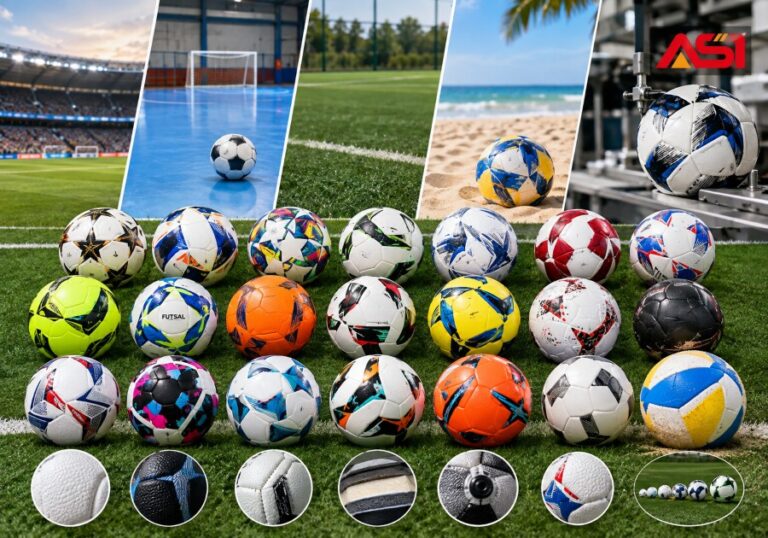
| Ball Category | Shore A Range | Panel Construction | Primary Use | Certification |
|---|---|---|---|---|
| Professional match ball | 45–52 | Thermo-bonded, 6–8 panels | Elite competition | FIFA Quality Pro |
| Club match ball | 50–56 | Machine-stitched, 32 panels | Competitive fixtures | FIFA Quality / IMS |
| Training match ball | 53–58 | Machine-stitched, 32 panels | Daily training | FIFA Quality / IMS |
| Futsal ball | 55–62 | Foam-filled, low-rebound | Hard court play | FIFA Futsal Quality |
| Beach soccer ball | 42–50 | 6 panels, thick foam backing | Sand surface | FIFA Beach Quality |
| Youth development ball | 40–48 | 32 panels, extra-thick PU | Age 5–14 training | Club / regional |
| Promotional / recreational | 60–75 | Machine-stitched, PVC-PU blend | Casual play | None |
7. Choosing the Right Hardness for Your Game
By Playing Position
The optimal PU hardness is genuinely position-dependent at the elite level:
- Goalkeepers benefit most from softer covers (Shore A 45–50). The ability to read spin on aerial balls and take clean catches depends heavily on how the ball’s surface behaves against the glove, and softer covers amplify spin cues.
- Central midfielders and playmakers favour soft-to-medium (Shore A 47–53). First-touch control, passing weight, and the ability to whip the ball around a wall are all enhanced by softer PU.
- Centre-backs and holding midfielders are well-served by medium hardness (Shore A 52–56), which balances control with the consistent clearance response needed when heading under physical pressure.
- Strikers focused on power often prefer slightly firmer balls (Shore A 55–60). Energy transfer on contact is maximised, and the reduced cover deformation means a cleanly struck ball travels truer.
- Full-backs and wide forwards occupy the soft-to-medium window (Shore A 48–55): soft enough for close control and crossing curl, firm enough for driven crosses and long diagonal passes.
By Playing Surface
- Natural grass, temperate climate: The Shore A 48–54 window is the standard recommendation and works reliably across the full range of professional pitches.
- Artificial turf (3G/4G): Firmer covers (Shore A 55–62) resist panel abrasion significantly better and maintain roundness across more training sessions. Soft-cover balls used on artificial turf show accelerated surface wear.
- Beach/sand: Softer covers (Shore A 42–50) absorb the irregular, high-friction contact of sand surfaces and reduce player discomfort on barefoot or boot-optional play.
- High altitude (above 1,500 m): Lower air density slightly alters aerodynamic behaviour. A softer cover helps compensate for reduced drag effects on ball flight. FIFA mandates altitude testing adjustments for competitions above 2,500 m.
By Training Objective
- Technical skill sessions: Use the softest compliant ball available. Extended dwell time during contact genuinely accelerates technique development — this is backed by sports science research on motor skill acquisition and haptic feedback.
- Physical conditioning drills: A medium-to-firm ball (Shore A 53–58) reduces injury risk in repetitive heading, volleys, and high-volume shooting sessions.
- Set-piece rehearsal: Use the exact specification of the ball your competition requires. If competing under FIFA Quality Pro, train with FIFA Quality Pro. Any hardness discrepancy between training and match ball means players are calibrating muscle memory to the wrong response curve.
- Goalkeeper training: Vary the hardness deliberately. Training with both softer (touch, reflexes) and medium (power shots, aerial command) covers builds adaptability.
8. Manufacturing Quality and Hardness Consistency
Understanding target hardness specifications only solves half the problem. The other half is manufacturing consistency — how reliably a batch of balls actually hits the specified Shore A range across every unit produced.
In low-quality production runs, Shore A variation of ±8 to ±10 units across a batch of 50 balls is common. This means a club ordering “Shore A 52” training balls may receive individual balls spanning Shore A 44 to Shore A 60 — a range that encompasses fundamentally different performance characteristics. Players training with this batch are unknowingly calibrating to different equipment every session.
Professional-grade manufacturing holds tolerances to ±2 Shore A units across a production run. This consistency is not a luxury specification — it is the baseline requirement for structured technical development programmes where skill acquisition depends on predictable equipment feedback.
The key quality markers to evaluate when procuring balls in volume are:
- Published Shore A specification with documented test methodology
- Panel thickness consistency (industry standard: ±0.1 mm)
- Bladder material specification (latex for touch-sensitive applications; butyl for pressure retention)
- Backing foam density and thickness
- Surface lamination method (thermal lamination outperforms adhesive lamination for water resistance)
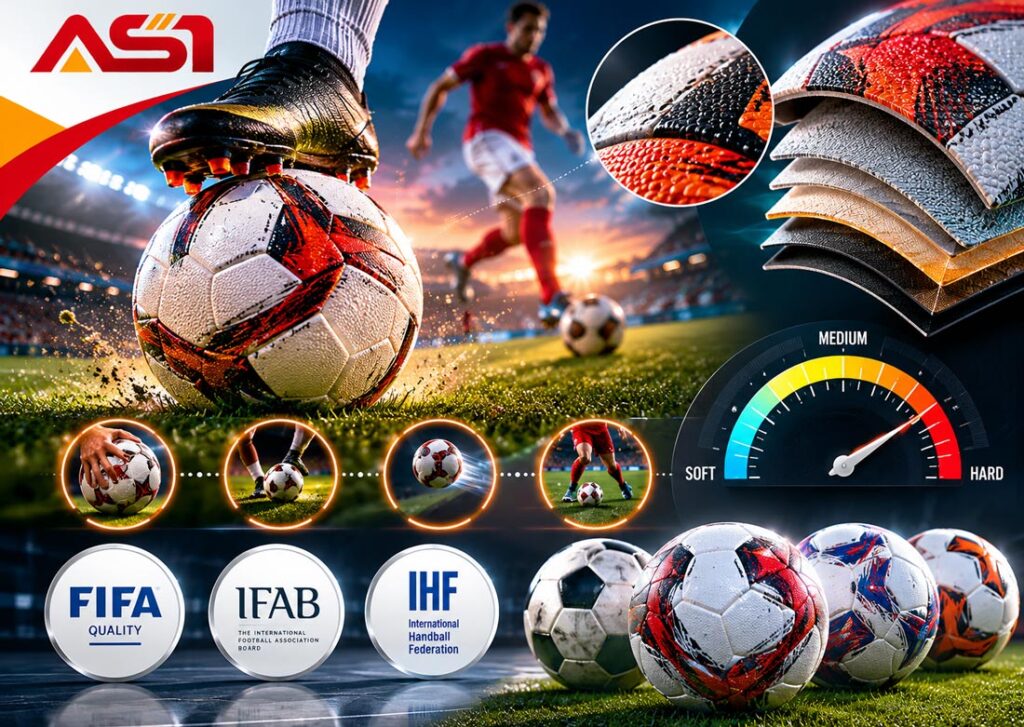
ASI Soccer manufactures and supplies soccer balls that meet international performance standards — including FIFA Quality and FIFA Quality Pro certifications — with published hardness specifications and manufacturing tolerances. For clubs and academies requiring consistent performance across bulk procurement, matching hardness specification to use case at controlled tolerances materially changes both playing development outcomes and long-term equipment budgets.
9. The Future of PU Technology in Ball Manufacturing
The evolution of PU cover technology has not plateaued. Several active development directions are worth tracking:
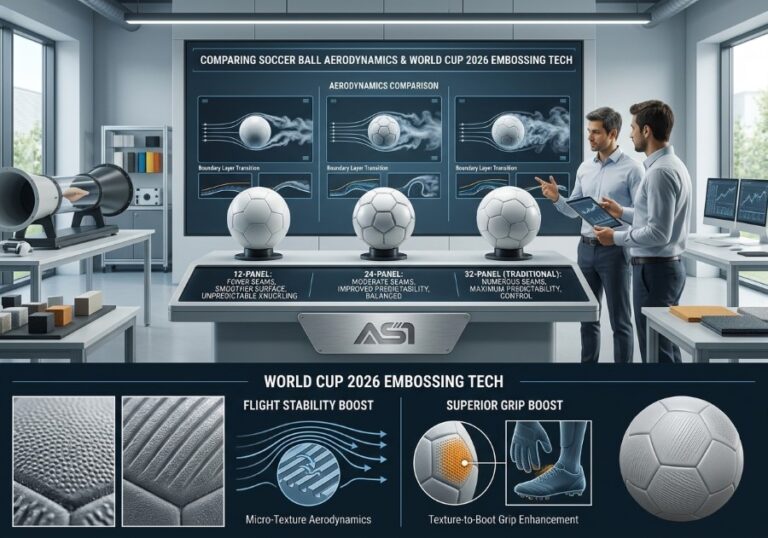
Micro-textured surfaces: Modern manufacturing can engineer surface texture at the sub-millimetre scale into the PU layer, altering aerodynamic behaviour and grip characteristics without changing bulk hardness. The distinctive surface patterns on recent World Cup balls are not aesthetic — they are aerodynamic and grip engineering.
Temperature-adaptive PU: Research into thermoresponsive polymers is exploring PU formulations that maintain a narrower effective hardness range across temperature variation. A ball that plays Shore A 50 in both summer heat and winter cold would eliminate one of the most significant and least-controlled variables in professional play.
Sustainability: Growing pressure on manufacturers to reduce reliance on petrochemical-derived PU has accelerated the development of bio-based polyurethane covers. Early bio-PU formulations have reached Shore A characteristics comparable to conventional PU in controlled conditions, though long-term durability data are still accumulating.
Frequently Asked Questions
Does a harder PU cover make a ball more durable?
Partially. Harder PU resists surface abrasion better, which matters significantly on artificial turf. However, overall durability also depends on cover thickness, backing foam density, panel bonding method, and bladder material. A softer, thick-cover ball with high-quality backing layers will outlast a thin, firm-cover ball in most natural-grass training environments.
Can players actually feel the difference between Shore A 48 and Shore A 55?
Yes — trained players consistently detect differences of four to five Shore A units in blind comparative tests, particularly during first-touch reception and free kicks. The difference between Shore A 48 and Shore A 55 is substantial enough that most elite players would describe one as “soft match feel” and the other as “firm training feel” without knowing the numbers.
Why do some professional match balls feel different even with the same FIFA certification?
Because FIFA certification tests performance outcomes, not material specifications. Two balls can both achieve FIFA Quality Pro rebound and water-absorption results through different hardness-thickness combinations. A very soft, thick cover can deliver the same rebound measurement as a firmer, thinner cover. The feel during play differs meaningfully even though both passed the same test.
What hardness do youth balls use?
Most governing bodies recommend Shore A 40–48 for players under 14. Softer covers reduce heading impact forces and extend foot-contact dwell time, both of which benefit technical development. Size also reduces with age: Size 3 for under-8, Size 4 for under-12, Size 5 from under-13 upward.
Is PU better than PVC for all players?
For performance, yes, without meaningful qualification. PU delivers superior touch, lower water absorption, and better shape retention across temperature ranges compared to PVC. The trade-off is manufacturing cost. PVC balls are viable for recreational or beginner use where certification compliance is not required. No FIFA-certified match ball uses a pure PVC outer layer.
How does inflation pressure interact with cover hardness?
They combine to produce effective surface resistance. A soft cover at high pressure plays firmer than its Shore A rating suggests. A firm cover at low pressure can feel deceptively soft. The optimal combination for elite match play is Shore A 48–54 at 0.8–0.9 atm (approximately 11.6–13 psi), which satisfies FIFA Quality Pro rebound standards while maximising touch responsiveness.
How do I know if a ball manufacturer is actually hitting their stated Shore A specification?
Request a technical data sheet showing Shore A values measured by an independent test institute. Reputable manufacturers test to ASTM D2240 (Shore Durometer standard) or equivalent ISO 868. Batch-level test certificates, rather than type-approval only, indicate a manufacturer controlling production quality rather than simply certifying a single prototype.
Conclusion
PU cover hardness is one of the most consequential and least discussed technical specifications in football equipment. It determines how the ball responds to every touch, pass, shot, and header across every minute of every session. The governing bodies — FIFA through its Quality Programme, IFAB through Law 2, IHF through its approval standards — have constructed their certification frameworks around performance outcomes that implicitly depend on getting this specification right.
For players, the practical message is straightforward: softer covers (Shore A 45–52) serve technical development and match-quality touch; firmer covers (Shore A 55–65) serve durability on abrasive surfaces and power training. Neither end of the spectrum is universally superior. The art is matching the specification to the purpose.
For clubs and academies, the message is about consistency as much as level. Batch-to-batch hardness variation undermines skill acquisition in ways that are invisible but real. Procuring from suppliers who publish and control their hardness specifications — and who offer the full range from soft match balls to durable training balls at compliant certification levels — is an investment in the reliability of the training environment itself.
ASI Soccer supplies international-standard balls across the full certification spectrum, from FIFA Quality Pro match balls at Shore A 48–52 to durable artificial-turf training balls at Shore A 55–60, at pricing structures that make specification-matched procurement accessible beyond the elite club tier. The game’s governing frameworks set the floor. Knowing the specifications and demanding them from your supplier is how you build on it.