

Shore A, Shore C, and Asker C Durometer Testing: The Definitive Guide for Sports Ball Standards
If you manufacture, certify, or purchase sports balls at an international level, hardness testing is not optional — and the scale you use matters enormously. Shore A measures soft, flexible materials. Shore C targets medium-firm compounds. Asker C (used almost universally in Asian and Japanese ball-manufacturing standards) measures softer foams and bladder materials with higher sensitivity at low hardness ranges. Using the wrong durometer scale produces meaningless results, causes regulatory non-compliance, and sends production batches back to the factory. Know your scale, know your material, know your standard.
Why Hardness Testing Is the Backbone of Sports Ball Quality
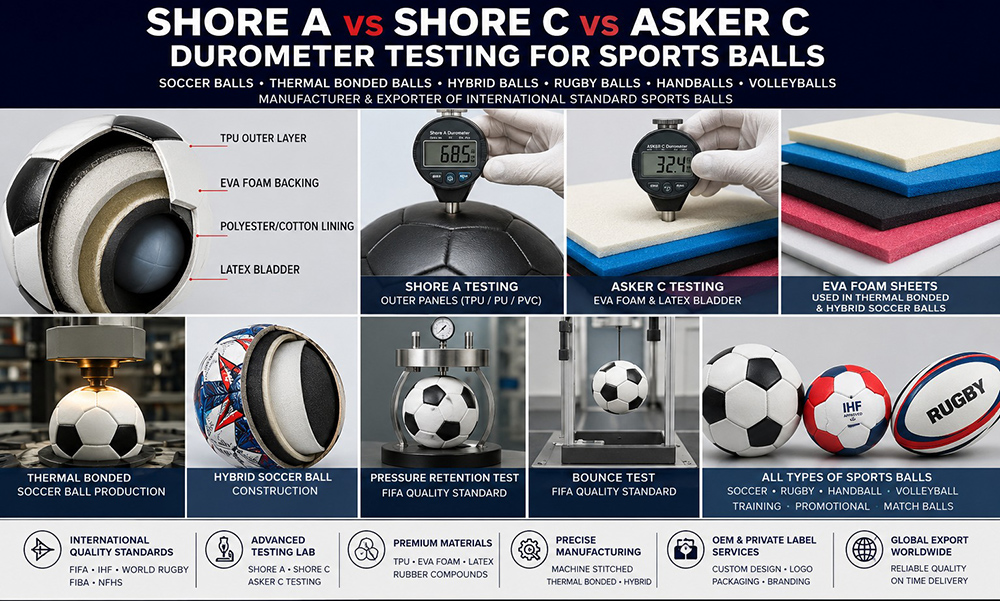
A soccer ball is not just stitched leather and air. It is a precisely engineered system — outer casing, foam backing, lining layers, and an internal bladder — each made from materials that must meet exact mechanical specifications. Too hard, and the ball causes injury or fails to behave predictably. Too soft, and it deforms under pressure, loses rebound consistency, and fails international certification.
The instrument that sits at the center of this quality chain is the durometer — a spring-loaded device that presses an indenter into a material surface and measures its resistance to penetration. That resistance, expressed as a number from 0 to 100, is the hardness value. The higher the number, the harder the material.
But here is where most people go wrong: there is no single universal durometer scale. The three scales most relevant to sports ball manufacturing — Shore A, Shore C, and Asker C — differ in their indentor geometry, spring force, and sensitivity range. Each was designed for a different category of materials. Applying the wrong scale is like measuring your weight in kilometers.
Understanding the Three Scales
Shore A: The Workhorse for Flexible Materials
Shore A is the most widely recognized durometer scale in the world. Governed by ASTM D2240 and ISO 868, it uses a truncated cone indenter and a spring force calibrated for soft, flexible elastomers and polymers.
Typical Shore A range for sports ball materials:
| Material | Approximate Shore A Value |
|---|---|
| Latex bladder (raw) | 20–35 |
| TPU outer panel | 55–75 |
| PVC synthetic leather | 60–80 |
| Rubber outsole compound | 50–70 |
| Soft foam backing | 10–30 |
Shore A is the go-to scale when you are testing the outer casing panels of a soccer ball, the synthetic leather surface of a volleyball, or the TPU shell of a futsal ball. Most European and American testing laboratories default to Shore A when no specific scale is prescribed.
Key limitation: Shore A loses sensitivity at extreme ends of its range. Values below 20 or above 90 Shore A are unreliable — the indenter either sinks fully into very soft material or barely penetrates very hard material, both producing erratic readings.
Shore C: The Middle Ground for Firm Compounds
Shore C occupies a less-discussed but practically important position. It uses the same indenter geometry as Shore A but operates with a significantly higher spring force — approximately 4.45 N versus Shore A’s 0.55 N at zero indentation, plus a larger load component.
This makes Shore C ideal for medium-firm to firm rubber compounds that would read above 90 on Shore A (and therefore be unreliable) but are not hard enough to warrant Shore D.
When Shore C becomes relevant in sports manufacturing:
- Hard rubber bladder walls in older ball constructions
- Firm rubber granules used in artificial turf (relevant to ball-surface interaction testing)
- High-density EVA midsoles in cleats worn during ball sport testing protocols
- Certain handball casings with stiffened rubber compounds
In practice, Shore C is less commonly specified in modern international soccer ball standards than Shore A or Asker C, but it appears in specialized industrial and footwear testing relevant to the broader sportswear supply chain.
Asker C: The Asian Standard for Foam and Soft Compounds
Asker C is defined by the Society of Rubber Science and Technology of Japan (SRSJ) and is standardized under JIS K 7312. It uses a flat, disc-shaped indenter (rather than a cone) and a spring calibrated specifically for soft foams, EVA compounds, and latex foams — materials that fall in the awkward “too soft for Shore A to be precise” territory.
This is the critical scale for soccer ball bladder and foam backing testing in Asian manufacturing environments, including Pakistan, China, and South Korea — collectively responsible for the vast majority of the world’s FIFA-certified ball production.
Asker C vs. Shore A — practical comparison:
| Property | Shore A | Asker C |
|---|---|---|
| Indenter Shape | Truncated Cone | Flat Disc |
| Spring Force at 0 indent | 0.55 N | 0.55 N (similar start) |
| Maximum Force | 8.05 N | 4.40 N |
| Best Sensitivity Range | 20–90 HA | 10–80 HC |
| Primary Use | Elastomers, TPU, PVC | EVA foam, soft latex, bladder foam |
| Governing Standard | ASTM D2240 / ISO 868 | JIS K 7312 |
| Common in Soccer Mfg. | Yes (outer casing) | Yes (foam & bladder layers) |
An important practical note: a reading of 45 Asker C is not equivalent to 45 Shore A. The two scales are not linearly interchangeable. A soft foam that reads 45 Asker C might read anywhere from 25–38 Shore A, depending on material composition. Always confirm which scale was used when comparing specifications across suppliers.
How International Football Regulators Specify Hardness
FIFA, the global governing body for football (soccer), does not leave material hardness to interpretation. Its certification programs — FIFA Quality and FIFA Quality Pro — specify testing protocols in exhaustive detail.
FIFA Quality Pro (Match Ball Standard)
Under FIFA Quality Pro requirements, soccer balls must pass eight key performance tests:
- Circumference
- Sphericity
- Rebound
- Water absorption
- Loss of pressure
- Shape and size retention
- Panel surface hardness (relevant to durometer testing)
- Seam strength
For panel surface hardness, the ball’s outer casing must present uniform resistance across all panels. Testing laboratories typically apply Shore A to the outer synthetic leather or TPU surface. Acceptable hardness values for match-grade outer casings typically fall in the 60–80 Shore A range, though FIFA’s published test reports express this through structured deflection and rebound protocols rather than a single durometer number.
For internal components — particularly the bladder — Asian manufacturers and testing facilities more commonly apply Asker C, given its superior sensitivity in the foam and latex hardness ranges that bladders occupy.
FIFA Futsal Ball Standard
Futsal balls present a unique case. They use a reduced-bounce inner foam fill instead of a standard air bladder, making foam hardness testing especially critical. This foam layer is almost always evaluated using Asker C, as it sits squarely in the scale’s ideal sensitivity range (typically 20–50 Asker C for futsal foam fills).
Other Governing Bodies
- UEFA follows FIFA testing protocols for UEFA-sanctioned balls.
- FIBA (basketball) specifies hardness through inflation pressure and panel indentation tests; direct durometer readings are more common in supply chain QC than in published FIBA certification.
- World Rugby specifies material properties for rugby balls that overlap with Shore A testing for synthetic leather panels.
- IHF (International Handball Federation) approval for handballs includes surface friction and grip testing that indirectly relates to Shore A surface hardness of the panel material.
The Practical Testing Protocol: Step-by-Step
Whether you are running incoming material inspection or final product QC, the testing procedure matters as much as the scale selection. Here is the standard approach used in ISO-compliant testing environments:
Step 1 — Sample conditioning Condition all samples at 23°C ± 2°C and 50% ± 5% relative humidity for a minimum of 16 hours before testing. Temperature dramatically affects polymer hardness; an unconditioned sample can read 5–10 durometer points off from its true specification value.
Step 2 — Surface preparation The test surface must be flat, smooth, and free of contamination. For curved ball panels, cut a flat test specimen of a minimum 6 mm thickness. Testing directly on a curved ball surface introduces angular error.
Step 3 — Indenter application Apply the durometer presser foot parallel to the sample surface. Apply contact quickly and without shock. Read the value at 15 seconds for viscoelastic materials (most foams and TPU). Instantaneous readings are permitted for highly elastic materials but must be specified in the test report.
Step 4 — Sampling points Take a minimum of 5 readings per specimen at points no less than 6 mm apart and 12 mm from any edge. Report the median value, not the average — outliers from surface irregularities can skew averages.
Step 5 — Document the scale. This sounds obvious, but it is the most commonly omitted step in supplier QC reports. A hardness value without its scale designation is meaningless. “65 hardness” tells you nothing. “65 Shore A (ASTM D2240, 15-second reading, 23°C)” tells you everything.
Common Testing Mistakes and How to Avoid Them
Mistake 1: Using Shore A on very soft foam. Foam backing materials below 20 Shore A produce erratic readings because the indenter sinks to maximum depth unpredictably. Switch to Asker C for these materials.
Mistake 2: Comparing Shore A and Asker C values. A supplier directly reports “45 HC,” and your specification says “45 HA.” These are not the same material. Always request clarification and, where possible, run comparative testing on the same sample using both scales to build your own conversion reference for your specific materials.
Mistake 3: Testing through the ball surface without specimen cutting. Testing outer hardness on an inflated ball introduces pressure effects and curvature errors. Panel test specimens must be cut and conditioned flat before testing.
Mistake 4: Ignoring temperature variation on the production floor. A factory floor in Sialkot in July can reach 38°C. Testing materials at ambient factory temperature without conditioning to ISO standard conditions produces results that are neither repeatable nor comparable to laboratory specifications.
Mistake 5: Using a worn durometer. Durometer indenters wear over time. Calibration against reference standards should occur every 12 months at a minimum, or every 50,000 cycles — whichever comes first. A worn indenter systematically reads lower than the actual hardness.
A Real-World Example: How Hardness Affects Ball Performance
Consider a standard-size 5 FIFA-certified match ball with the following construction:
- Outer casing: Micro-fiber synthetic leather
- Foam backing: 3 mm EVA foam
- Lining: 4-ply polyester/cotton
- Bladder: Latex
Testing scenario:
The outer casing should read approximately 68–72 Shore A. If it comes in at 55 Shore A, the panel surface is too soft — it will scuff easily, absorb water more readily through micro-surface compression, and lose shape under repeated impact.
The EVA foam backing should read approximately 30–45 Asker C. If it reads 55 Asker C, the foam is too firm — it reduces the progressive feel at ball contact, increases felt impact hardness for the player, and changes the ball’s energy return characteristics in ways that affect rebound test results.
The latex bladder wall should read approximately 25–35 Shore A when tested as a flat cut specimen. If it reads 50 Shore A, the bladder has excessive stiffness, which compromises pressure retention uniformity and creates an asymmetric ball under inflation.
Each of these values, tested on the wrong scale, would produce meaningless data and potentially pass or fail material that should have done the opposite.
FAQ: Durometer Testing for Sports Balls
Q: Can I convert Shore A values to Asker C values mathematically?
There is no single universal conversion formula. Conversion curves exist for specific material families (e.g., natural rubber, EVA foam), but they are material-specific. For reliable cross-scale comparison, always test the same physical specimen on both scales and document your own conversion reference.
Q: Does FIFA publish minimum Shore A values for match ball panels?
FIFA’s published test standards express ball performance through functional tests (rebound, shape retention, water absorption) rather than direct durometer cutoffs. However, FIFA-accredited laboratories use Shore A as part of incoming material QC. Contact your certification laboratory for their specific incoming material specification sheets.
Q: What durometer scale do Pakistani ball manufacturers in Sialkot typically use?
Most Sialkot-based manufacturers use Shore A for outer panel and casing testing (as required by European buyers) and Asker C for foam and bladder component testing (aligned with Japanese and Asian QC standards). Many facilities maintain both instruments in their QC labs.
Q: Is Shore C used in any current FIFA or UEFA ball testing protocol?
Shore C is not a primary scale in FIFA Quality or FIFA Quality Pro test protocols for ball surfaces. Its main use in the sports manufacturing supply chain is for intermediate-hardness rubber compounds in footwear and turf granule applications.
Q: How many test points are required for a valid durometer reading per FIFA QC standards?
ISO 868 (the underlying standard) requires a minimum of 5 readings per specimen. FIFA-accredited lab protocols may specify additional sampling across multiple panels of the same ball.
Q: Does the thickness of a sample affect durometer readings?
Yes. ISO 868 requires a minimum specimen thickness of 6 mm. Thinner samples produce artificially high readings because the indenter force transfers to the backing surface beneath the specimen. Always stack identical specimens to reach the minimum thickness if needed.
Q: What is the difference between instantaneous and time-delayed durometer readings?
An instantaneous reading is taken at the moment the indenter contacts the sample. A time-delayed reading (typically 15 seconds) allows the material to creep and deform under the indenter. For viscoelastic materials like EVA foam and TPU, the 15-second value is more representative of in-use hardness. Always specify which method was used.
What This Means for Sports Ball Buyers
When sourcing footballs, futsal balls, or any certified sports ball from a manufacturer, hardness testing documentation should be a standard part of your quality assurance package. Ask for:
- The durometer scale used (Shore A, Asker C, or Shore C)
- The governing standard referenced (ASTM D2240, ISO 868, JIS K 7312)
- The test temperature and conditioning protocol
- The number of readings and the reported value type (median, average)
- The instrument calibration date
A supplier that cannot provide this information clearly is a supplier whose QC processes are not aligned with international standards.
Companies like ASI Soccer, which supply international standard sports balls and sportswear, embed these testing requirements into their manufacturing and sourcing process — ensuring that every ball that reaches players, referees, and tournaments has been validated against the correct hardness specifications for each component layer, not just the visible surface.
Scale Selection Summary: Quick Reference
| If you are testing… | Use this scale |
|---|---|
| TPU / PVC outer casing panels | Shore A (ASTM D2240) |
| Latex bladder wall | Shore A |
| EVA foam backing (soft) | Asker C (JIS K 7312) |
| Futsal foam fill | Asker C |
| Medium-firm rubber compounds | Shore C |
| Hard rubber (above 90 Shore A) | Shore D |
| Comparing Asian vs. European specs | Run both scales; document conversion |
Conclusion
Shore A, Shore C, and Asker C are not interchangeable — they are purpose-built measurement tools for different regions of the material hardness spectrum. In sports ball manufacturing, where millimeters of foam thickness and single-digit hardness variations determine whether a ball passes FIFA Quality Pro certification or fails at the testing lab, scale selection is a technical decision with real regulatory consequences.
The outer casing needs Shore A. The foam backing and bladder need Asker C. The QC report needs both values, both scales, and both standards clearly documented. Everything else is guesswork dressed up as quality control.
For players, coaches, and procurement teams who want certified performance without navigating this complexity themselves, the answer is straightforward: source from manufacturers who understand this testing landscape at a technical level. ASI Soccer maintains these standards across its product line — because a ball that feels right on the pitch is a ball that was built right in the factory, one durometer reading at a time.