

The Physics of the “Perfect” Match: Engineering Beyond FIVB Approved Ball Specs
Imagine standing at the baseline of a professional volleyball court. The crowd is a muffled hum, the lights are blinding, and in your hand sits a sphere of synthetic leather that feels less like a ball and more like a loaded spring. You toss it high—exactly 3 meters up—and leap. As your hand connects, you aren’t just hitting an object; you are initiating a complex sequence of aerodynamic events governed by strict international laws.
This isn’t just a game. It is a masterclass in physics, where the difference between a “point” and a “fault” is measured in grams or pounds per square inch. While most players see a FIVB-approved volleyball ball, engineers see a finely tuned instrument designed to push the limits of human performance.
1. The Weight & Pressure Synergy: The “Float” Mystery
The most terrifying weapon in a server’s arsenal isn’t necessarily the 100 km/h power spike; it’s the float serve. To the naked eye, the ball appears to be “dancing”—it wobbles, drops, and veers as if haunted. This “ghostly” movement is a direct result of the Weight & Pressure Synergy strictly mandated by the FIVB Official Volleyball Rules.
The Numbers Behind the Magic
According to international world-class standards, a professional indoor volleyball player must meet precise physical criteria to ensure uniform playability across global competitions:
- Weight: The ball must weigh between 260g and 280g. If the ball were heavier, it would lack the aerodynamic buoyancy required to “catch” the air; if it were lighter, even a slight draft in the arena would toss it like a beach ball.
- Circumference: The official size must be between 65cm and 67cm. This ensures the surface area is perfectly balanced with the weight to optimize its flight path.
- Internal Pressure: The FIVB stipulates a pressure of 0.30 to 0.325 kg/cm² (approximately 4.26 to 4.61 psi).
Why 4.3 PSI is the “Sweet Spot” for Physics
When a player strikes a ball inflated to the standard 4.3–4.6 psi, the casing deforms slightly upon impact. This momentary deformation shifts the internal air mass and slightly alters the center of gravity for a fraction of a millisecond.
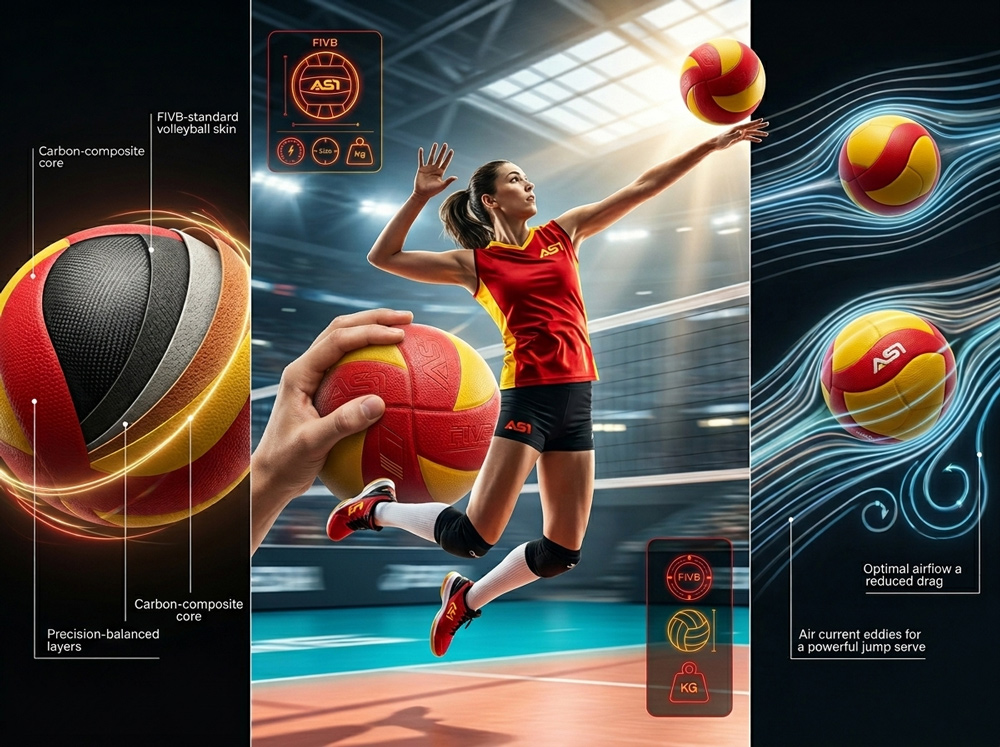
In a float serve, the objective is to strike the ball with zero spin. Because the ball is relatively light and soft, the air currents passing over the seams and panels become chaotic. This phenomenon is known as the Karman Vortex Street—a series of swirling eddies that create alternating pressure differentials, physically pushing the ball left, right, up, or down in an unpredictable manner.
The “Rigidity” Factor
The specific pressure range is critical for the “rebound” effect on a player’s arms. If a volleyball were inflated to the 12 psi typical of a soccer ball, the “float” would vanish entirely. The ball would become too rigid to deform upon impact, preventing the chaotic air-seam interaction required for that erratic, unhittable flight. Furthermore, FIVB standards ensure that the material—often a synthetic leather—complements this pressure by providing a soft touch that absorbs just enough energy to allow for high-level defensive control.
2. Material Science: From Leather to Micro-Dimples
For decades, the standard for professional volleyballs was genuine leather. While leather offered a soft touch, it possessed a significant mechanical flaw: high porosity. During a grueling five-set match, a leather ball could absorb sweat and floor moisture, gaining between 10 and 15 grams in weight. This weight gain completely compromised the ball’s aerodynamic profile, making it sluggish and unpredictable for players.
The Synthetic Revolution & FIVB Standards
To address the moisture issue, the FIVB (Fédération Internationale de Volleyball) revised its official match ball specifications to incorporate advanced synthetic leather. Modern professional balls are typically constructed with a microfiber composite that mimics the feel of leather but remains entirely waterproof.
The most significant breakthrough in recent years, however, is the introduction of the micro-dimpled surface. If you examine an official FIVB-approved ball closely, you will notice thousands of tiny, precise indentations.
Why Dimples Matter: Engineering the Flight
The integration of dimples isn’t just for aesthetics; it is a critical application of fluid dynamics:
- Boundary Layer Control: Similar to a golf ball, these dimples create a thin “turbulent boundary layer” of air that clings to the ball’s surface. This allows the air to follow the ball’s curvature for a longer period, significantly reducing the low-pressure “wake” behind it. This reduction in form drag allows the ball to maintain higher velocities during power spikes.
- Precision Moisture Management: Sweat remains the enemy of the setter. The micro-dimple pattern acts as a functional grip enhancer by providing channels for moisture to disperse. This ensures that even in high-humidity environments, a setter’s fingers find a firm, slip-free purchase for a pinpoint 1-meter set.
- Flight Stability & Anti-Stall: By stabilizing the air around the ball, dimples prevent “stalling”—where the ball suddenly loses lift and drops. This ensures the trajectory remains true to the player’s mechanical intent, resisting the influence of random ambient air currents found in large indoor arenas.
- Dual-Layer Cushioning: Most FIVB-standard balls using this technology also incorporate a double-layered internal structure to maintain the perfect spherical shape and “pop” (rebound energy) despite the textured exterior.
3. The Power Game: 18×9 Meters of Controlled Chaos
The FIVB standard court is a compact 18×9 meters. Within this relatively confined space, twelve elite athletes—often standing well over two meters tall—must navigate with the precision and grace of ballerinas. The modern “Power Game” is only possible because of the specific engineering behind the ball’s flight physics. Because the ball is designed to fly at high velocities but drop sharply due to controlled drag, players can swing with 100% force without the ball constantly sailing out of bounds.
Comparative Standards of the “Perfect” Ball
To maintain this balance between explosive power and court-bound control, the FIVB (Fédération Internationale de Volleyball) enforces a rigid set of technical specifications for every official match ball:
| Feature | FIVB Professional Standard | Why it Matters |
| Circumference | 65–67 cm | Ensures a consistent and predictable “hit zone” for the palm during spikes and serves. |
| Weight | 260–280g | Perfectly balances high-speed travel with the aerodynamic “wobble” required for effective float serves. |
| Internal Pressure | 0.30–0.325 kg/cm² | Creates the ideal “rebound” energy off the forearm, allowing for precise defensive “digs” and passes. |
| Panel Construction | 18 Panels | Standardizes the seam-to-surface ratio, which is critical for maintaining stable flight paths and consistent spin. |
The Role of Court Dimensions
The interaction between the ball and the court is further governed by specific markings that dictate player movement and strategy:
- The Attack Line: Situated exactly 3 meters from the center line, this boundary restricts back-row players from attacking the ball within the front zone.
- The Free Zone: FIVB regulations typically require a free zone of at least 5 meters from the sidelines and 8 meters from the end lines in international competitions to allow for high-speed “pursuit” plays.
- Boundary Precision: Every line on a professional court is 5 cm wide, integrated into the playing area, meaning a ball touching any part of the line is considered “in”.
4. ASI Soccer: Engineering Quality at a Reasonable Price
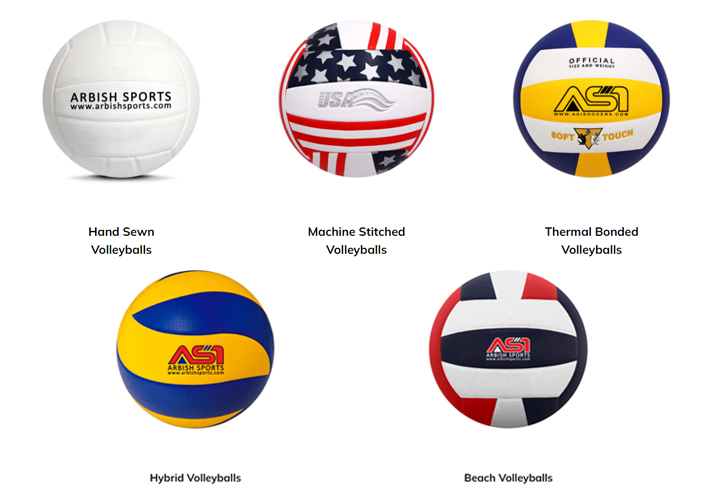
At ASI Soccer, we understand the deep science behind every stitch. Whether you are looking for a high-performance volleyball that meets rigorous standards or a soccer ball that holds its shape through a thousand strikes, our focus is on precision engineering. We maintain business partnerships with established local manufacturing firms in Sialkot, a globally recognized hub for high-quality sports equipment.
We believe that professional-grade equipment shouldn’t be reserved only for the elite. That is why ASI Soccer provides sports balls—including professional volleyballs and soccer balls—and sportswear that prioritize durability and performance at a reasonable price. Our manufacturing process, rooted in the expertise of global sports hubs like Sialkot, ensures that every ball we produce offers the same synergy of weight and pressure that the “power game” demands.
When you choose ASI Soccer, you aren’t just buying a ball; you’re buying the result of years of material science research and engagement with the manufacturing of surgical instruments and sports equipment. Our expertise ensures your game is never limited by your gear.
5. FAQ: Everything You Need to Know About Ball Specs
Understanding the technical nuances of your equipment is the first step toward mastering the game. Here are the most common questions regarding Volleyball FIVB Standards and maintenance.
Q: Can I use a soccer ball to practice volleyball?
A: No. A soccer ball is nearly double the weight—approximately 450g compared to the 260–280g standard for volleyballs. Soccer balls also operate at triple the internal pressure (often 8.7–12 psi). Using a soccer ball for volleyball can lead to severe wrist and forearm injuries, and it will not behave aerodynamically like a volleyball, specifically lacking the “float” capability.
Q: Why does my ball feel “harder” in the winter?
A: Physical materials, including the synthetic leather used in official match ball specifications, tend to stiffen in lower temperatures. Furthermore, air contracts in the cold; while the ball feels “stiff” to the touch, the internal pressure actually drops. To maintain the “sweet spot” for performance, always use a pressure gauge to ensure you remain within the 4.3–4.6 psi range required by the FIVB.
Q: How long does a synthetic FIVB-approved ball last?
A: With proper care, a high-quality synthetic ball can maintain its aerodynamic dimples and structural integrity for 1–2 years of consistent play. To maximize longevity, players should:
1- Wipe the ball down with a damp cloth after use to remove sweat and floor oils.
2- Avoid using indoor balls on rough surfaces like concrete or asphalt, which can sand down the micro-dimples.
3- Store the ball in a temperature-controlled environment to prevent the bladder from degrading.
Q: Does the color of the ball matter for FIVB standards?
A: Yes. The FIVB mandates specific color combinations (often blue, yellow, and white) to ensure the ball is easily visible to players, officials, and spectators under bright arena lighting. The panel arrangement, usually 18 panels, is standardized to ensure the seams interact with the air consistently, regardless of how the ball is rotating.
The Story is in the Sphere
The next time you see a volleyball soaring over the net, remember the invisible forces at play. Remember that the 270 grams in flight are a testament to decades of engineering. From the micro-dimples that battle drag to the internal pressure that creates the perfect float, the volleyball is a marvel of the modern world.
Whether you are a casual player at the park or a pro competing under the bright lights, your equipment is your partner. At ASI Soccer, we are proud to be part of that journey, providing the gear that lets you focus on the game, while we handle the physics.
👉 Ready to bring your vision to life? Contact ASI Soccer Company on WhatsApp today to discuss your custom sports gear and apparel needs.