
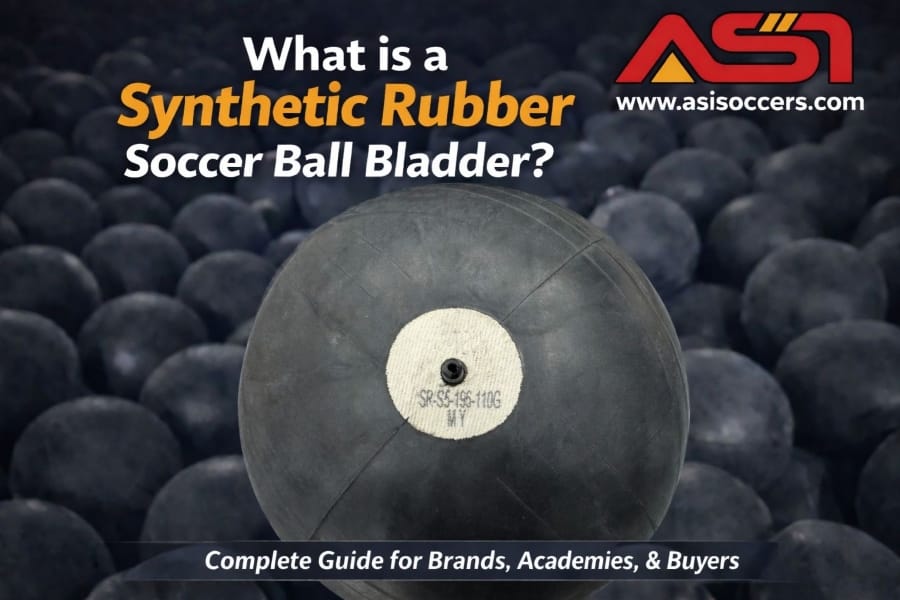
What Is A Synthetic Rubber Bladder? A Complete Guide For Brands, Academies, And Buyers
The synthetic rubber bladder, commonly referred to as the SR bladder, is one of the most misunderstood bladders. Many brand owners and customers assume it is simply a cheaper alternative to latex or butyl. In reality, the SR bladder was developed to solve a performance gap in the market and today plays a strategic role in ball engineering.
This guide explains what an SR bladder is, why it was introduced, how it compares to latex and butyl, and when it is the right choice for your soccer ball project.
The Evolution of Soccer Ball Bladders
To understand SR bladders, we first need to understand what existed before them.
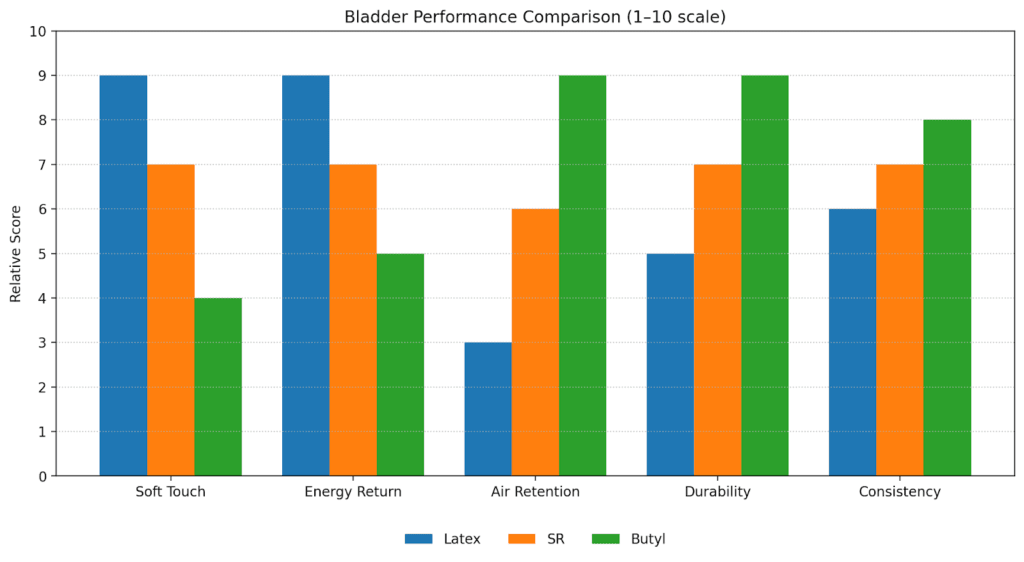
For decades, two bladder types dominated the soccer industry. Latex bladders were known for their liveliness, responsiveness, and soft touch. Butyl bladders became popular for their superior air retention and pressure stability. Each material had clear strengths, but they represented opposite ends of the performance spectrum.
Latex offered excellent rebound and feel but required frequent inflation due to higher gas permeability. Butyl offered strong air retention but slightly less bounce and a firmer response. As organized soccer expanded globally, especially through academies, schools, and amateur leagues, demand increased for a ball that could deliver both adequate rebound and reliable air retention.
By the late 1980s and early 1990s, as soccer ball production scaled significantly in Pakistan and China, manufacturers identified this performance gap. The industry needed a middle ground. This led to the rise of the synthetic rubber, or SR, bladder.
Why the SR Bladder Was Introduced
The SR bladder was not introduced as a downgrade. It was introduced as a solution. Manufacturers realized that a synthetic polymer compound could be engineered to balance elasticity and air retention more effectively. Unlike natural latex, synthetic rubber can be formulated with different ratios of polymers, fillers, and curing systems to achieve targeted performance characteristics.
Another major advantage was manufacturing flexibility. SR compounds allowed faster curing cycles and more scalable production, making them suitable for growing global demand. Cost efficiency also played a role. Because synthetic rubber materials such as styrene butadiene rubber are produced at large industrial scales, they offer economic advantages compared to natural latex and premium butyl formulations.
Over time, SR bladders were widely adopted in promotional and entry-level balls, which unfortunately created the misconception that SR equals low quality. In reality, performance depends entirely on compound grade and construction standards.
What Is an SR Bladder Made Of?
An SR bladder is typically made from styrene butadiene rubber, a synthetic copolymer derived from styrene and butadiene monomers. The compound is vulcanized using sulfur-based curing systems and reinforced with carbon black or mineral fillers.
Because the material is synthetic, manufacturers can adjust:
- Elasticity and rebound response
- Wall thickness and compression behavior
- Air permeability characteristics
- Durability and aging resistance
In premium formulations, SR bladders can be engineered to approach the liveliness of latex while maintaining air retention closer to butyl. Lower-grade formulations, however, may prioritize cost over performance.
From a brand or buyer perspective, what matters most is not the name of the material but the quality control and compound specification behind it.
SR vs Latex vs Butyl: Practical Comparison
Latex remains the most lively and responsive option. It is often used in high-level professional match environments where balls are constantly checked and reinflated. However, latex loses air faster.
Butyl offers the best air retention. It is ideal for training environments where pressure stability is critical, and maintenance may be inconsistent.
SR sits between the two. It can be engineered for balanced rebound and acceptable air retention, making it suitable for academy-level, high school, and collegiate play, especially in markets where both performance and practicality matter.
In our professional opinion, SR bladders are most valuable when they are intentionally specified for balanced performance rather than selected purely for cost reduction. A well-engineered SR bladder in a properly constructed ball can outperform a poorly specified butyl bladder.
Which Bladder Should You Choose for Your Soccer Ball?
There is no universal best bladder. The correct choice depends entirely on the usage environment and the target customer.
In the world of ball engineering, the right bladder isn’t found by accident—it’s chosen by design. Whether you need the explosive life of latex or the steady reliability of SR, ASI Soccers ensures your brand’s performance never falls flat; contact us today to find your perfect fit.