

In the high-stakes arena of amateur athletics, precision and standardization are the silent referees that ensure fairness, safety, and a level playing field. At the heart of this ecosystem in the United States stands the National Federation of State High School Associations (NFHS).
As a leading voice in the sports industry, ASI Soccer understands that adhering to these rigorous standards isn’t just about following rules—it’s about providing athletes with the tools to perform at their absolute peak.
The Evolution of the NFHS: A Century of Student-Athlete Advocacy
Established in 1920, this organization was born from a need to synchronize high school athletics across state lines. What began as a small coalition has grown into the primary governing body for amateur sports and fine arts in the United States. Based in Indianapolis, it functions as a non-profit service hub, representing 51 state associations—including the District of Columbia—and impacting millions of students annually.
Rather than acting as a federal regulator, the body serves as a collaborative platform. It ensures that a student-athlete in rural Montana competes under the same fundamental safety and fair-play guidelines as one in downtown Chicago.
The Engine of Governance: How the Organization Operates
The governance of the association is built on a committee-based architecture. Unlike professional leagues that may prioritize commercial interests, this body utilizes a democratic process driven by educators, coaches, and athletic directors.
Annual Rule Reviews
Each sanctioned sport has a dedicated rules committee that convenes once a year. During these summits, officials analyze game data, injury reports, and feedback from the field. They debate potential changes and vote on updates that reflect the evolving nature of modern athletics while maintaining the integrity of the game.
Collaboration with State Associations
While the national body provides the rulebooks, the actual implementation and enforcement fall to the individual state associations. This two-tier system allows for a unified national standard while giving states the flexibility to manage local tournament structures and eligibility requirements.
Core Pillars: The Philosophy Behind the Rules
Every regulation passed by the association is filtered through three essential lenses to ensure the program aligns with the goals of secondary education.
1. The Safety-First Mandate
The primary motivation for rule changes is risk mitigation. Whether it is mandating specific protective headgear in pole vaulting, adjusting tackling techniques in football, or setting compression standards for soccer balls, the goal is to minimize physical danger. By setting strict equipment specifications, the organization ensures that gear provides consistent protection across all schools.
2. Sports as an Extension of the Classroom
In the high school environment, the field is considered a “laboratory for learning.” The rules are designed to foster sportsmanship, discipline, and teamwork. By penalizing unsportsmanlike conduct more strictly than professional leagues, the organization reinforces the idea that character development is just as important as the final score.
3. National Equity and Standardization
Standardization prevents “rule creep” where wealthy districts might otherwise gain a technical advantage. By specifying exact dimensions for courts, weights for balls, and durations for periods, the body creates an even playing field. This equity allows for seamless interstate competition and provides a clear benchmark for manufacturers like ASI Soccer to follow when producing gear for the high school market.
Expanding the Horizon: Beyond Athletics
While sports are the most visible aspect, the organization’s influence extends into the performing arts. It provides resources and guidelines for speech, debate, music, and theater programs. By treating these activities with the same level of administrative rigor as varsity sports, the body validates the diverse talents of the entire student body, ensuring that every extracurricular activity contributes to a well-rounded educational experience.
Sports Under the Unified Umbrella: More Than Just the “Big Three”
While mainstream media often focuses on the “Big Three”—Football, Basketball, and Baseball—the organization’s oversight is vast, covering nearly 20 different athletic disciplines. This diversity ensures that students with various talents have access to standardized, safe competition.
Field Sports
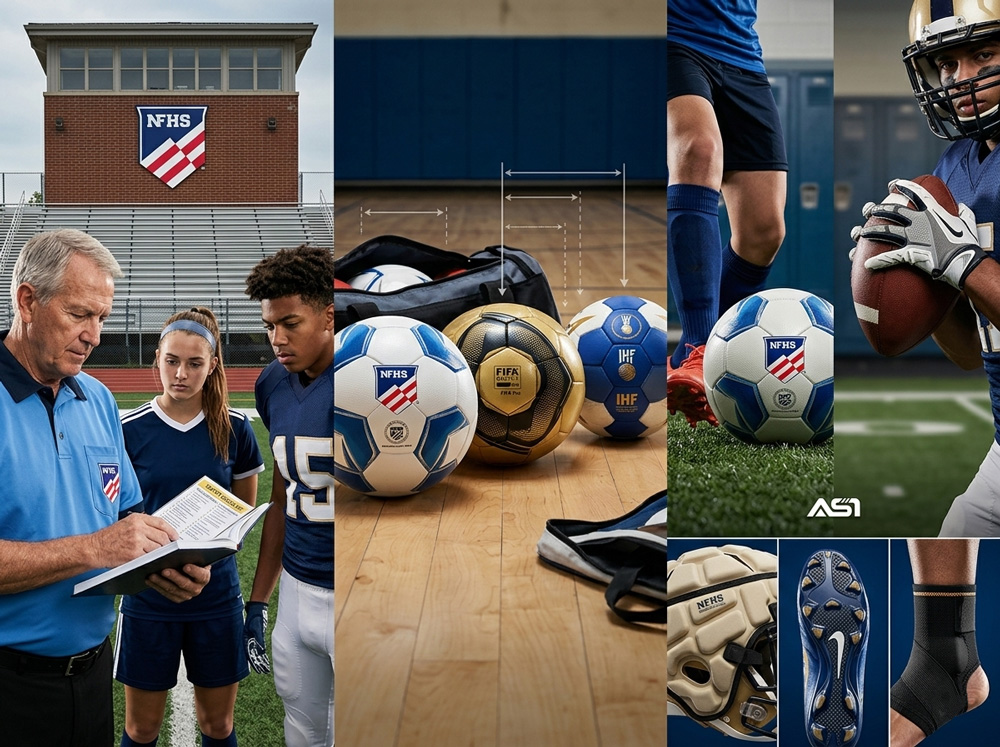
The organization maintains a rigorous set of rules for sports played on grass or turf. These include Soccer, Football, Baseball, Softball, Field Hockey, and Lacrosse. Each of these sports requires specific field markings, equipment standards (such as the NFHS Authenticating Mark on game balls), and safety protocols to manage contact and environmental factors.
Court Sports
The two primary court-based disciplines are Basketball and Volleyball. For these sports, regulations focus heavily on court dimensions, net heights, and ball pressure. In 2026, the organization introduced significant updates for Volleyball, such as allowing textured balls and simplifying the Libero’s uniform requirements to make the game more accessible and modern.
Individual and Combat Sports
The reach extends into highly technical and individual disciplines, including:
- Combat: Wrestling (where recent 2026 changes adjusted body fat percentage requirements for female athletes to prioritize health).
- Aesthetics & Precision: Gymnastics, Golf, and Tennis.
- Aquatics & Athletics: Swimming & Diving, and Track & Field.
Standardization Face-Off: The Precision of Play
In the world of high-performance sports, a millimeter of difference in ball circumference or a few grams of weight can alter a championship’s outcome. While the organization provides the framework for American high schools, international bodies like FIFA, FIVB, and the IHF set the global professional benchmarks.
1. Soccer: NFHS vs. FIFA Quality Pro
While FIFA (Fédération Internationale de Football Association) sets the global pro standard, the US high school game introduces specific technical nuances.
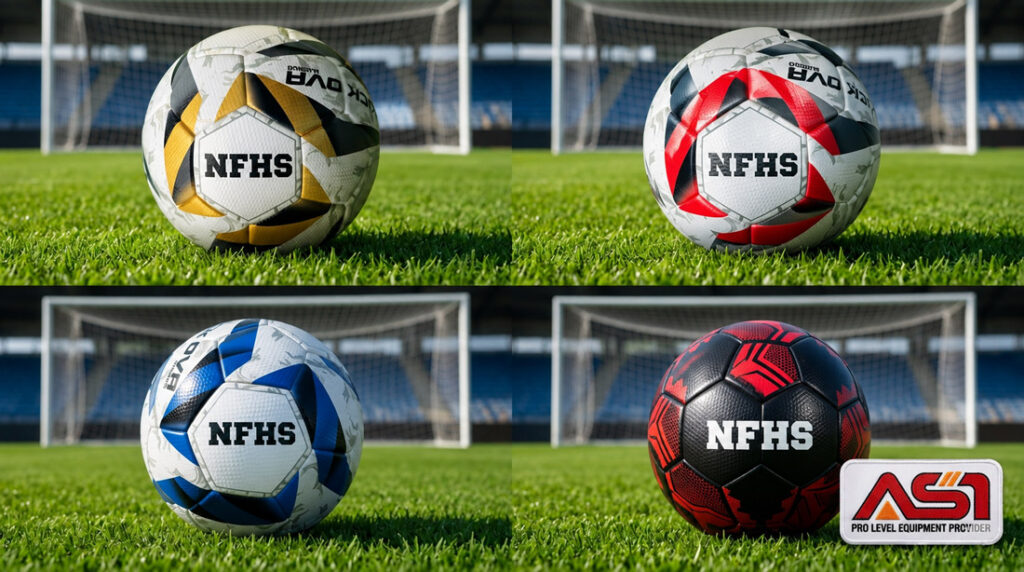
- The Authenticating Mark: For any ball to be used in post-season high school play, it must bear the NFHS Authenticating Mark. While a ball may meet FIFA Quality Pro specifications, it is ineligible for sanctioned matches without this specific seal.
- Physical Specs: Both standards align closely in size (Size 5), but the organization is strict on the casing. The outer layer must be leather or an approved synthetic that is weather-resistant.
- The Participation Rule: A major philosophical shift appears in substitutions. FIFA allows limited changes; however, the high school rules allow players to re-enter the game under specific conditions, prioritizing student-athlete development over professional-style roster management.
2. Volleyball: NFHS vs. FIVB Standards
International volleyball follows FIVB (Fédération Internationale de Volleyball) rules, but the American high school version has several distinct 2026 updates.
- Texture and Panels: Beginning with the 2026-27 season, state associations can now adopt textured or non-smooth volleyballs. This move aligns with international trends where textured surfaces are used to improve grip and flight stability.
- Pressure and Feel: FIVB balls are often calibrated for a slightly softer touch (0.300–0.325 kg/cm). In contrast, high school specifications allow for a slightly firmer feel, which is often preferred for the varied power levels found in teen athletics.
- The Libero Evolution: Recent updates now allow the Libero to wear any color uniform bottoms as long as the top contrasts with their teammates, a significant shift toward simplifying uniform compliance for schools.
3. Handball: Adapting to the Multi-Purpose Gym
Handball is a specialized discipline where the IHF (International Handball Federation) and high school standards diverge most in the environment.
- Ball Sizing: The IHF is rigid with sizes: Size 3 for men (58-60 cm) and Size 2 for women (54-56 cm).
- Safety Adaptations: Because many US schools play in multi-purpose gyms rather than dedicated handball arenas, the high school guidelines focus heavily on floor elasticity and protective equipment to prevent injuries on harder surfaces.
4. Futsal: The FIFA Pro Influence
Futsal is defined by its “low-bounce” physics. Unlike soccer, where the ball is designed to soar, a Futsal ball is weighted for the floor.
- FIFA Pro Futsal Standards: These balls must have a circumference of 62–64 cm and a weight of 400–440 grams.
- Technical Footwork: For high school athletes, using a ball that meets these exact FIFA specifications is critical. A ball with too much bounce ruins the technical essence of the game. ASI Soccer ensures that its futsal gear maintains the low-rebound properties required for high-speed, indoor court play.
Comparative Equipment Standards Table
| Feature | Soccer (NFHS) | Soccer (FIFA) | Futsal (FIFA Pro) |
| Circumference | 27–28 inches | 68.5–69.5 cm | 62–64 cm |
| Weight | 14–16 oz | 420–445 g | 400–440 g |
| Pressure | 8.5–15.6 psi | 0.6–1.1 atm | 0.6–0.9 atm |
| Marking | NFHS Authenticating Mark | FIFA Quality Pro Logo | FIFA Quality Pro Logo |
Why Quality Matters: The ASI Soccer Advantage
Navigating these complex regulations requires a partner who knows the technical landscape. ASI Soccer provides international-standard sports balls and sportswear that meet the stringent requirements of both the NFHS and international bodies like FIFA and IHF.
By balancing technical precision with reasonable pricing, ASI Soccer ensures that schools and clubs don’t have to choose between their budget and their performance. Whether you need a high-rebound soccer ball for an NFHS-sanctioned tournament or a low-bounce FIFA-spec futsal ball, ASI Soccer delivers gear that feels professional and plays by the rules.
FAQ: Quick Answers for Coaches & Players
Q: Can we use a FIFA Pro ball in an NFHS match?
A: Yes, provided it also carries the NFHS Authenticating Mark. Many high-end balls from manufacturers like ASI Soccer are designed to meet both standards simultaneously.
Q: What is the main difference in NFHS game timing?
A: In soccer, for example, the clock typically counts down to zero in NFHS play, whereas in FIFA/International play, the clock counts up and the referee adds “stoppage time.”
Q: Does the NFHS regulate jersey designs?
A: Heavily. There are strict rules about number placement, size, and contrasting colors for the home and away teams to ensure visibility for officials.
👉 For further assistance, please contact the ASI Soccer support team today.