

Uniforms for Every Athlete: Adaptive & Plus-Size Sportswear: The Future of Inclusive Manufacturing
The Inclusivity Gap in Performance Apparel
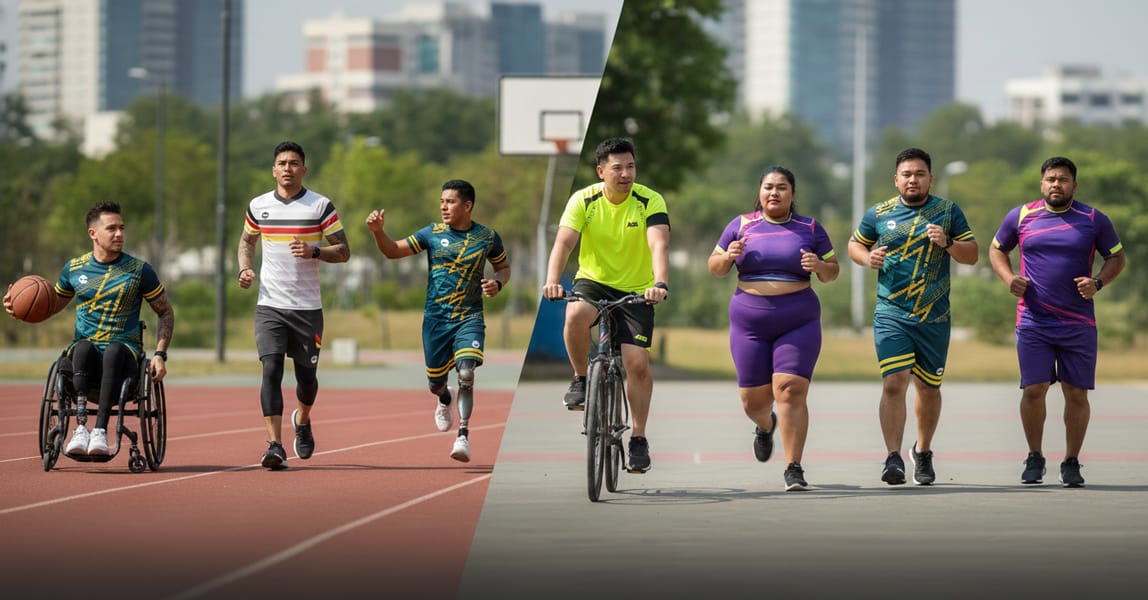
Sport is a universal language, yet the uniforms athletes wear often speak a language of exclusion. For decades, the sports apparel industry has operated on standardized body types, inadvertently creating a significant barrier to participation for millions of athletes, particularly those who are plus-size or require adaptive functional features. This is not just a matter of social responsibility; it is a fundamental design failure and a massive missed market opportunity. Modern athletes demand gear that performs without compromise, regardless of their size or ability. The current status quo—marked by ill-fitting garments, compromised performance, and aesthetic exclusion—is unacceptable. The next era of sportswear manufacturing must be defined by true inclusion, driven by advanced technology and a profound understanding of diverse body dynamics. This article delves into the critical pain points facing athletes today and outlines a blueprint, anchored by vertically integrated manufacturing expertise, for building a truly inclusive uniform ecosystem.
Table of Contents
ToggleModern Pain Points in Truly Inclusive Sportswear
To truly capture the attention of serious readers—the club managers, brand developers, and entrepreneurs seeking genuine solutions—we must diagnose the subtle, yet pervasive, failures of current mainstream apparel. These failures directly impact an athlete’s comfort, confidence, and, critically, their performance.
A. Plus-Size Uniforms: Beyond Scaling Up
The greatest misconception in sportswear is that a larger size is merely a stretched version of a smaller one. This flaw is known as the “Shrink-and-Grow” Myth, and it represents a critical failure in garment grading, particularly evident in the production of athletic uniforms.
1. The “Shrink-and-Grow” Myth (Grading Inaccuracy)
Traditional grading involves uniformly increasing measurements across key points of the pattern (e.g., chest, waist, hip) based on a simple geometric scale. However, the human body does not scale linearly. In plus sizes, the weight distribution shifts, requiring complex, non-linear adjustments to the pattern blocks.
Critical Grading Failures:
Armhole Curvature: A simple scale-up leads to armholes that bind or cut into the armpit, restricting the necessary full range of motion required for sports like basketball or volleyball.
Shoulder Slop: Shoulders often become too broad without adequate depth, causing the uniform to slide off the shoulder or bunch up near the neck.
Hip-to-Waist Ratio: Plus-size uniforms often fail to account for the actual proportional differences in the hip and waist, resulting in shirts that are excessively baggy at the sides but still tight across the stomach or bust.
This failure of proper pattern development is the primary driver behind the alarmingly high rate of returns in plus-size apparel. When a uniform doesn’t fit, it doesn’t just mean a return; it means an athlete’s trust in the brand is broken, and their participation is jeopardized.
2. Performance Compromise is Non-Negotiable
A uniform is meant to enhance, or at least not impede, athletic performance. When a garment is ill-fitting, it becomes a direct performance liability.
Chafing and Blistering: One of the most common complaints is severe chafing. Seams—especially those on the inner thigh of shorts or under the arm in jerseys—are subjected to different, higher-pressure movement patterns on larger bodies. If not strategically placed or constructed with flat-lock seams, this friction causes pain, skin damage, and mandatory breaks in activity.
Moisture Management Failure: If the jersey is baggy in some areas and tight in others, the technical fabric cannot perform its core function: wicking moisture evenly. Excessive bagging in the waist traps heat, while tightness in the chest or back causes rapid saturation, leading to discomfort, weight gain, and potentially overheating.
Restricted Range of Motion: Consider a soccer goalie in a poorly graded keeper glove or jersey; a constricted shoulder or elbow can directly cost a game. Performance gear requires freedom, and generic sizing destroys that freedom.
3. Aesthetic Exclusion: The Emotional Barrier
Beyond the physical limitations, the lack of thoughtful design in extended sizes creates a profound psychological barrier. This is the Aesthetic Exclusion.
The “Afterthought” Look: Plus-size uniforms often utilize simplified, less technical construction, resulting in a boxy, unflattering fit that looks fundamentally different from the streamlined, sharp appearance of the “straight-size” team uniforms.
Lack of Style Options: Many brands only extend their most basic, generic designs into plus sizes. This means that athletes who are not size-standardized are denied access to the latest trends, colorways, and technical innovations, reinforcing the feeling that their dedication to the sport is secondary.
Confidence Impact: A uniform is a powerful symbol of identity, belonging, and confidence. When an athlete feels awkward or uncomfortable in their uniform, it erodes their confidence and can lead to withdrawal from the team or the sport itself. The uniform should be armor, not a hurdle.
B. Adaptive Uniforms: The Functionality Gap
The challenges in adaptive sportswear move beyond fit and into critical functionality, demanding a complete re-thinking of garment construction. For athletes with disabilities, the uniform is not just clothing—it is a piece of essential equipment.
1. Lack of Universal Design Integration
The current pain point is that adaptive features are often seen as bespoke, expensive additions. The solution lies in Universal Design (UD), where features are integrated so seamlessly that they benefit everyone.
Traditional Feature | Adaptive Pain Point | Universal Design Solution | Benefit for All Athletes |
|---|---|---|---|
Zipper/Buttons | Difficult for limited dexterity | Magnetic or extra-large zipper pulls | Faster gear changes, easier dressing. |
Standard Seams | Pressure points, sensory irritation | Flat-lock seams or bonded construction | Eliminates chafing and increases durability. |
Fixed Waistband | Difficult to dress/accommodate devices | Drawcords, adjustable side vents | Perfect fit adjustment, breathability. |
Adaptive wear should not be a separate category; the best adaptive design is simply the best design.
2. Accommodating Prosthetics and Mobility Devices
Adaptive uniforms must perform flawlessly in conditions and postures for which standard apparel was never intended.
Seated Comfort (Wheelchair Users): Standard pants accumulate excess fabric in the lap while riding down in the back, exposing the skin to the chair. The solution requires a radical pattern shift:
Higher Back Rise: To cover the lower back and prevent exposure.
Lower Front Rise: To eliminate uncomfortable bunching around the stomach and lap.
Seamless Back Panel: Using seamless or offset-seam construction in high-pressure areas (like the buttocks and thighs) to prevent pressure sores and friction damage.
Access Points for Medical Needs: Athletes may require hidden, secure access panels for ports, catheters, or other medical monitoring devices. These openings must be subtle yet functional, secured by Velcro or magnetic closures that maintain the uniform’s aesthetic integrity and protection during intense play.
Donning/Doffing Challenges: The simple act of putting on a garment can be a major hurdle. For athletes with upper-limb differences or reduced mobility, traditional compression wear is impossible. Solutions include:
Strategic Openings: Full-length side or shoulder zippers, secured with hidden magnetic snaps that can be operated one-handed.
Extended Pulls: Loops or extended pull-tabs on necklines and sleeves to assist with leverage and dressing independence.
3. Sensory and Material Sensitivity
For some athletes with disabilities (e.g., autism, sensory processing disorders), the texture and feel of the fabric against the skin are critical barriers.
Seamless Construction: Essential for eliminating internal friction and irritation points.
Fabric Choice: Prioritizing ultra-soft, yet high-performance knits that offer moisture management without stiffness or scratchiness.
Labeling: Using heat-transferred labels instead of traditional sewn-in tags, which are common sensory irritants.
Addressing these specific functional gaps proves to true adaptive athletes that the manufacturer understands their needs, not just the general concept of “adaptive.”
The Solution: Customization, Technology, and Traceability
The complexity of inclusive sizing and adaptive needs cannot be met by off-the-shelf production. It requires a manufacturing partner with the vision and capability to embrace personalization at scale. This is where the competitive advantage shifts to vertically integrated, design-oriented companies like ASI SOCCER Company.
1. Data-Driven Pattern Development: The Role of AI
The future of inclusive fit lies in digital precision, moving far beyond the tape measure.
Virtual Reality Garment Simulation: Using 3D software to design, drape, and test patterns on custom digital avatars that represent a true spectrum of body shapes, weight distribution, and postures (e.g., seated vs. standing). This drastically reduces the time and cost of physical prototyping and ensures an accurate fit before a single piece of fabric is cut.
AI and Body Scanning: Integrating data from body-scanning technology to map specific proportions for plus-size and adaptive athletes. This allows for the creation of precise, inclusive custom pattern blocks—the foundational requirement for true fit—treating a size 4XL not as an outlier, but as a scientifically engineered requirement.
2. On-Demand, Customized Production and MOQs
The prevailing challenge for clubs and smaller brands wanting inclusive options is the Minimum Order Quantity (MOQ). Most factories demand large MOQs for specialized sizes or adaptations, making it financially impossible for a team to order one adaptive jersey or two 5XL shirts.
The solution is a flexible, customized production model that leverages vertical integration. By controlling the entire process, a manufacturer can:
Treat Every Size as Standard: By streamlining digital pattern generation, the cost difference between producing a size Small and a size 5XL is minimized, allowing for flexible ordering that treats every size and adaptation as a legitimate, equally priced order.
Enable Small Batch Production: ASI’s production coherence allows organizations and entrepreneurs to test the market with small, custom runs of inclusive sizes, reducing financial risk and ensuring that no athlete is left waiting for an exclusionary batch production cycle.
3. Raw Material Control and Performance Equality
A critical factor that separates a capable manufacturer from a commodity producer is the control over the materials themselves. ASI SOCCER Company’s strength lies in controlling the material supply chain from raw materials to finished products—a core vertical integration advantage.
Guaranteed Quality Equality: This control ensures that adaptive and plus-size uniforms utilize the same high-performance, durable, moisture-management, and anti-bacterial fabrics as traditional uniforms. There is no compromise in material quality, guaranteeing equality in performance and longevity.
Technical Fabric Integrity: Manufacturing from the raw stage guarantees the fabric’s specific technical integrity—ensuring the right blend of elastane for compression, the correct knit structure for breathability, and the essential durability needed for the high-friction points of plus-size and adaptive wear.
4. Sustainability, Ethical Production, and Transparency
Today’s consumers, particularly those in the inclusive apparel space, are highly value-driven. They look for authenticity and transparency in production.
Design for Disassembly (DfD): A commitment to inclusive design must be paired with sustainability. DfD means creating garments (uniforms) that are easy to break down at the end of their life cycle, minimizing mixed fibers and simplifying construction to facilitate recycling. This reduces textile waste and aligns with modern ethical mandates.
Vertical Coherence and Ethical Labor: ASI’s long-standing heritage and factory structure provide verifiable supply chain traceability. This is crucial for brands that need to prove their uniforms are ethically sourced, eliminating concerns about outsourcing or opaque labor practices often associated with non-integrated supply chains. This deep operational consistency, backed by half a century of inherited worker skill, builds the trust that is essential in the modern, conscious consumer market.
Introducing ASI SOCCER Company: The Engine of Inclusivity
In the competitive landscape of sportswear manufacturing, ASI SOCCER Company stands apart as a vertically integrated partner uniquely equipped to lead the charge toward truly inclusive apparel.
A. ASI’s Vision and Core Values
ASI SOCCER COMPANY IS A CONSUMER-DRIVEN, DESIGN-ORIENTED, AND INNOVATIVE COMPANY. This vision directly addresses the inclusive sportswear challenge. We view the demand for adaptive and extended sizing not as a logistical burden, but as a primary business and design opportunity. Our mission is to work with coherence of customized products, organizations, and entrepreneurs, translating marketing and business goals into design strategy, novelty, and to attain new product success. This means we don’t just fill orders; we collaborate to design solutions, ensuring your inclusive product line is a success from pattern to pitch.
B. The Vertical Integration Advantage
Established in 2006, ASI’s key differentiator is its complete control over the production process. We produce all from raw materials to finished products in sports, casual, fitness, and gym wear.
Quality Control (QC) and Efficiency: This vertical integration is the foundation of our superior quality control and efficient service structure. By owning the process end-to-end, we eliminate the variables and quality degradation that plague multi-sourced supply chains. Every stitch, every seam, and every fabric blend meets our distinguishing standards.
Adaptability and Heritage: Our technology is always at the forefront of innovation in fast-running quality competition in this new era, but this innovation is built upon a strong foundation: the skills of our workers have been inherited for half a century. This fusion of traditional craftsmanship with modern manufacturing technology is precisely what is required to handle the complexity of adaptive patterns and plus-size grading with unwavering precision.
C. Scope of Service and Capacity
ASI SOCCER Company offers a wide and reliable scope of custom production services for diverse clients: brands, stores, clubs, academies & all other buyers looking for custom production.
Our comprehensive portfolio includes:
Apparel: Sports, Casual, Fitness & Gym wear, Fashion wear, and Martial Arts wear.
Sports Balls: All types of Sports Balls like Soccer, Rugby, basketball, Hand, Mini, Baseball, Volleyball, Bonded Ball, Cricket Ball, and Keeper Gloves (backed by a manufacturing capacity of 20,000-30,000 BALLS PER MONTH).
This demonstrates a scalable, reliable partner ready to meet both high-volume standardized demand and the detailed, low-volume requirements of specialized inclusive uniforms.
ASI SOCCER Company: Our Commitment to Sportswear Manufacturing
ASI SOCCER Company, established in 2006, is driven by a legacy of craftsmanship and a mandate for innovation. Our vertically integrated factory allows us to maintain unparalleled quality control and offer efficient, customized service across a comprehensive product range, including all sports apparel, fitness wear, and a high-capacity output of specialized Sports Balls. By fusing inherited skills with modern, improvisational technology, we are dedicated to translating your vision and market needs—especially those concerning adaptive and plus-size athletes—into new product success, providing the quality and coherence demanded by leading brands, stores, clubs, and academies worldwide.
Leading the Inclusive Athletic Revolution
The conversation surrounding uniforms for every athlete has moved past awareness and into action. The current pain points in plus-size and adaptive sportswear—from inaccurate grading and performance compromise to the critical functionality gaps for disabled athletes—reveal a deep, systemic failing in traditional manufacturing models.
The solution is clear: it demands advanced, customized production underpinned by technological sophistication and absolute control over the supply chain. ASI SOCCER Company, with its foundation of half a century of manufacturing skill, its commitment as a CONSUMER DRIVEN, DESIGN ORIENTED, AND INNOVATIVE COMPANY, and its capability to produce custom wear from raw material to finished product, is uniquely positioned to partner with brands, clubs, and entrepreneurs who are serious about building the next generation of truly inclusive sports apparel. Equality in sport begins with a uniform that fits, performs, and empowers every single athlete.